Stateless MCP: A New Era for MCP Server Connectivity
As of July 28th, 2026, the much-anticipated Stateless MCP (Managed Configuration Protocol) specification has been officially released. This marks a significant shift in how MCP Servers can be connected and configured, moving away from traditional stateful interactions towards a more streamlined, stateless approach. The primary impact of this new spec is its direct compatibility with AI Gateways, promising to simplify the integration and management of complex distributed systems.
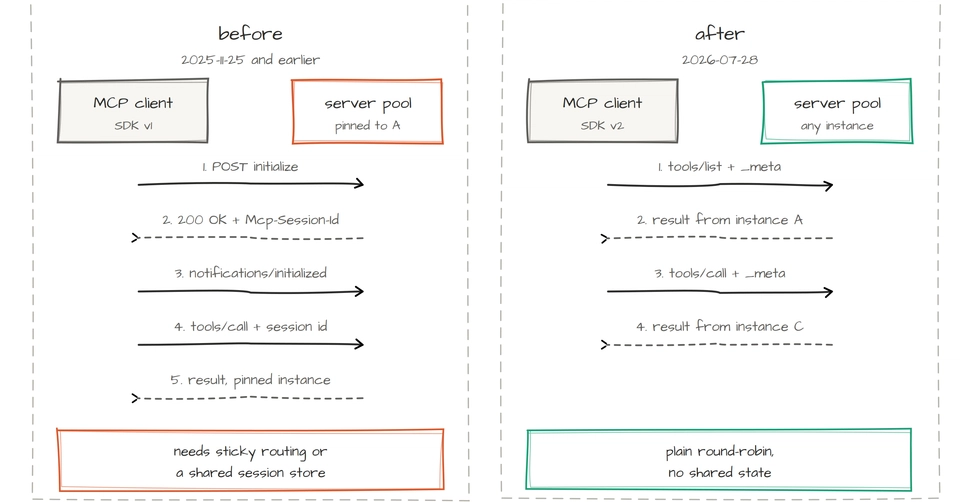
The core of the Stateless MCP specification lies in its elimination of initialization handshakes and session IDs. Historically, establishing a connection to an MCP Server involved a multi-step handshake process to synchronize state and verify identity. This was followed by the management of session IDs to maintain that state throughout the communication. While robust, these mechanisms added overhead and complexity, particularly for systems that are inherently stateless or require rapid, ephemeral connections, such as many modern AI-driven applications and gateways.
By removing these requirements, the Stateless MCP spec drastically reduces the latency and complexity associated with establishing and maintaining connections. This is particularly beneficial for AI Gateways, which often need to communicate with multiple services, ingest data streams in real-time, and respond with low latency. The stateless nature means that each request to the MCP Server can be treated independently, without the need for the server to maintain a memory of past interactions with a specific client.
Key Changes and Their Implications
The specification update, tagged with the version 2026-07-28, introduces two pivotal changes: the removal of initialization handshakes and the deprecation of session IDs. Let's break down what this means:
Removal of Initialization Handshakes
Previously, connecting to an MCP Server required a sequence of messages exchanged between the client and server to establish a mutual understanding of the communication parameters, security contexts, and operational modes. This handshake ensured that both parties were ready and configured correctly before any actual data or configuration commands were exchanged. For AI Gateways, this could translate to a noticeable delay before the gateway could begin sending critical inference requests or receiving model updates. The stateless approach bypasses this entirely. Clients can now send configuration or data requests directly, assuming the server is configured to receive them. This is akin to sending a letter through a postal service without needing to call the recipient beforehand to confirm they are ready to receive mail; the system is designed such that mail is always ready to be processed upon arrival.
Deprecation of Session IDs
Session IDs were the backbone of stateful communication in the older MCP versions. They allowed the server to track individual client sessions, manage their associated states, and enforce access controls or rate limits based on ongoing activity. In a stateless model, the concept of a persistent session is largely irrelevant. Each request must carry all the necessary information for the server to process it, including any authentication or authorization tokens, and the specific command or data payload. This simplifies server-side logic, as it no longer needs to manage a potentially vast number of active client sessions. For AI Gateways, this means that even if a gateway is managing thousands of concurrent connections for different AI models or tasks, the MCP server doesn't need to maintain a unique state for each one. The responsibility shifts to the client (the gateway) to ensure each request is self-contained and valid.
Implementing Stateless MCP with AI Gateways
The shift to statelessness offers several advantages for developers working with AI Gateways. Firstly, it simplifies the client-side implementation. Developers no longer need to meticulously manage handshake protocols or session state synchronization, reducing the potential for bugs and simplifying the codebase. This allows them to focus more on the core AI functionalities and the specific configurations required for their models.
Secondly, the increased efficiency and reduced overhead are critical for performance-sensitive AI applications. AI Gateways often act as the front-end for complex machine learning pipelines. Any delay in configuration or data retrieval can directly impact inference times and user experience. The stateless MCP protocol minimizes this bottleneck, enabling faster data ingestion, quicker model updates, and more responsive system management.
For developers looking to integrate with the new spec, the primary consideration is ensuring that their AI Gateway implementations construct self-contained requests. This means embedding all necessary metadata, authentication credentials, and command parameters within each individual message sent to the MCP Server. While this might seem like it shifts complexity to the client, it often leads to a more predictable and manageable system architecture overall, especially when dealing with microservices and distributed AI deployments.
The engineering details surrounding this transition can be found in supplementary quickstart guides, which detail other changes accompanying the new spec. These resources are invaluable for developers needing to update existing systems or build new ones that leverage the stateless MCP protocol.
Future Outlook and Compatibility
The introduction of the Stateless MCP specification is a strategic move to align MCP's capabilities with the demands of modern, AI-centric architectures. As AI continues to permeate various technological domains, the need for efficient, scalable, and flexible communication protocols becomes paramount. The stateless MCP spec directly addresses these needs.
Compatibility with existing AI Gateways is a key consideration. While the spec is new, its design prioritizes interoperability. Gateways built with awareness of the stateless principles can leverage the new protocol directly. For older gateways or systems that relied on stateful MCP connections, migration paths will likely involve updating the gateway's MCP client implementation to adhere to the stateless principles. This might require significant architectural changes depending on how tightly the old system was coupled to stateful session management.
The broader implication is a more agile and responsive infrastructure for deploying and managing AI models and services. This could accelerate the development and iteration cycles for AI applications, making it easier to roll out new models, update configurations dynamically, and manage large-scale AI deployments with greater ease and efficiency. The move towards statelessness is not just a technical update; it's an enablement for the next generation of AI-driven systems.