
The Bug That Isn't a Bug
Imagine this scenario: It's Wednesday, and a batch of messages has mysteriously vanished from your orders-queue. You turn to your AI assistant, Claude Code, for an immediate answer. It confidently states that the orders-queue has no dead-letter queue (DLQ) configured, and therefore, failed messages are dropped after the maximum receive count. This answer, delivered with absolute certainty, is wrong. The AI read a real snapshot of your AWS account, but that snapshot was taken on Monday.
This is the insidious failure mode that emerges when AI assistants are provided with deterministic infrastructure context instead of being allowed to infer or guess. Guessing, while often producing uncertain answers, prompts users to treat them with appropriate caution. A stale snapshot, however, delivers authoritative-sounding responses. It cites real table names, actual queue names, and valid ARNs. Crucially, nothing in the AI's response signals that the underlying facts it's reporting have expired. The confidence of the AI, derived from seemingly concrete data, masks a fundamental disconnect from reality.
This problem is not theoretical. Tools like Infrawise aim to extract deterministic infrastructure context to provide AI assistants with a grounded understanding of your environment. The intention is noble: to move beyond the vague pronouncements of LLMs to precise, actionable insights. However, the mechanism of providing this context – typically through snapshots or exported configurations – introduces a critical vulnerability: staleness. When the infrastructure changes, but the AI's knowledge base does not, the AI becomes a source of misinformation, not insight.
Consider the implications for developers. They rely on these tools to understand complex cloud environments, troubleshoot issues, and even generate code for infrastructure management. If the AI provides incorrect information about resource configurations, dependencies, or security settings, the consequences can range from minor inconveniences to catastrophic data loss or security breaches. A developer might proceed with a change based on an outdated understanding of a database schema, leading to application failures. Or, they might trust an AI's assessment of network security rules, leaving a critical system exposed.
The Illusion of Authority
The core issue lies in the AI's presentation of information. Modern LLMs are trained to be helpful and often project a high degree of confidence. When this confidence is coupled with seemingly factual data pulled from a recent-but-not-current snapshot, the output becomes highly deceptive. Unlike a human colleague who might say, "I think I saw that configuration yesterday, but let me double-check," the AI presents the information as current fact. There's no built-in mechanism to flag the age of the data it's referencing, nor is there a clear way for the user to query the recency of the information.
This creates a dangerous illusion of authority. Developers, under pressure to deliver quickly, might not have the time or the inclination to manually verify every piece of information provided by an AI assistant, especially when it seems to be pulling directly from their own environment's metadata. The AI becomes a black box that spits out answers derived from a specific point in time, a point in time that may no longer reflect the live system. This is akin to using an old map to navigate a city that has undergone significant road construction; the map might show a street that no longer exists or has been rerouted, leading the traveler astray.
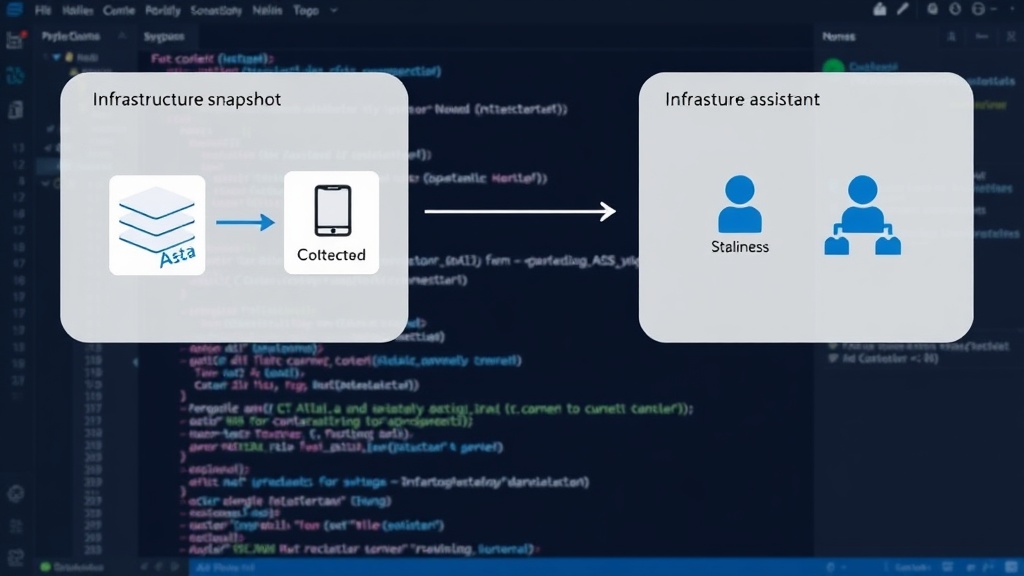
The problem is compounded by the fact that infrastructure is dynamic. Cloud environments are constantly being updated, scaled, reconfigured, and patched. Automated deployment pipelines, Infrastructure as Code (IaC) tools, and manual changes all contribute to a state of perpetual flux. To provide accurate assistance, an AI needs access to the most up-to-date information. Relying on periodic snapshots creates a lag, and in the fast-paced world of cloud operations, even a lag of a few hours can be significant.
Mitigation Strategies and the Path Forward
The immediate implication is that any tool providing deterministic infrastructure context to AI assistants must incorporate robust mechanisms for tracking and signaling data recency. This could take several forms:
- Timestamping and Versioning: Every piece of data ingested by the AI should be timestamped, and the AI's responses should clearly indicate the age of the information used. For example, "Based on a snapshot taken on YYYY-MM-DD HH:MM:SS UTC..."
- Real-time or Near Real-time Data Ingestion: Instead of relying on periodic snapshots, tools could integrate more directly with cloud provider APIs or event streams to ingest changes as they happen. This is technically challenging and potentially costly but offers the highest fidelity.
- User-configurable Refresh Rates: Users should be able to specify how frequently their infrastructure context is updated and how aggressive the AI should be in seeking fresh data.
- Confidence Scoring and Uncertainty Indicators: The AI should be trained to express uncertainty when the data is older or when there are conflicting pieces of information. This could manifest as a confidence score or a more nuanced textual response.
Furthermore, developers must cultivate a healthy skepticism towards AI-generated infrastructure advice. Treat AI outputs as a starting point for investigation, not as definitive truth. Always cross-reference critical information with live system data or your authoritative IaC definitions. The goal should be to augment human expertise, not to replace critical thinking.
The promise of AI assistants deeply understanding and assisting with infrastructure management is immense. However, the current reliance on static snapshots presents a significant risk. Stale context is not just unhelpful; it is actively harmful, leading engineers down paths of incorrect assumptions and potentially costly mistakes. The industry must prioritize solutions that ensure the AI's knowledge of infrastructure is as current as the infrastructure itself.