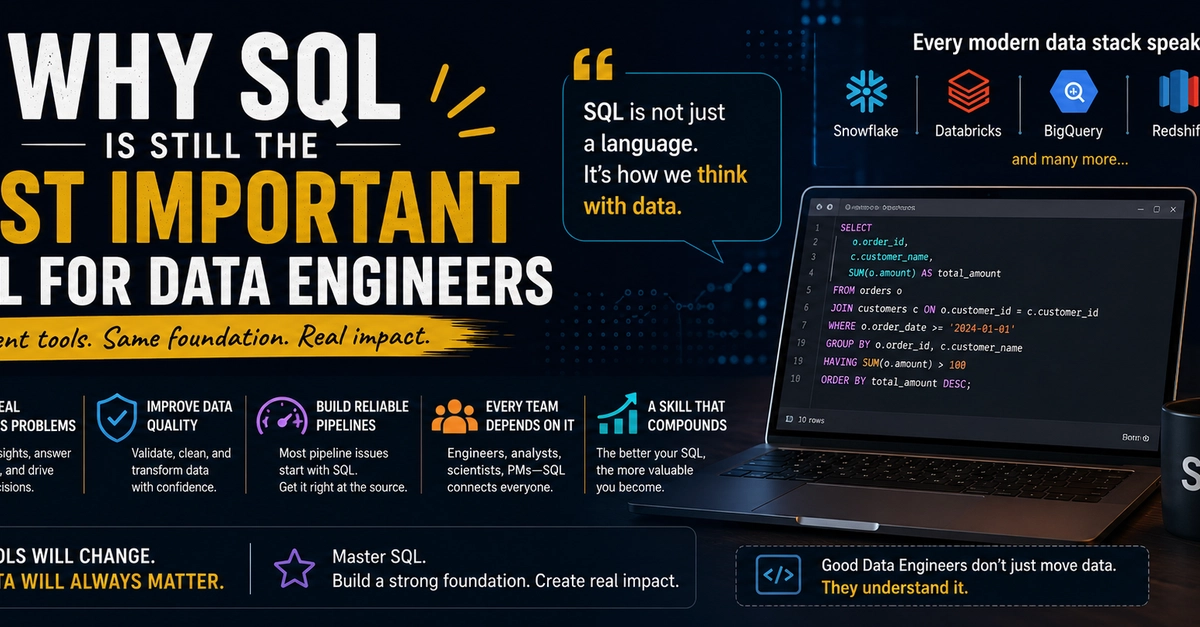
The Unwavering Foundation: Why SQL Persists
Every year, the data engineering landscape is flooded with new technologies promising to revolutionize how we handle information. We see the rise of distributed processing frameworks like Spark, real-time data streaming platforms such as Kafka, unified data platforms like Databricks and Snowflake, and the ever-present buzz around AI and Large Language Models (LLMs). Amidst this constant churn, it's easy to assume that foundational skills become obsolete. However, one language has weathered every technological storm and remains indispensable: SQL.
For many aspiring data engineers, SQL might initially seem like a checkbox item – a basic requirement to be mastered and then moved beyond in favor of more complex programming languages like Python. This perspective is a critical misjudgment. The reality, learned through hands-on experience with real-world projects, is that SQL is not merely a query language; it is the fundamental cognitive framework through which data engineers conceptualize, manipulate, and extract value from data. It forms the bedrock upon which more advanced tools and techniques are built.
SQL's Ubiquity Across the Data Ecosystem
The most compelling argument for SQL's continued dominance is its pervasive presence across nearly every modern data platform. Whether you are working with cloud data warehouses, distributed computing engines, or traditional relational databases, SQL is almost invariably involved. Consider the prominent players in the data space:
- Snowflake
- Databricks
- Google BigQuery
- Amazon Redshift
- PostgreSQL
- Microsoft SQL Server
- Oracle
- Apache Spark SQL
- DuckDB
Each of these platforms offers unique architectures and capabilities, yet they share a common interface for data interaction: SQL. This consistency means that proficiency in SQL provides a transferable skill set, enabling engineers to adapt to new environments with greater ease. Companies recognize this. They don't just seek candidates who can operate specific tools; they seek individuals who possess a deep understanding of data manipulation principles, which SQL embodies. This understanding allows engineers to write efficient, performant queries that can unlock insights and power downstream applications, regardless of the underlying infrastructure.
Beyond Basic Queries: SQL as a Problem-Solving Tool
The true power of SQL for a data engineer extends far beyond simple `SELECT` statements and `JOIN` operations. It is a sophisticated tool for complex data transformation, aggregation, and analysis. Data engineers frequently encounter scenarios requiring them to:
- Transform raw data into structured formats: This involves cleaning, normalizing, and reshaping data to meet the requirements of data warehouses, data marts, or analytical models. SQL's expressive power allows for intricate transformations using functions, conditional logic, and subqueries.
- Aggregate and summarize large datasets: Generating key performance indicators (KPIs), calculating rolling averages, or performing cohort analysis are common tasks that rely heavily on SQL's aggregation functions (`SUM`, `AVG`, `COUNT`, `MAX`, `MIN`) and `GROUP BY` clauses.
- Build complex data pipelines: Many data pipelines, even those orchestrated by tools like Airflow or Prefect, involve SQL-based steps for data loading, transformation, and validation. Common Table Expressions (CTEs) and window functions are crucial for breaking down complex pipeline logic into manageable, readable, and efficient SQL queries.
- Optimize query performance: Understanding query execution plans, indexing strategies, and data partitioning is vital for ensuring that data pipelines run efficiently and within acceptable timeframes. This requires a deep, nuanced understanding of how SQL queries are processed by different database engines.
The ability to craft performant SQL queries is often the difference between a data pipeline that meets its Service Level Agreements (SLAs) and one that consistently fails or runs prohibitively slowly. This optimization skill is directly tied to a deep understanding of SQL's underlying principles and the specific database engine being used.
The Human Element: How Data Engineers Think with SQL
The statement that SQL is 'how data engineers think' is not hyperbole. When faced with a data problem, an experienced data engineer often instinctively frames the solution in terms of relational algebra and set theory – the mathematical underpinnings of SQL. They visualize data as tables, relationships as joins, and desired outcomes as filtered and aggregated sets. This mental model, honed through years of SQL practice, allows them to:
- Deconstruct complex requirements: Break down business needs into logical data extraction and transformation steps.
- Identify potential data quality issues: Anticipate inconsistencies, missing values, or structural problems that might arise during data processing.
- Design efficient data models: Create schemas that are optimized for querying and analysis, often leveraging concepts like star or snowflake schemas.
- Troubleshoot errors: Systematically debug data pipeline failures by tracing data flow and examining intermediate results, often using SQL to inspect data at various stages.
This way of thinking is transferable. Even when working with NoSQL databases or data lakes, the principles of data structuring, filtering, and aggregation remain relevant. Engineers who master SQL develop a robust mental toolkit for approaching any data-related challenge.
The Future is SQL-Enhanced, Not SQL-Replaced
While new technologies will undoubtedly continue to emerge and evolve, they are unlikely to replace the fundamental need for data manipulation and querying. Instead, these new tools often serve to augment or provide new interfaces for interacting with data, frequently leveraging SQL as a primary or secondary interface. For example, Spark SQL allows engineers to query data residing in distributed file systems using familiar SQL syntax. Data lakehouse platforms like Databricks and Snowflake integrate SQL interfaces with broader data processing capabilities. Even in the realm of AI and LLMs, SQL plays a role in preparing and accessing the data used to train and fine-tune models.
The continued evolution of data infrastructure means that data engineers will need to integrate SQL with other tools and languages. Python, for instance, is essential for orchestration, complex logic, and interacting with APIs, but it often calls SQL queries to perform the heavy lifting of data manipulation within databases. The skill is not about choosing between SQL and Python, but mastering how they complement each other.
For data professionals, investing time in deepening their SQL expertise is not a step backward; it is reinforcing the most critical pillar of their career. It provides a stable, high-demand skill that remains relevant regardless of the prevailing technological trends. As the data landscape matures, the ability to efficiently and effectively query and transform data using SQL will continue to be a defining characteristic of a top-tier data engineer.