The Unseen Bottleneck in SQLite WAL
SQLite's Write-Ahead Logging (WAL) mode offers performance benefits by allowing readers and writers to operate concurrently. However, a subtle interaction between read transactions and the checkpointing mechanism can lead to a critical starvation scenario. This isn't a bug in the traditional sense, but a consequence of how WAL maintains consistency. A single, long-lived read transaction, even one that appears idle, can effectively halt the checkpoint process, causing the WAL file to grow indefinitely. This can occur even while the application appears to be functioning normally, responding to health checks and basic queries.
The core of the issue lies in the checkpoint's responsibility: to merge committed changes from the WAL file back into the main database file. This process is essential for reclaiming space and maintaining performance. However, SQLite must ensure that no active readers are relying on data that is about to be overwritten or removed during a checkpoint. If a read transaction is open, it holds a consistent snapshot of the database at the time it began. The checkpoint process cannot proceed if it risks invalidating this snapshot for an active reader.
Reproducing the Starvation
Reproducing this starvation is surprisingly straightforward and requires only two connections to the same SQLite database in WAL mode. The procedure highlights how a single, forgotten reader can become a significant operational risk.
Here’s a controlled drill to demonstrate the problem:
- Initialization: Enable WAL mode for your SQLite database. If you haven't already, execute
PRAGMA journal_mode=WAL;. Create a small table for testing purposes. - The Stalled Reader: Open a connection (let's call it Connection A). Immediately begin a read transaction. Crucially, keep this transaction open. This can be done by simply not issuing a
COMMITorROLLBACK. - The Flood of Writes: Open a second connection (Connection B). This connection will be responsible for generating write activity. For a sustained period, such as 60 seconds, commit batches of writes. These writes will accumulate in the WAL file.
- Monitoring the State: Throughout the write activity, periodically sample key metrics. This includes the WAL file size, the results of
PRAGMA wal_checkpoint(PASSIVE);(which returns three counters: the number of frames written, the number of frames flushed, and the number of frames in the free list), and the age of the oldest transaction. - The Observation: After the write period, release Connection A by committing or rolling back its transaction. Observe the system's behavior. You should see the checkpoint process finally begin to catch up, and the WAL file size should stabilize or begin to decrease as space is reclaimed.
The SQL commands involved are simple:
PRAGMA journal_mode=WAL;
PRAGMA wal_checkpoint(PASSIVE);
The PASSIVE mode for wal_checkpoint is important here. It attempts a checkpoint but will not wait for writers to finish. If a checkpoint is blocked by an open reader, PASSIVE mode will report the current state without advancing the checkpoint. Continuous execution of this PRAGMA during the test will show that the 'flushed' counter remains static while the 'written' counter increases, indicating accumulated data in the WAL that cannot be checkpointed.
The Mechanics of Starvation
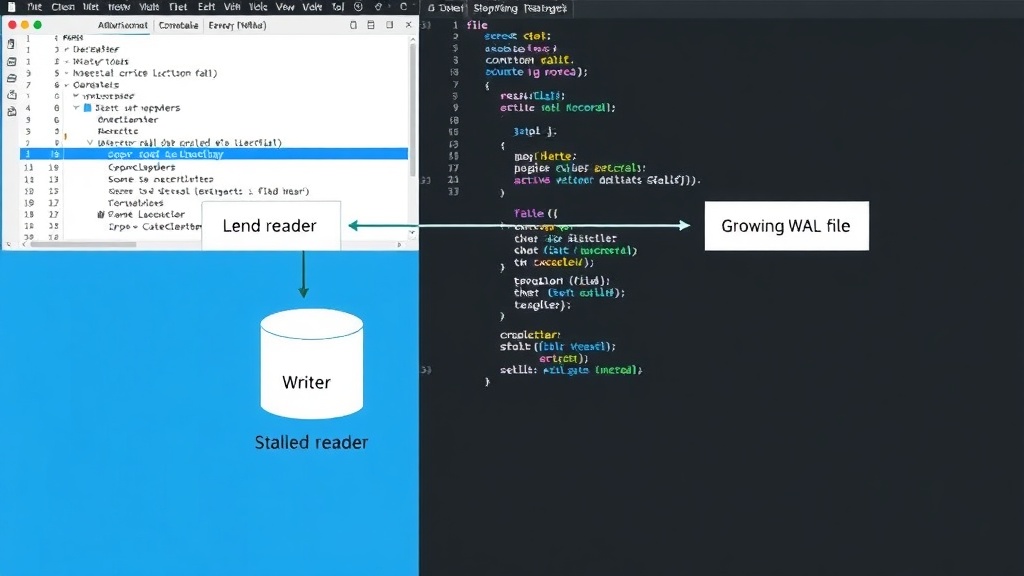
In WAL mode, the database operates with three main components: the main database file, the WAL file, and the shared memory file (SHM). New writes are appended to the WAL file. Readers consult the WAL file for changes that have occurred since their transaction began. When a checkpoint occurs, SQLite merges the committed changes from the WAL file into the main database file. This process advances the 'checkpoint' marker in the WAL file, indicating that the data up to that point is safely in the main database and can potentially be discarded from the WAL.
The critical dependency is this: the checkpoint process cannot remove or modify pages in the WAL file that might still be needed by an active reader. A read transaction establishes a point-in-time snapshot. As long as that transaction is open, SQLite must preserve the WAL segments containing data up to that snapshot's timestamp. If a writer commits a transaction, and then a reader starts a new transaction, the writer's changes are visible to the new reader only if they are already in the main DB or in the WAL file *after* the reader's snapshot point. The checkpoint's job is to make sure WAL data eventually gets to the main DB, but it must not disrupt readers.
Consider a scenario where Connection A starts a read transaction. This transaction needs a consistent view of the database. Now, Connection B starts writing and committing many transactions. These commits are appended to the WAL. SQLite's background checkpointing process (or an explicit call to wal_checkpoint) attempts to merge these committed writes into the main database. However, if Connection A's transaction is still active, it might be referencing data that the checkpoint operation would need to remove from the WAL. To prevent data corruption or inconsistent reads, SQLite halts the checkpoint. The WAL file continues to grow with new writes, but no progress is made in merging these writes into the main database file. The 'oldest transaction age' metric would steadily increase, reflecting the duration of the stalled read transaction.
Consequences and Mitigation
The immediate consequence of WAL checkpoint starvation is unbounded WAL file growth. This can consume significant disk space, leading to performance degradation and potential system failures due to disk exhaustion. Applications might appear to be working correctly because they can still read from and write to the database, but the underlying storage is silently filling up.
Mitigation strategies focus on ensuring that read transactions are short-lived or that checkpointing is managed proactively:
- Short-Lived Transactions: Design applications to keep read transactions as brief as possible. Avoid long-running queries or holding read transactions open unnecessarily. If a read transaction needs to span a long period, consider committing and re-acquiring it periodically, though this can impact consistency guarantees.
- Proactive Checkpointing: Implement regular, explicit calls to
wal_checkpoint. Use theTRUNCATEmode to actively reclaim space after a checkpoint. However, even with proactive checkpointing, a single open reader can still block it. The key is to ensure no readers are active when the checkpoint is attempted. - Connection Management: Carefully manage database connections. Ensure that connections intended only for reading do not inadvertently hold transactions open. Implement timeouts on read operations and transactions where feasible.
- Monitoring: Monitor WAL file size and the output of
PRAGMA wal_checkpoint(PASSIVE);. A consistently increasing WAL size without corresponding increases in the 'flushed' counter from checkpoint calls is a strong indicator of starvation. Monitor the 'oldest transaction age' metric as well.
The surprising detail here is not the complexity of WAL mode, but how a single, seemingly benign open read transaction can bring the entire checkpointing mechanism to a halt. It’s a potent reminder that even in robust systems, careful transaction management is paramount.
What Next?
What nobody has addressed yet is how to automatically detect and resolve this starvation without manual intervention or application-level changes, especially in highly distributed or ephemeral environments where connections are managed dynamically. Current solutions rely heavily on developer discipline and monitoring, but a more robust, self-healing mechanism within SQLite itself, or a standard library for managing WAL checkpoints, would be invaluable for large-scale deployments.