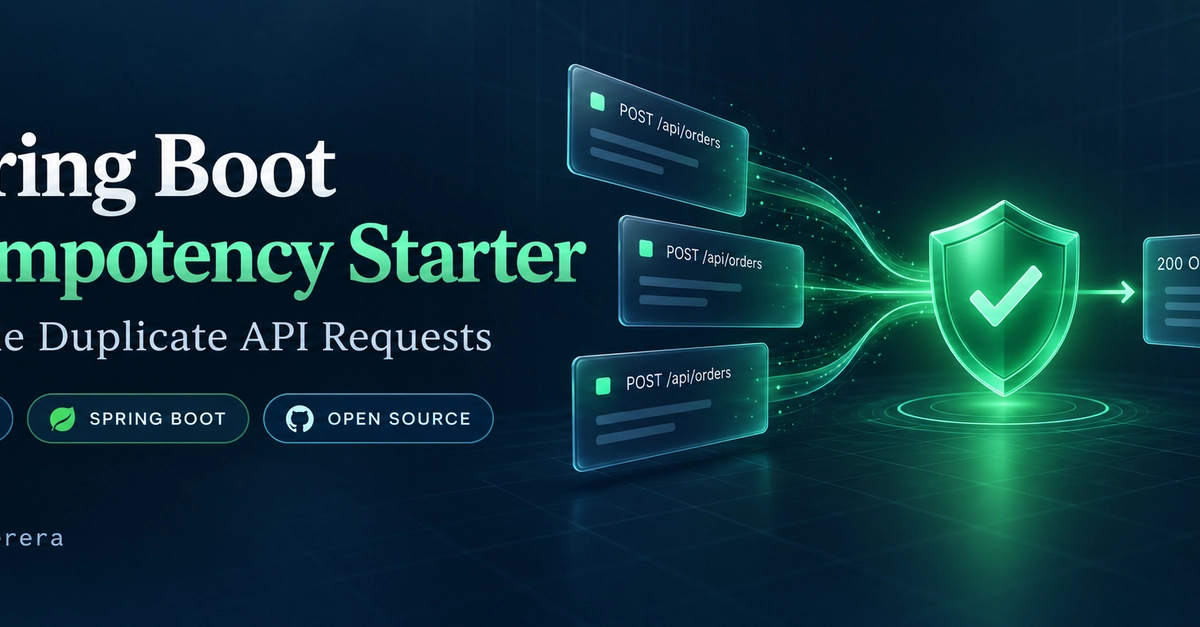
The Problem of Duplicate API Requests
Imagine a client initiating an order creation request. The server successfully processes it, but the network connection fails before the confirmation can reach the client. The client, unaware of the server's success, retries the operation. Without a mechanism to detect this retry, the server might create a second, identical order, leading to inconsistencies and potential business logic errors. This common scenario highlights the critical need for handling duplicate API requests gracefully, particularly in distributed systems where network reliability is not guaranteed.
The challenge lies in ensuring that repeated identical requests, often sent due to client-side timeouts or network interruptions, do not result in unintended side effects. This is precisely the problem that the new open-source Spring Boot Idempotency Starter aims to solve.
Understanding Idempotency in APIs
Idempotency is a fundamental concept in API design. An operation is considered idempotent if making the same request multiple times produces the same result as making it once. In practical terms, this means that repeating a logical request should not cause any additional changes to the server's state beyond the first successful execution. For example, setting a resource's state to a specific value is idempotent, as is deleting a resource.
To achieve idempotency, clients typically employ an idempotency key. This key is a unique identifier generated by the client for each distinct logical operation. When a client retries a request, it reuses the same idempotency key. The server can then use this key to recognize that the operation has already been performed and avoid executing it again, instead returning the original response.
The responsibility for generating and managing these keys lies with the client. For new operations, a new, unique key must be generated. For retries of the same operation, the existing key must be reused. This client-driven approach ensures that the server remains stateless regarding idempotency tracking, relying solely on the provided key.
Key Features of the Spring Boot Idempotency Starter
The Spring Boot Idempotency Starter provides a robust and flexible solution for implementing idempotency in Spring Boot applications. It abstracts away much of the complexity involved in tracking and managing idempotent requests, allowing developers to focus on their core business logic.
The starter introduces several key features:
@IdempotentAnnotation: This annotation is applied to API endpoints that require idempotency protection. By annotating a controller method, developers signal to the starter that requests to this endpoint should be managed idempotently.Idempotency-KeyRequest Header: The starter relies on a standard request header, conventionally namedIdempotency-Key, to receive the unique identifier from the client. This header must be present for idempotent operations.- Request Body Hashing: To ensure that retried requests are truly identical to the original, the starter can validate the request body. It calculates a hash of the incoming request body and compares it with the hash of the original request associated with the idempotency key. If the bodies differ, the request is treated as a new operation, preventing false positives.
- Response Caching and Replay: Upon successful execution of an idempotent request, the starter caches the generated response. If a subsequent request arrives with the same idempotency key and a matching request body hash, the starter bypasses the actual business logic execution and directly replays the cached response to the client. This significantly improves performance for retried requests.
- In-Memory Storage: For simplicity and ease of use, the starter initially supports in-memory storage for tracking idempotency keys and cached responses. This is suitable for single-instance applications or development environments. For distributed or high-availability scenarios, further integration with external caching solutions like Redis or Memcached would be necessary, which is a potential area for future enhancements.
Implementation Details and Considerations
Implementing idempotency correctly involves careful consideration of several factors. The starter simplifies this by providing a declarative approach with the @Idempotent annotation. When a request arrives at an annotated endpoint, the starter intercepts it. It extracts the Idempotency-Key header.
If the key is present, the starter checks its internal storage (initially in-memory) to see if a request with this key has already been processed. If found, it verifies the request body hash against the stored hash. A mismatch in body hashes would typically result in an error response, indicating a potential issue with the client's retry logic or an attempt to modify the operation. If the hashes match, the starter retrieves the previously generated response and sends it back to the client, effectively short-circuiting the controller's execution. This process is akin to a smart gatekeeper who, upon seeing a familiar face and a valid pass, simply lets you walk through the already-opened door without any further fuss.
If the idempotency key is not found in the cache, or if it's the first time the key is encountered, the starter allows the request to proceed to the controller method. After the controller method executes and returns a response, the starter intercepts this response. It stores the idempotency key, the request body hash, and the generated response in its cache for future reference. This ensures that any subsequent identical requests will be handled by replaying the cached response.
The in-memory storage mechanism is straightforward for development and testing. However, for production environments with multiple application instances, this approach would not work because each instance would maintain its own independent cache. In such scenarios, a shared, distributed cache solution like Redis is essential. The starter's design likely allows for pluggable storage implementations, enabling developers to integrate with external caching systems to achieve scalability and resilience.
What This Means for Developers
This starter significantly simplifies the implementation of a crucial but often overlooked aspect of robust API design. Developers building RESTful services with Spring Boot can now easily add idempotency protection to their endpoints without writing extensive boilerplate code. This not only saves development time but also leads to more reliable and resilient APIs that can better handle network uncertainties and client-side issues.
The starter's declarative nature means that adding idempotency to an existing endpoint is as simple as adding an annotation. This makes it particularly valuable for APIs that handle state-changing operations, such as creating resources, processing payments, or updating critical data. By ensuring these operations are idempotent, developers can build more trustworthy systems.
Future Enhancements and Considerations
While the current in-memory implementation is a great starting point, future enhancements could include support for distributed caching solutions (e.g., Redis, Hazelcast) to enable idempotency across multiple instances of an application. Additionally, more sophisticated error handling and configurable retry policies could be added. The starter could also explore different strategies for generating idempotency keys or provide guidance on best practices for clients implementing idempotency key management.
The need for such a tool underscores a broader trend towards building more resilient and fault-tolerant microservices. As systems become more complex and distributed, mechanisms that ensure exactly-once processing semantics, even in the face of network failures, become indispensable.