The Need for a Unified AI Context
As AI systems grow in complexity, managing their interactions and capabilities becomes a significant challenge. Consider a scenario with multiple specialized AI agents, each equipped with unique tools and access to different data sources. A customer service agent might need to interact with Order APIs, Payment APIs, CRM APIs, a Knowledge Base, and an Email Service. Simultaneously, a sales agent could require access to CRM, Calendar, Email, and a Customer Database. Without a standardized way to communicate and share context, these agents operate in silos, limiting their collective power and creating integration headaches.
This is where the Model Context Protocol (MCP) emerges as a crucial solution. MCP provides a standardized way for AI models and applications to share context, enabling them to work together seamlessly. Think of it less like a complex API gateway and more like a universal translator for AI agents, allowing them to understand each other's needs and data, regardless of their underlying implementation.
The previous article explored building AI agents with Spring AI, covering LLMs, RAG, Tool Calling, Memory, and Agent Workflows. Tool calling, in particular, grants AI applications the ability to interact with external capabilities. However, the challenge of managing multiple, interconnected AI systems necessitates a more robust protocol for context sharing.
Building MCP Clients and Servers with Spring AI
Spring AI, a project aimed at simplifying the development of AI-powered applications with Spring, provides the foundation for implementing MCP. By leveraging Spring AI, developers can construct both MCP clients and servers in Java, creating a cohesive ecosystem for their AI agents.
MCP Server Implementation
An MCP server acts as a central hub, managing the context and capabilities exposed by an AI model or agent. In a Spring AI context, this involves defining beans that represent the AI's state and its available tools. The server is responsible for receiving requests, processing them with the AI model, and returning responses, all while maintaining the shared context.
Key components of an MCP server implementation include:
- Context Management: Storing and updating the conversational history and relevant data that the AI needs to operate.
- Tool Registration: Exposing the available tools (APIs, functions) that the AI can invoke.
- Request Handling: Receiving incoming requests, potentially from multiple clients, and orchestrating the AI's response.
The Spring AI framework simplifies this by providing abstractions for LLMs, prompt templates, and tool definitions. Developers can wire these components together using Spring's dependency injection, creating a robust and scalable MCP server.
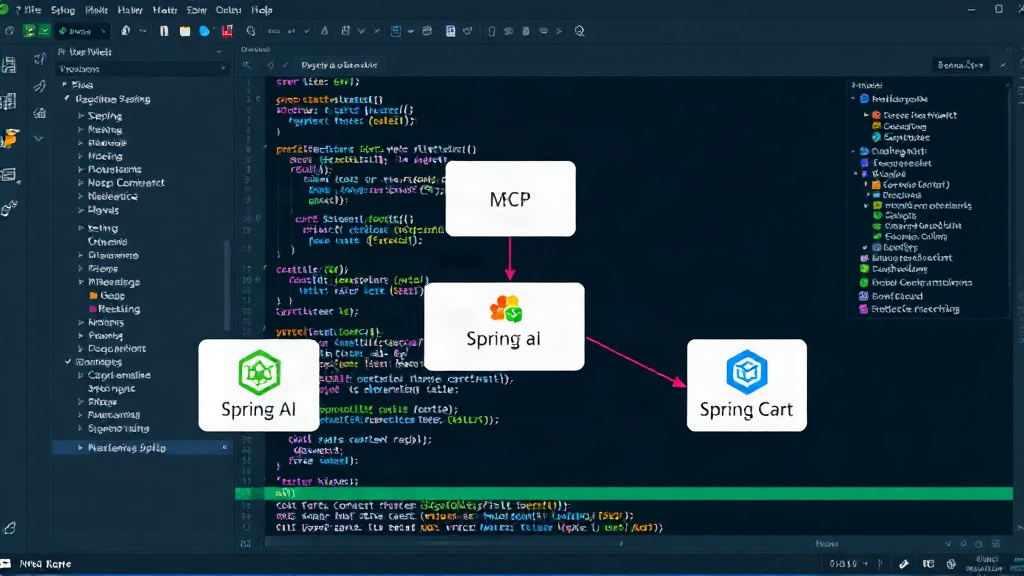
MCP Client Implementation
An MCP client, on the other hand, consumes the capabilities offered by an MCP server. This could be another AI agent or a traditional application that needs to interact with an AI service. The client's role is to formulate requests, send them to the server, and interpret the server's responses.
Building an MCP client in Java with Spring AI involves:
- Defining the AI Interface: Specifying the methods and data structures that the client will use to interact with the server.
- Invoking Server Endpoints: Making HTTP requests to the MCP server, sending the necessary context and tool calls.
- Processing Responses: Handling the server's replies, which may include generated text, tool execution results, or updated context.
Spring's RestTemplate or WebClient can be used to facilitate these client-server communications. The client logic would abstract away the HTTP details, presenting a cleaner interface for developers to integrate AI capabilities into their applications.
Benefits of the Model Context Protocol
Implementing MCP with Spring AI offers several significant advantages:
- Interoperability: Enables different AI agents and applications, potentially built by different teams or even organizations, to communicate and collaborate effectively.
- Scalability: Provides a structured approach to managing complex AI systems, making it easier to scale by adding new agents or capabilities.
- Maintainability: Centralizing context management and tool definitions improves code organization and simplifies updates or debugging.
- Developer Productivity: Spring AI's abstractions and Spring's ecosystem reduce the boilerplate code required for building and integrating AI services.
The ability to build both clients and servers within the familiar Spring ecosystem means developers can leverage their existing Java and Spring expertise to create sophisticated, interconnected AI solutions. This protocol is not just about connecting individual AI models; it's about orchestrating entire AI ecosystems, allowing for emergent intelligence and more powerful applications.
The Future of Interconnected AI
The Model Context Protocol, powered by frameworks like Spring AI, represents a significant step towards building more modular and integrated AI systems. As AI continues to permeate every aspect of software development, standardized protocols for context sharing will become indispensable. This approach allows for the creation of AI agents that are not isolated entities but rather integral parts of a larger, collaborative intelligence. For developers, this means building AI applications that are not only intelligent but also interoperable, scalable, and easier to manage, paving the way for more complex and impactful AI-driven solutions.