Local AI, Enhanced Privacy
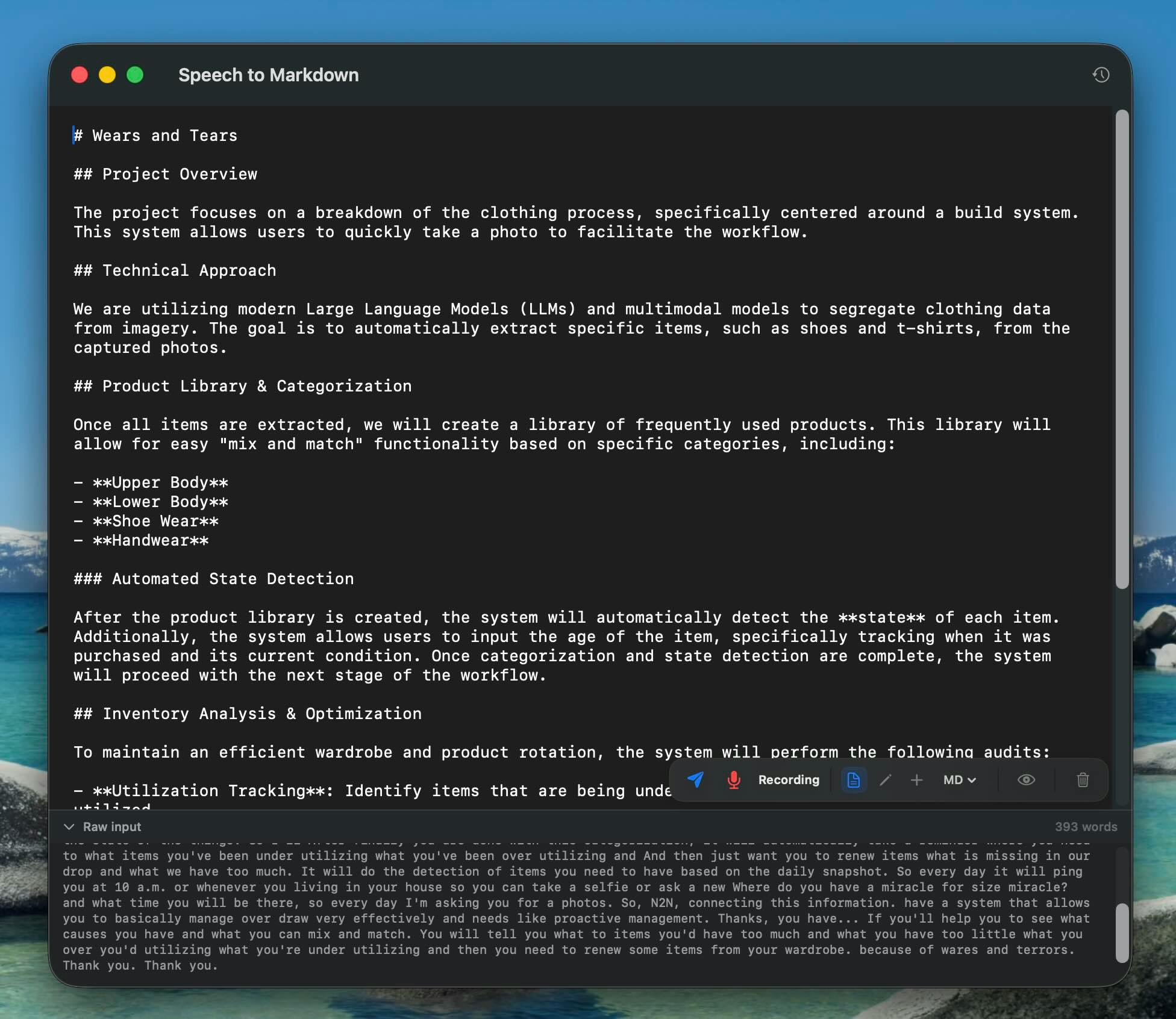
Speech To Markdown emerges as a privacy-conscious alternative in the increasingly crowded field of AI-powered note-taking and transcription. Unlike cloud-based services that send audio data to remote servers for processing, this new tool emphasizes local AI processing. This means your voice data remains on your device, offering a significant advantage for users concerned about data security and privacy. The core promise is to harness the power of AI for transcribing spoken words into structured markdown text without compromising sensitive information.
The application is designed for individuals who frequently take notes, dictate ideas, or record meeting minutes and wish to do so with a higher degree of privacy. By running the AI model locally, Speech To Markdown aims to provide a secure environment for capturing thoughts and information. This approach aligns with a growing trend among users and developers to seek out applications that minimize data sharing and maximize on-device processing capabilities, especially for personal or sensitive content.
Functionality and Workflow
Speech To Markdown's primary function is straightforward: it converts spoken audio into markdown formatted text. This might seem simple, but the implications for productivity are substantial. Markdown is a lightweight markup language with plain-text formatting syntax, widely used for creating documentation, writing blog posts, and organizing notes. Its simplicity and readability make it an ideal output format for transcribed speech, allowing for easy editing, structuring, and integration into various workflows.
The process typically involves the user speaking into their device's microphone. The application then captures this audio and processes it using its integrated local AI model. The transcribed text is then automatically formatted into markdown. This could include automatic paragraph breaks, bullet points for lists, and potentially even basic markdown syntax for emphasis or headings, depending on how the user speaks and how the AI interprets it. The output can then be copied, saved, or further processed by the user.
This local processing capability is a key differentiator. Many existing speech-to-text services rely on large, cloud-based AI models, which, while powerful, necessitate sending data across the internet. For professionals in fields like law, medicine, or journalism, where confidentiality is paramount, or for individuals simply uncomfortable with their voice data residing on external servers, Speech To Markdown offers a compelling alternative. The friction of copy-pasting from a third-party transcription service is also removed, streamlining the workflow from speech to actionable text.
The Rise of Local AI in Productivity Tools
The emergence of Speech To Markdown is indicative of a broader shift in how productivity tools are being developed and adopted. For years, cloud computing has been the default for sophisticated AI features, offering scalability and access to powerful, pre-trained models. However, this has come with inherent trade-offs regarding data privacy, latency, and reliance on internet connectivity. As AI models become more efficient and hardware capabilities on consumer devices increase, the viability of running these models locally has grown significantly.
This trend towards local AI is driven by several factors. Firstly, user awareness and demand for privacy have never been higher. High-profile data breaches and concerns about how personal data is used by large tech companies have made users more discerning. Secondly, advancements in machine learning, particularly in model compression and efficient inference, allow complex AI tasks to be performed on devices with limited computational resources. Libraries and frameworks are increasingly optimized for edge computing, making it feasible to deploy sophisticated models directly onto smartphones, laptops, and even embedded systems.
For developers, building applications with local AI capabilities can also offer advantages. It can reduce infrastructure costs associated with managing large server farms and potentially lead to a more consistent user experience, as performance is not dependent on network conditions. For users, the benefits are clear: faster response times, offline functionality, and the peace of mind that sensitive data is not being transmitted or stored elsewhere. Speech To Markdown taps directly into this growing ecosystem of privacy-focused, on-device AI tools.
Implications for Note-Taking and Content Creation
For individuals who rely on dictation for drafting documents, emails, or creative writing, Speech To Markdown offers a more integrated and secure solution. The markdown output format is particularly beneficial for content creators who often work with platforms that support markdown, such as blogs, forums, or documentation sites. It reduces the need for post-transcription reformatting, saving valuable time and effort.
Consider a journalist who needs to quickly transcribe interview notes. Instead of recording the interview and then uploading the audio to a cloud service, they can use Speech To Markdown to get an immediate, locally-processed markdown transcript. This allows them to start structuring their article or extracting key quotes much faster, all while knowing the raw audio never left their machine. Similarly, students can use it to transcribe lecture notes or their own thoughts on a topic, turning spoken ideas into organized study materials.
The tool's reliance on local AI also means it can potentially function even without an internet connection, a crucial feature for users who work in areas with unreliable connectivity or who prefer to maintain an offline workflow. This offline capability, combined with the privacy assurances of local processing, positions Speech To Markdown as a valuable utility for a wide range of users looking to streamline their note-taking and content creation processes securely.
What remains to be seen is the sophistication of the local AI model. While privacy and local processing are significant draws, the accuracy and nuance of the transcription will ultimately determine its long-term adoption. Can it handle accents, background noise, or complex technical jargon as effectively as its cloud-based counterparts? The success of Speech To Markdown will hinge on balancing its privacy-first approach with the performance expected by users accustomed to the capabilities of large, cloud-hosted AI systems.