
The Puzzling Convergence of Model Failures
In machine learning, a persistent, yet often overlooked, phenomenon occurs when diverse models, trained on seemingly distinct architectures and datasets, exhibit strikingly similar failure modes when presented with underspecified tasks. This isn't just a matter of chance; it suggests a deeper, systemic issue in how we define and present problems to AI. The core question, posed by /u/breadstickdingdong on Reddit's r/MachineLearning, is whether this correlation in failure can be directly measured and quantified. Specifically, can the ambiguity inherent in a task's specification serve as a predictable indicator of how frequently independent models will fail in identical ways?
The current understanding points to a shared vulnerability. When a task is underspecified, meaning the instructions or data lack crucial details or context, models are forced to make assumptions. These assumptions, even across different model families (e.g., transformers, CNNs, RNNs), can converge on similar interpretations of the ambiguity, leading to parallel errors. This is analogous to giving a group of people a vague instruction to 'draw a house.' Some might draw a generic suburban home, others a fantastical castle, but many might default to a simple, iconic representation with a square, a triangle roof, and a chimney – a shared, underspecified ideal. The research community is now asking: can we quantify the 'vagueness' of the instruction and then see if more vague instructions lead to more people drawing the same kind of house?
Seeking Measurable Ambiguity Metrics
The crucial aspect of the inquiry is measurement. The user is not seeking explanations for *why* this happens, but rather *how* to quantify it and test its predictive power. This involves two primary components: first, developing a metric for task specification ambiguity, and second, empirically testing this metric against observed correlated failure rates across different model families. The ideal scenario would be to find existing benchmarks or propose new ones that allow for this direct correlation to be measured.
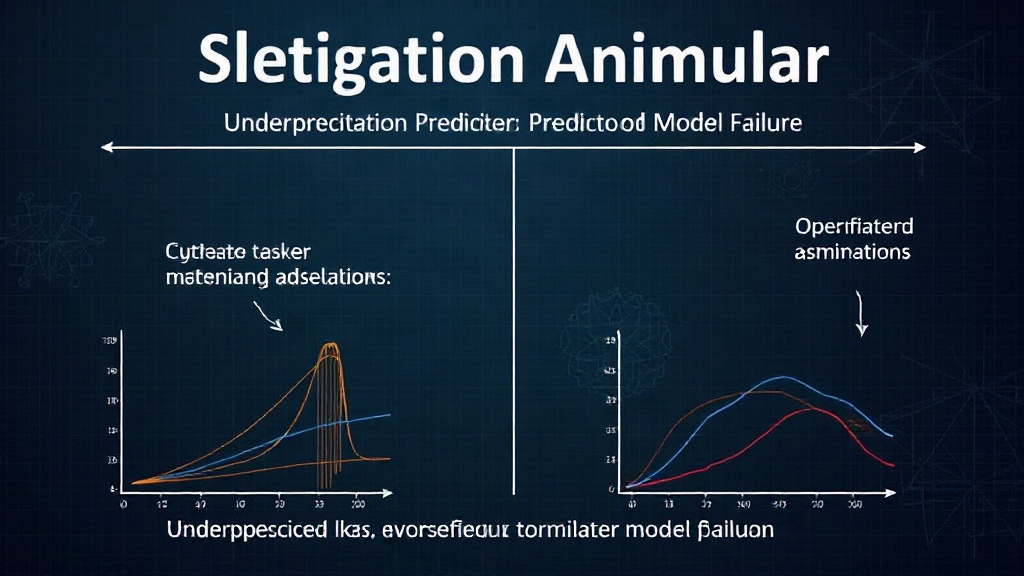
The hypothesis is that as the ambiguity of a task specification increases, so too will the rate at which independent models fail in identical ways. The question then becomes one of the nature of this relationship. Is it a smooth, monotonic increase, where more ambiguity linearly translates to more correlated failures? Or is there a more dramatic, threshold-like effect, where a certain level of ambiguity triggers a sharp jump in the coincidence rate of failures? Understanding this shape is critical for developing robust mitigation strategies. If it's a smooth increase, incremental improvements in specification clarity might suffice. If it's a threshold, then ensuring specifications are unambiguously clear becomes paramount.
This line of inquiry has significant implications for the robustness and reliability of AI systems. If we can predict correlated failures based on specification ambiguity, we can proactively design tasks, training procedures, and evaluation metrics to mitigate these risks. It could lead to the development of new datasets specifically designed to probe for and measure specification ambiguity, or new evaluation frameworks that penalize correlated failures more heavily when specifications are known to be ambiguous.
Adjacent Work and Future Directions
While direct measurements of specification ambiguity as a predictor of correlated model failures might be scarce, several areas of research offer relevant insights. Work on adversarial robustness, for instance, explores how models react to subtle perturbations in input data, which can be seen as a form of specification ambiguity in the input itself. Similarly, research into out-of-distribution (OOD) detection and generalization touches upon how models perform when faced with tasks that deviate from their training distribution, a scenario often exacerbated by underspecified instructions.
The field of interpretability and explainability might also provide tools. Understanding *why* models fail in certain ways, even if not the primary focus, can inform the development of metrics that capture the 'reasoning paths' taken by different models. If these paths converge due to ambiguous specifications, interpretability methods might highlight this convergence. Furthermore, research into prompt engineering for large language models (LLMs) implicitly deals with specification ambiguity, as prompt designers iteratively refine instructions to elicit desired behaviors and avoid undesired ones.
The challenge lies in translating these related concepts into a quantifiable metric for specification ambiguity that can be rigorously tested. This might involve analyzing the variance in model outputs for a given input and instruction, measuring the entropy of predicted distributions, or developing novel benchmarks that systematically vary the level of detail and context in task descriptions. The ultimate goal is to move beyond anecdotal observations of correlated failures to a predictive, data-driven understanding that can enhance AI safety and reliability across the board.