
Beyond the Linear: The Case for Spatial Programming
Traditional programming languages confine code to a linear, text-based structure. While effective for decades, this approach struggles with the increasing complexity of modern software. Spatial languages propose a radical shift: organizing code not just line by line, but across a two-dimensional canvas. This isn't about visual programming in the drag-and-drop sense, but about treating layout as a first-class citizen in code design, akin to how architects use blueprints. The idea is that relationships, dependencies, and program flow can be more intuitively represented and understood when not confined to a single axis.
The core motivation behind spatial languages is to tackle the cognitive load associated with large, intricate codebases. As projects grow, understanding the interplay between different modules, functions, and data structures becomes a significant challenge. Linear text can obscure these relationships, forcing developers to mentally map them out. Spatial arrangements, proponents argue, can make these connections explicit and easier to grasp. Think of it less like a book and more like a circuit diagram or a mind map, where the physical placement of elements conveys meaning.
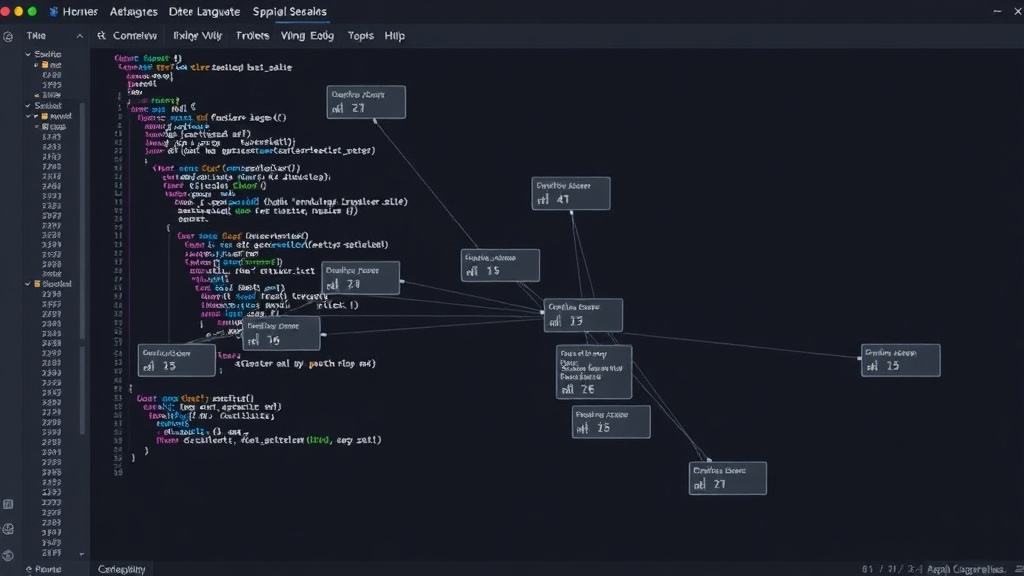
How Spatial Languages Work: Layout as Semantics
Unlike visual programming tools where components are linked by wires, spatial languages maintain a textual or block-based core but imbue the arrangement of these elements with semantic meaning. For instance, placing a function definition adjacent to its primary caller might indicate a strong coupling or a common usage pattern. Grouping related data structures in a specific region of the canvas could signify a cohesive module. The compiler or interpreter would then understand not just the logic within the code blocks but also the relationships implied by their spatial proximity and alignment.
This approach could manifest in several ways. One possibility is a grid-based system where functions, classes, or modules are treated as cells that can be arranged and resized. Another might involve freeform placement, where developers can position elements anywhere on a canvas, with the system inferring relationships based on distance, alignment, and explicit connection lines. The key is that the 2D layout would carry information that is either lost or difficult to express in purely linear code. This could include things like data flow paths, control flow dependencies, or even the scope and visibility of variables.
Potential Benefits: Clarity, Maintainability, and Debugging
The envisioned benefits of spatial languages are significant. For developers, navigating and understanding complex systems could become dramatically easier. Visualizing the architecture and interdependencies directly on the canvas could reduce the time spent tracing execution paths or deciphering implicit relationships. This improved clarity could lead to faster development cycles and fewer bugs introduced due to misunderstandings of the codebase’s structure.
Maintainability stands to gain considerably. When a change is needed, a developer could more readily see the potential ripple effects by observing the spatial arrangement of related code. Refactoring might become more intuitive, as blocks could be moved and reorganized on the canvas, with the system helping to ensure that dependencies are maintained. Debugging could also be enhanced. Imagine being able to visualize the state of different code modules or data structures in their spatial context, providing a more holistic view of the program's execution and helping to pinpoint the source of errors more efficiently.
Challenges and the Road Ahead
Despite the compelling potential, the path to widespread adoption of spatial languages is fraught with challenges. The most immediate hurdle is the development of robust tooling. Compilers, interpreters, IDEs, version control systems, and debugging tools would all need to be fundamentally rethought to support this new paradigm. How would version control handle spatial diffs? How would code reviews be conducted on a 2D canvas? These are non-trivial questions.
Furthermore, there's the question of developer adoption. Programmers are accustomed to text-based coding. Introducing a new spatial model requires not only learning new syntax and semantics but also a new way of thinking about program structure. This learning curve could be steep, and the benefits would need to be overwhelmingly clear to justify the shift. The risk of creating systems that are visually complex but logically opaque is also real. Without careful design and strong tooling, spatial languages could become more of a hindrance than a help.
What nobody has addressed yet is what happens to the vast existing codebase written in traditional languages. Will spatial languages be a niche for new projects, or will there be tools for gradual migration or interoperability? The transition from purely linear to spatial code organization represents a fundamental paradigm shift, and its success will depend on overcoming these practical and theoretical obstacles. The promise is a more intuitive and manageable way to build the increasingly complex software systems of the future, but realizing that promise requires significant innovation in both language design and development tooling.