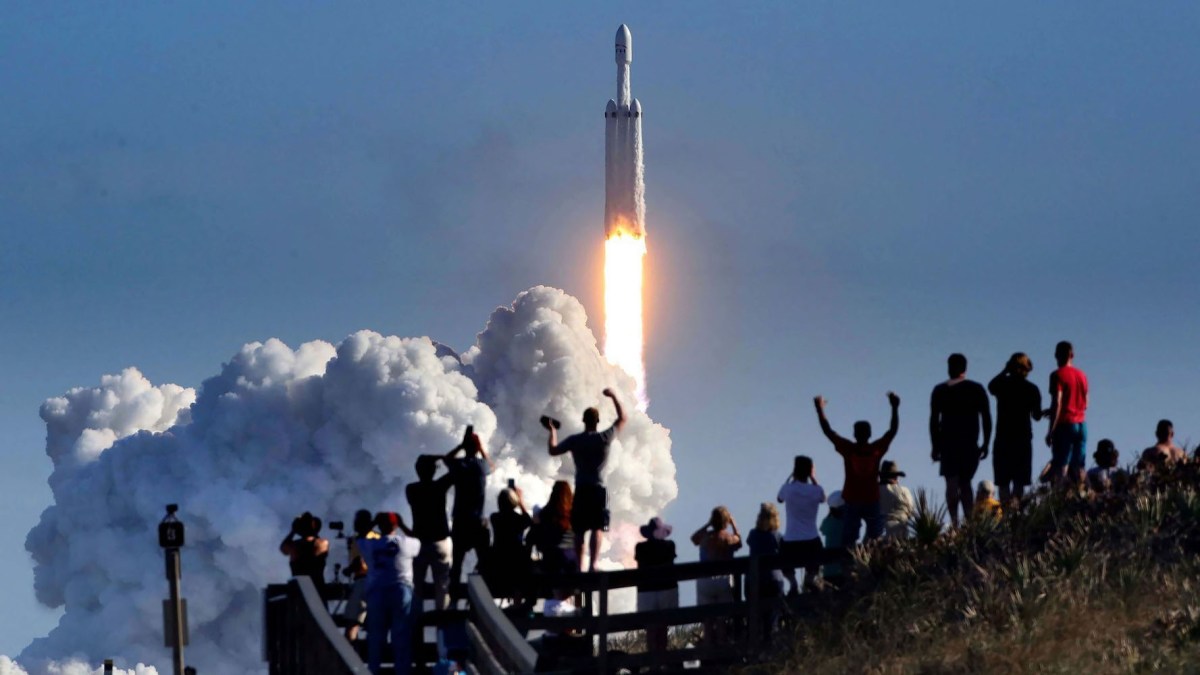
SpaceX Surges Past Amazon in Market Cap Race
SpaceX's valuation experienced a dramatic surge on Tuesday, briefly eclipsing Amazon and approaching Microsoft's market capitalization. The aerospace giant's stock climbed a staggering 20% on Monday, its first full day of trading after its recent public offering. Tuesday's gains were further fueled by the announcement of SpaceX's acquisition of AI coding company Cursor, alongside the commencement of options trading on its shares. This confluence of events sent the company's valuation soaring to a peak of $2.9 trillion before a slight pullback ahead of the market close.

Factors Driving the Valuation Spike
Several key developments contributed to SpaceX's meteoric rise in market valuation. The acquisition of Cursor, an AI coding company, signals SpaceX's strategic expansion into artificial intelligence and software development, areas increasingly vital for technological advancement and operational efficiency. This move suggests an ambition to integrate advanced AI capabilities across its diverse operations, from rocket design and mission control to satellite communications and ground systems. The AI sector itself is experiencing unprecedented growth and investor interest, making acquisitions in this space particularly attractive.
Furthermore, the initiation of options trading on SpaceX's shares provided a new avenue for investors to speculate on the company's future performance. Options trading allows for more complex trading strategies and can amplify both gains and losses, often leading to increased price volatility. For a company with such high growth expectations as SpaceX, the introduction of options can significantly boost trading volume and, consequently, its market valuation as demand for its stock intensifies. This mechanism allows a broader range of investors to participate in the company's growth trajectory, albeit with increased risk.
The initial public offering itself was a significant event, immediately placing SpaceX under the scrutiny of public markets. The company's demonstrated success in reusable rocket technology, its ambitious Starlink satellite internet constellation, and its long-term vision for Mars colonization have all contributed to a narrative of immense future potential. Investors are betting heavily on SpaceX's ability to disrupt multiple industries and achieve ambitious long-term goals that few other companies can even contemplate.
Market Context and Competitive Landscape
SpaceX's temporary leap past Amazon places it among the top tier of global companies by market capitalization. Amazon, a titan of e-commerce and cloud computing, has long been a benchmark for technological innovation and market dominance. For SpaceX to approach its valuation, even briefly, underscores the market's perception of its disruptive potential and future revenue streams. The aerospace industry, traditionally dominated by large government contractors, is being reshaped by private sector innovation, with SpaceX at the forefront. Companies like Blue Origin, Rocket Lab, and a host of smaller startups are also vying for market share, but SpaceX's scale, technological lead, and operational cadence currently set it apart.
The comparison to Microsoft, another of the world's most valuable companies, highlights the broad range of industries SpaceX is perceived to impact. While Microsoft's strength lies in software, cloud services, and gaming, SpaceX's influence spans space exploration, telecommunications, and potentially future transportation and resource extraction. This diversification, coupled with a strong track record of execution, fuels investor confidence. The market is valuing SpaceX not just as a rocket company, but as a multifaceted technology conglomerate with a roadmap to the stars.

The Impact of the Cursor Acquisition
The acquisition of Cursor is more than just a financial transaction; it represents a strategic pivot and an investment in the future of software development. Cursor, known for its AI-powered code editor, aims to accelerate the development process by leveraging large language models to assist developers. Integrating such technology could significantly enhance SpaceX's internal engineering capabilities. Imagine a scenario where AI assists in writing, debugging, and optimizing the complex software that controls rocket launches, satellite operations, or the intricate systems required for interplanetary missions. This could lead to faster development cycles, reduced errors, and potentially more innovative designs.
For the broader AI and developer tools market, this acquisition signals a growing trend of major technology players integrating AI deeply into their core offerings. It suggests that AI is no longer a niche add-on but a fundamental component of building and scaling complex technological ventures. The demand for tools that can enhance developer productivity is immense, and companies that can effectively harness AI to meet this demand are poised for significant growth. SpaceX's move validates this trend and may spur further consolidation or innovation in the AI developer tool space.
Future Outlook and Investor Sentiment
While the $2.9 trillion peak valuation was a temporary spike, the sustained high valuation reflects strong investor confidence in SpaceX's long-term prospects. The company's ambitious projects, such as Starship, its fully reusable super heavy-lift launch vehicle, and its ongoing expansion of the Starlink constellation, represent massive market opportunities. Starship, in particular, is envisioned as a key to enabling deep space exploration, lunar missions, and potentially even point-to-point travel on Earth. The success of these ventures could unlock entirely new industries and revenue streams, justifying current high valuations.
However, the volatility observed also highlights the inherent risks associated with investing in a company with such ambitious, capital-intensive, and technologically challenging goals. The path to Mars colonization, for instance, is fraught with technical hurdles and requires sustained, massive investment. Market sentiment can shift rapidly based on technological breakthroughs, launch successes or failures, and broader economic conditions. The brief period where SpaceX surpassed Amazon serves as a powerful indicator of market sentiment, but the company's sustained success will ultimately depend on its ability to deliver on its audacious promises.

What remains to be seen is how SpaceX balances its rapid growth and public market demands with its long-term, often multi-decade, strategic objectives. The pressure to meet quarterly earnings expectations could, in theory, influence project timelines or risk appetite. Yet, SpaceX has historically operated with a unique blend of agility and long-term vision, driven by founder Elon Musk's ambitious goals. The market's current embrace of this vision, as evidenced by its valuation, suggests a collective belief that SpaceX is not just building rockets, but shaping the future of humanity beyond Earth.