Beyond Annotations: Introducing Solon's AppContext API
Solon's annotation-driven development, with staples like @Component, @Inject, and @Bean, streamlines the creation and wiring of application components. However, this declarative approach hits its limits when you need to interact with the Inversion of Control (IoC) container at runtime. This is where Solon's AppContext API becomes essential. It provides the programmatic interface to manage beans, process annotations, and build framework extensions or plugins that require deeper container manipulation.
AppContext is the beating heart of Solon. It houses the IoC container and the AOP capabilities, forming the bedrock for Solon's hot-plugging features. While annotations handle the 'what' and 'how' of bean declaration and injection, AppContext governs the 'when' and 'where' of container operations. Understanding this API is key for developers venturing beyond standard application development into framework-level customization.
Accessing the AppContext
Developers can obtain a reference to the AppContext instance through several methods, depending on their current context within the Solon application. This ensures that programmatic control is available wherever it's needed.
Global Access
The simplest way to get an AppContext reference is through the static Solon.appContext() method. This provides immediate access from anywhere in the application, making it convenient for utility classes or components that need to interact with the container without direct injection. This global access point is a direct consequence of Solon's design philosophy, aiming to provide flexibility.
Contextual Access via Injection
For components that are themselves managed by Solon's IoC container, direct injection is the preferred and more idiomatic approach. By declaring a field or constructor parameter of type AppContext and annotating it with @Inject, Solon will automatically provide the current AppContext instance upon bean creation. This adheres to the principle of dependency injection, ensuring that components receive their required dependencies cleanly.
@Component
public class MyService {

    @Inject
    private AppContext appContext;

    public void doSomething() {
        // Use appContext here
    }
}
Access via Event Listener
Solon's event-driven architecture also provides a pathway to the AppContext. Certain lifecycle events within the framework carry an AppLoadEndEvent, which contains a reference to the AppContext. By implementing an EventListener for such events, developers can gain access to the AppContext during specific phases of the application's startup or shutdown. This is particularly useful for performing setup or cleanup operations that depend on the container's state at a particular moment.
Core AppContext Operations
Once you have a handle on the AppContext, a suite of methods becomes available for programmatic bean management. These operations extend beyond simple bean retrieval, enabling dynamic bean registration, modification, and even removal.
Bean Retrieval
The most fundamental operation is retrieving beans. AppContext offers methods like getBean(Class and getBean(String name) to fetch instances of registered beans. These methods are the programmatic equivalent of @Inject, allowing you to fetch beans by their type or their registered name. The API also supports retrieving all beans of a certain type using getBeansOfType(Class.
Bean Registration
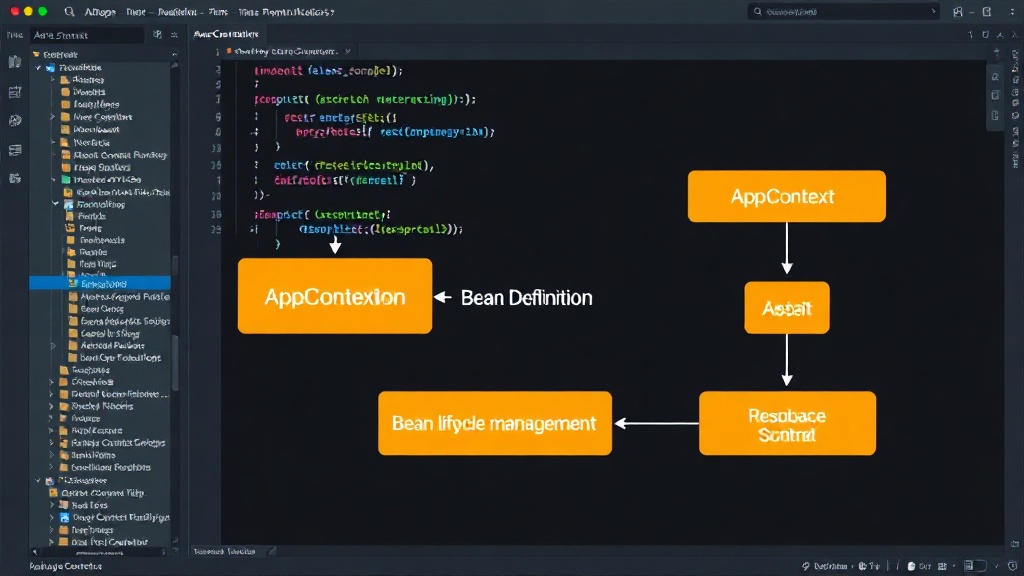
Beyond retrieving existing beans, AppContext allows for the dynamic registration of new beans. The registerBean(BeanDefinition definition) method is central to this. A BeanDefinition object encapsulates all the necessary information about a bean, including its type, name, scope, and factory method or supplier. This enables the creation of beans on the fly, based on runtime conditions or configurations that cannot be expressed through static annotations.
For simpler cases, methods like registerBean(Object obj) or registerBean(Class clz) offer shortcuts. Registering an object directly adds an existing instance to the container, while registering a class allows Solon to manage its lifecycle and injection. This dynamic registration capability is crucial for building flexible plugins that can introduce new services or components into the running application without requiring a full redeploy.
Annotation Processing
AppContext is also responsible for managing annotation processors. These processors are invoked to discover and create beans based on annotations like @Component, @Service, or custom annotations. The AppContext orchestrates the discovery and application of these processors, ensuring that the IoC container is populated correctly. When building custom annotation-driven features or plugins, developers can leverage or extend this annotation processing mechanism. This involves defining custom annotations and corresponding processors that the AppContext can then discover and execute.
Lifecycle Management
The AppContext provides hooks into the bean lifecycle. You can register lifecycle callbacks for specific beans or for the container itself. This allows for fine-grained control over initialization and destruction phases. For instance, you might want to perform a specific network connection setup when a data source bean is initialized or gracefully shut down a background thread when the application context is closed. The AppContext facilitates this by allowing the registration of listeners or the definition of init and destroy methods within BeanDefinitions.
Use Cases for AppContext
The programmatic control offered by AppContext unlocks powerful capabilities, particularly in advanced Solon development scenarios.
Plugin Development
Solon's hot-plugging feature relies heavily on the AppContext. Plugins often need to register new beans, configure existing ones, or even modify the container's behavior dynamically after the main application has started. AppContext provides the necessary APIs for plugins to integrate seamlessly with the host application's IoC container. A plugin might dynamically register a set of utility beans or implement a new endpoint based on runtime configuration, all managed through AppContext.
Framework Extensions
Developers building extensions or custom middleware for Solon will find AppContext indispensable. This includes creating custom configuration loaders, advanced AOP aspects, or new integration points. The ability to programmatically define bean relationships and lifecycle hooks allows for the creation of sophisticated framework components that can adapt to various application needs.
Advanced Configuration and Runtime Adaptation
In scenarios where application configuration is highly dynamic or determined at runtime, AppContext allows for the creation and registration of beans based on these changing conditions. This could involve creating different database connection beans based on environment variables, or registering caching mechanisms only if a specific feature flag is enabled. This level of runtime adaptation is beyond the scope of static annotations.
Conclusion: Empowering Advanced Solon Development
While Solon's annotations provide an elegant and efficient way to manage most application components, the AppContext API offers the essential programmatic layer for more complex scenarios. It grants developers direct access to the core of Solon's IoC container, enabling the creation of robust plugins, framework extensions, and applications requiring dynamic runtime control. Mastering AppContext empowers developers to push the boundaries of what's possible within the Solon ecosystem.