The Shifting Landscape of Software Development
The narrative around artificial intelligence in software development often focuses on its ability to churn out code at an unprecedented speed. While AI's capacity to generate lines of code is indeed impressive, it fundamentally misunderstands the core of what software engineering entails. Programming, in isolation, is a relatively straightforward task. An individual developer, or an AI agent, can produce a script. However, a script alone is rarely sufficient. True software engineering encompasses the entire lifecycle: shipping the code, ensuring its long-term maintainability, scaling it to meet demand, and guaranteeing it integrates seamlessly with existing systems without causing cascading failures.
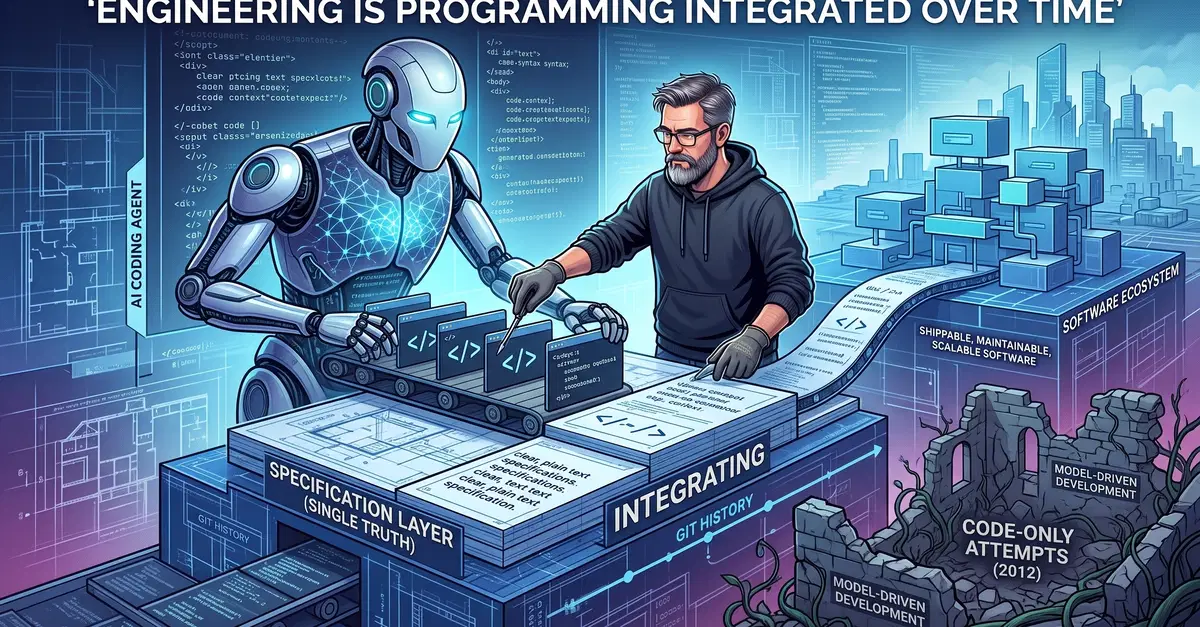
Software engineering is not merely about writing code; it's about the complex, integrated process of building and sustaining software systems over time. This definition, "Software Engineering is programming integrated over time," highlights the crucial distinction. AI can accelerate the programming aspect, but it cannot yet replicate the intricate human collaboration, strategic decision-making, and long-term stewardship required for successful engineering.
Beyond Code Generation: The Integration Challenge
AI's current prowess lies in generating code snippets, functions, or even entire modules based on prompts. This can significantly boost individual developer productivity, allowing them to prototype faster or offload repetitive coding tasks. Yet, this capability does not address the more complex, systemic challenges that define modern software engineering. The areas where AI still struggles are precisely where engineering expertise is most critical: long-term maintainability, system reliability, managing technical debt, and navigating the inherent ambiguities of real-world project requirements.
These challenges are not about writing more code, but about making difficult trade-offs, aligning with evolving business goals, and ensuring the software remains robust and financially viable over years, not just days or weeks. The true engineering work happens in the 'gray areas' – optimizing for performance versus cost, choosing between rapid iteration and stability, and meticulously managing dependencies. AI can assist in these decisions, but the ultimate responsibility and strategic direction remain human-driven.
The New Frontier: Systemic Integration and Reliability
As AI tools become more adept at code generation, the bottleneck in software development is shifting. It's moving away from the act of writing individual lines of code and towards the complex task of integrating these generated components into larger, cohesive systems. This involves ensuring compatibility, managing dependencies, orchestrating workflows, and deploying reliably. The 'programming' part might be faster, but the 'engineering' part – the integration, testing, deployment, and ongoing operation – becomes the critical path.
Consider a large enterprise system. AI might generate a new microservice that handles customer notifications. The engineering challenge isn't just verifying that the microservice code is correct. It's about integrating it into the existing authentication system, ensuring it can handle peak loads, updating monitoring and alerting to include this new service, handling potential rollback scenarios, and ensuring it conforms to the company's security and compliance standards. This holistic view, encompassing the entire system and its operational context, is where human engineers excel.
Navigating Ambiguity and Technical Debt
One of the most significant aspects of software engineering is dealing with ambiguity. Project requirements are rarely perfectly defined. Business needs evolve. Unexpected issues arise. Engineers must interpret vague specifications, ask clarifying questions, and make informed decisions based on incomplete information. This iterative process of clarification, implementation, and refinement is core to engineering.
Furthermore, managing technical debt is an ongoing engineering responsibility. As systems evolve, shortcuts are taken, and older codebases become harder to maintain. Engineers must constantly evaluate the trade-offs between delivering new features quickly and investing time in refactoring or modernizing existing components. AI can help identify potential areas of debt, but the strategic decision of how and when to address it requires a deep understanding of the business context and long-term product vision. This is a human judgment call, informed by experience and strategic foresight.
The Future Role of the Software Engineer
The rise of AI code generation tools does not render software engineers obsolete. Instead, it elevates their role. The focus shifts from the tactical execution of writing code to the strategic responsibilities of system design, architecture, integration, and long-term system health. Engineers will spend more time defining problems, architecting solutions, guiding AI tools, and ensuring the quality and reliability of the integrated system.
This evolution means that skills in areas like system design, distributed systems, cloud architecture, security best practices, and effective communication become even more paramount. Engineers become conductors of complex systems, leveraging AI as a powerful instrument rather than a replacement. The ability to understand the 'big picture,' manage complexity, and make strategic decisions about trade-offs will define the successful software engineer of the future.
The question for development teams is not whether AI can write code, but how they will integrate AI-generated code into their existing workflows and systems. The engineering discipline will adapt, placing a higher premium on architectural thinking, integration expertise, and the human ability to manage complex, evolving software ecosystems.