
The Limits of Traditional Buses in Modern SoCs
System-on-Chip (SoC) designs have grown exponentially in complexity. What was once a handful of processors and memory controllers has ballooned into hundreds, even thousands, of specialized cores, accelerators, and I/O interfaces. This explosion in component count and connectivity demands a communication backbone far more sophisticated than the traditional bus architectures that served us for decades. Buses, with their shared communication medium, suffer from critical bottlenecks as the number of connected devices increases. Contention for the bus rises dramatically, leading to reduced bandwidth, increased latency, and significant power consumption as arbitration logic becomes more complex and active. For applications demanding high throughput and low latency, such as advanced AI/ML, high-performance computing, and complex automotive systems, the bus has simply outgrown its capabilities.
Think of a traditional bus like a single-lane highway with many on-ramps. As more cars (data packets) try to merge, traffic grinds to a halt. Every car has to wait its turn, regardless of its destination. This shared resource model worked when there were only a few cars. Now, with thousands of cars, the highway becomes a parking lot. This is precisely the challenge facing modern SoC interconnects.
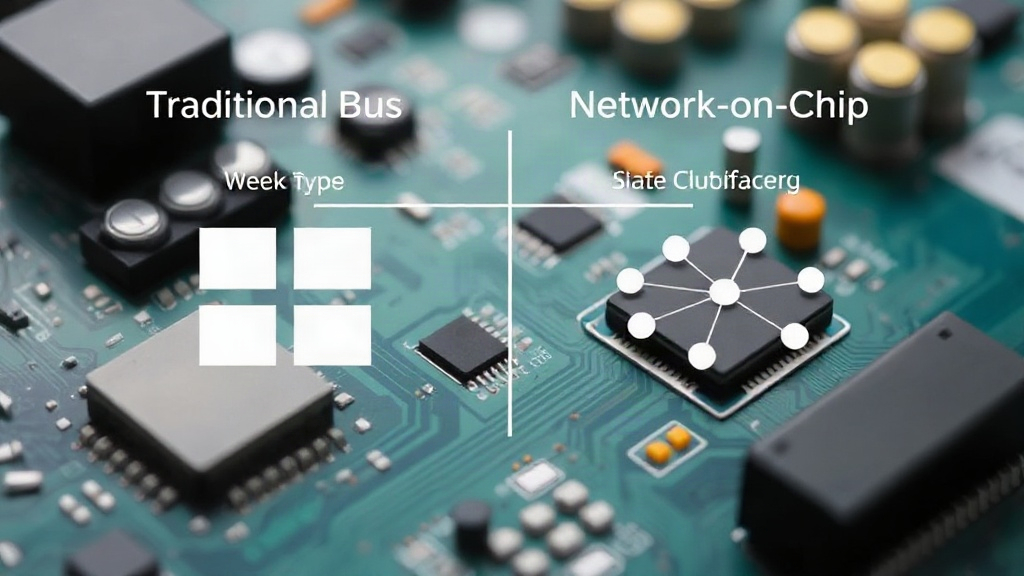
The Rise of Network-on-Chip (NoC)
The natural evolution from bus architectures is the Network-on-Chip (NoC). Unlike buses, NoCs treat the interconnect as a network, employing routers, links, and Network Interface Controllers (NICs) to manage data flow. This distributed approach allows for parallel communication paths, significantly increasing overall bandwidth and reducing contention. Each component connects to a router, and data packets are routed efficiently across the network to their intended destination, much like data packets on the internet. This architectural shift is fundamental to achieving the scalability required for next-generation SoCs.
NoCs offer several key advantages. Firstly, they provide inherent scalability. Adding new IP blocks to an SoC means connecting them to the existing NoC infrastructure, which can be expanded with additional routers and links without fundamentally redesigning the entire communication fabric. This modularity is crucial for handling the ever-increasing number of IP blocks in advanced designs. Secondly, NoCs enable better performance isolation. A communication bottleneck between two specific components is less likely to impact the performance of unrelated components, unlike on a shared bus where one heavy user can starve all others.
Coherent Subsystem IP: A Key Enabler
While NoCs provide the physical and logical pathways for data, ensuring that data is consistent and accessible across different processing elements is paramount. This is where coherent subsystem IP plays a critical role. Coherent interconnects manage the complex protocols that ensure all caches within the SoC have a consistent view of memory, even when multiple processors or accelerators are accessing and modifying data simultaneously. This is essential for multi-core processors and heterogeneous computing environments, preventing data corruption and simplifying software development.
Modern coherent subsystem IP integrates seamlessly with NoC architectures. These IPs handle the intricate details of cache coherency protocols, such as MESI or MOESI, across a distributed network. They abstract away the complexity of managing shared memory spaces, allowing developers to focus on application logic rather than low-level data consistency issues. This integration is vital for enabling high-performance, multi-processor systems where multiple agents need to access shared data efficiently and reliably. Without robust coherent interconnects, the performance gains offered by NoCs would be significantly hampered by data staleness or race conditions.
Addressing Next-Gen Challenges: Scalability, Safety, and Performance
The transition to NoCs and coherent subsystem IP is not merely an architectural upgrade; it's a necessary response to the industry's most pressing challenges. Scalability, as discussed, is addressed by the inherent modularity and parallelism of NoCs. Performance is boosted by reduced latency and increased bandwidth, enabling more complex workloads to run efficiently.
Safety is an increasingly critical concern, particularly in automotive and industrial applications. Advanced NoC designs can incorporate features for reliability, availability, and serviceability (RAS). This includes error detection and correction mechanisms, redundant paths, and mechanisms to isolate faulty components without bringing down the entire SoC. Coherent IPs also contribute to safety by ensuring data integrity, a fundamental requirement for safety-critical systems. The ability to predict and manage communication behavior, along with robust error handling, makes NoCs a superior choice for systems where failure is not an option.
The industry is moving decisively towards NoC-based interconnects. Companies are investing heavily in developing and refining NoC architectures and coherent IP blocks. This shift is driven by the undeniable limitations of buses in the face of ever-increasing SoC complexity and performance demands. As chips continue to integrate more specialized processing units, the need for efficient, scalable, and reliable communication fabrics will only intensify, making NoCs the de facto standard for advanced SoC design.