Leveraging Small Language Models Locally
Small language models (SLMs) are increasingly viable alternatives to their larger, cloud-based counterparts for specific tasks. While they cannot replicate the broad, general-purpose intelligence of models like GPT-4, SLMs excel in scenarios demanding local processing, privacy, and predictable performance. The key to their effective use lies in understanding their inherent limitations and strategically applying them to suitable operations.
Consider SLMs not as replacements for massive, generalist AI systems, but as specialized tools. Think of them less like a vast public library and more like a meticulously curated personal bookshelf, holding exactly the information and capabilities you need for particular projects. This focused approach allows developers and businesses to deploy AI without the latency, cost, or privacy concerns associated with sending data to external servers.
The primary advantage of SLMs is their ability to run on local hardware, including personal computers, mobile devices, and edge computing platforms. This enables real-time processing and inference, crucial for applications where immediate responses are necessary. Furthermore, keeping data on-device significantly enhances user privacy and data security, as sensitive information never leaves the user's control. This is particularly important in regulated industries or for applications handling personal user data.
Core Operations Suitable for SLMs
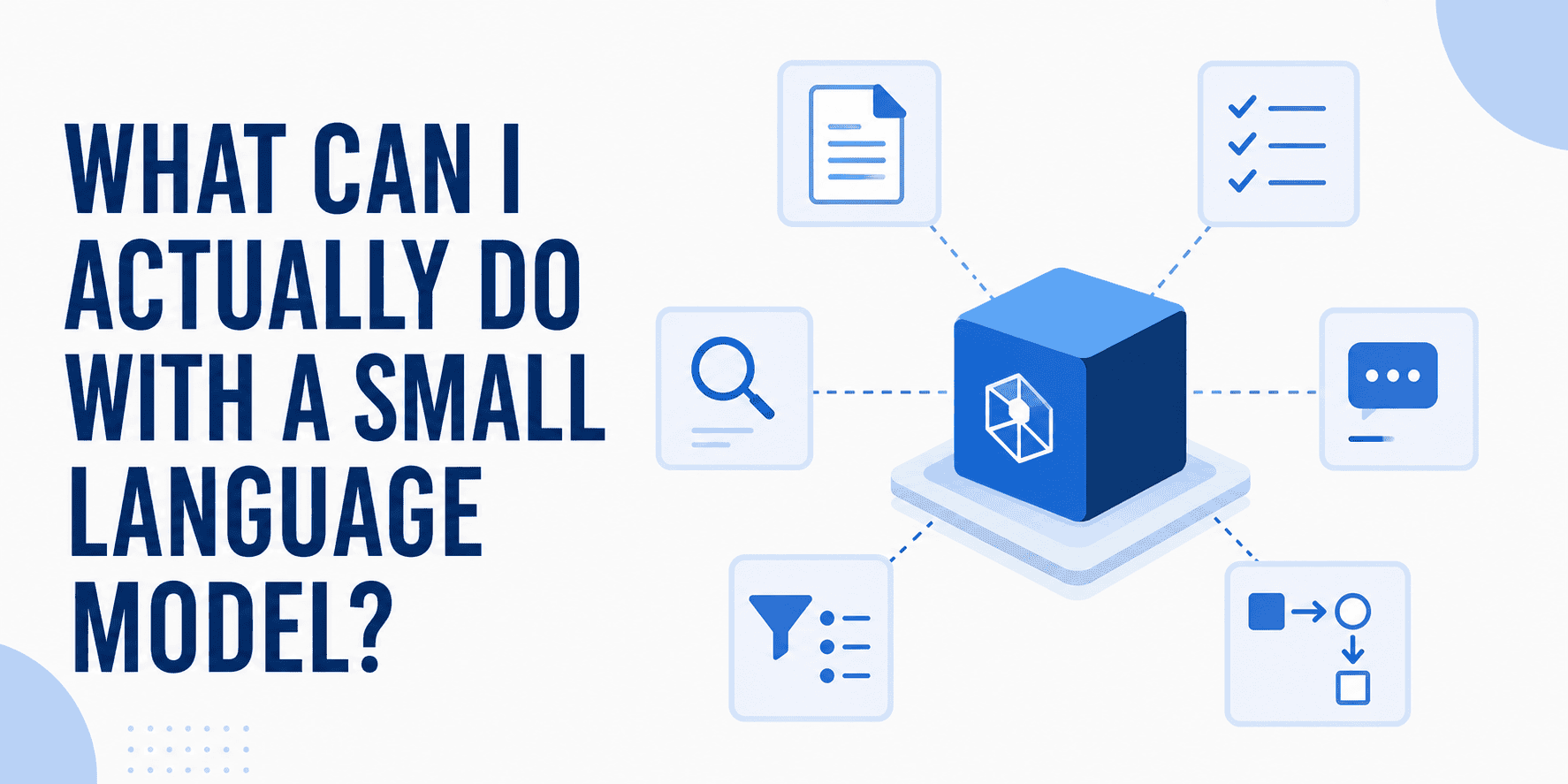
Several broad operational scenarios are well-suited for SLMs. These include:
Text Summarization and Extraction
SLMs can efficiently condense long documents into concise summaries or extract specific pieces of information. For instance, a legal team could use an SLM to quickly summarize case files, or a researcher could extract key findings from multiple academic papers. The model’s ability to grasp context within a defined domain allows it to perform these tasks with high accuracy, provided the input text is within its training scope.
Content Generation (within limits)
While SLMs won't write a novel, they can be highly effective for generating specific types of content. This includes drafting routine emails, creating product descriptions, writing social media posts, or generating boilerplate code snippets. The output might require human review and refinement, but the SLM can significantly speed up the initial drafting process, acting as a powerful writing assistant.
Imagine an e-commerce platform using an SLM to generate unique product descriptions for thousands of items. The model can be trained on existing descriptions and product specifications to produce varied, engaging copy, saving considerable human effort. The critical factor is defining clear parameters and providing sufficient context for the SLM to work within.
Classification and Categorization
SLMs are excellent at classifying text into predefined categories. This is useful for tasks such as sorting customer feedback into sentiment categories (positive, negative, neutral), routing support tickets to the correct department, or identifying spam in user-generated content. Their efficiency makes them ideal for processing large volumes of text data in real-time.
Personalized Recommendations
By analyzing user behavior and preferences stored locally, SLMs can generate personalized recommendations. This could range from suggesting articles to read, products to buy, or content to consume. The local processing ensures that user privacy is maintained, as their activity data is not shared externally.
Code Assistance and Debugging
For developers, SLMs can offer assistance with coding tasks. This includes suggesting code completions, explaining code snippets, identifying potential bugs, or refactoring code. Running these tools locally provides a faster, more integrated development experience, especially for common programming tasks.
Strategic Considerations for SLM Deployment
Deploying SLMs effectively requires careful planning. Here are key considerations:
Data Privacy and Security
As mentioned, SLMs excel when data must remain on-device. This is a significant advantage over cloud-based LLMs, which require data transmission. For applications dealing with sensitive personal, financial, or medical information, SLMs provide a robust solution for embedding AI capabilities without compromising privacy.
Performance and Latency
SLMs offer lower latency compared to large models. This is because they avoid network round trips and operate directly on the user’s hardware. For real-time applications like interactive chatbots, instant content suggestions, or on-device voice assistants, this speed advantage is critical.
Resource Constraints
SLMs require less computational power and memory than their larger counterparts. This makes them suitable for deployment on devices with limited resources, such as smartphones, IoT devices, or embedded systems. Developers must still consider the specific hardware requirements of the chosen SLM, but the barrier to entry is significantly lower.
Fine-tuning and Domain Adaptation
While SLMs are pre-trained, their performance can be significantly enhanced by fine-tuning them on domain-specific data. This process adapts the model to understand and generate text relevant to a particular industry or task. For example, fine-tuning an SLM on medical literature will improve its ability to summarize research papers in that field. This targeted adaptation is where SLMs can often outperform generalist models for niche applications.
Integration with Existing Workflows
SLMs can be integrated into existing software and workflows without requiring major infrastructure changes. They can function as plugins, background processes, or standalone applications. The ease of integration allows businesses to gradually adopt AI capabilities and enhance existing tools and processes.
When NOT to Use Small Language Models
It's crucial to recognize the limitations. SLMs struggle with tasks requiring:
- Complex reasoning and problem-solving.
- Generating highly creative or novel content.
- Understanding nuanced or ambiguous language across diverse contexts.
- Accessing and synthesizing information from the entire internet in real-time.
- Performing tasks that demand the vast knowledge base of a general-purpose LLM.
For these more demanding applications, larger, cloud-hosted models remain the superior choice. The decision to use an SLM hinges on matching the task's complexity and requirements with the model's capabilities and deployment constraints.
By understanding these trade-offs, developers can confidently leverage SLMs to build efficient, private, and performant AI-powered applications. The future of AI deployment will likely involve a hybrid approach, using large models for broad tasks and specialized SLMs for localized, specific needs.