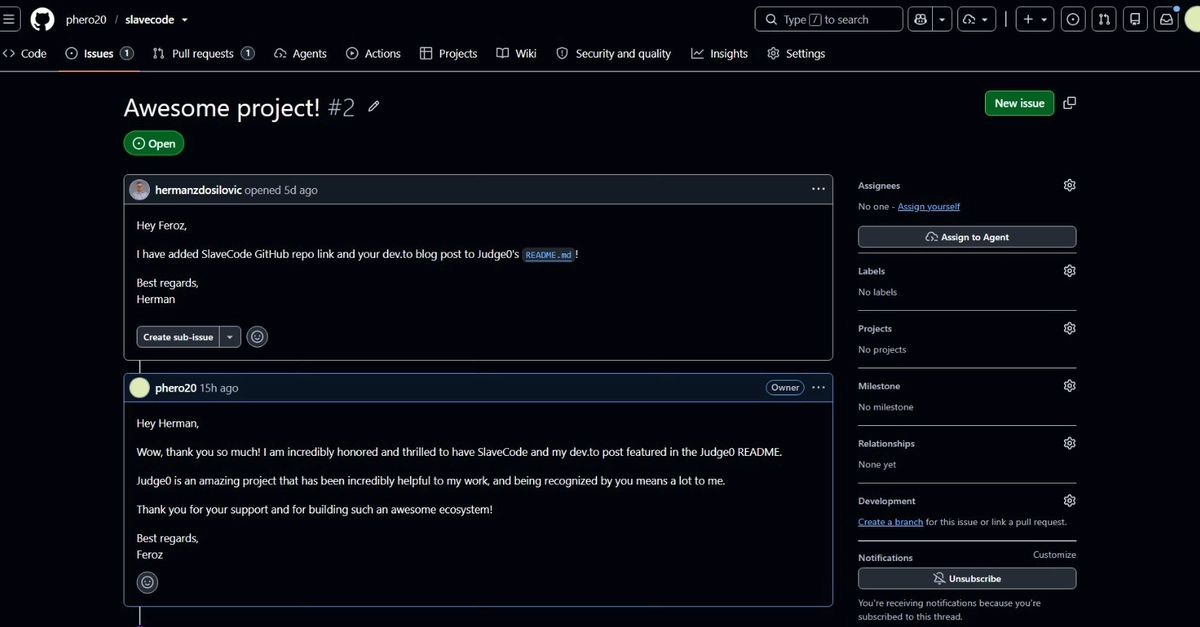
Judge0 Recognizes SlaveCode Integration
SlaveCode, a platform designed for efficient code execution, has achieved a notable milestone by being featured in the official repository of Judge0. Herman Zvonimir Došilović, the creator of Judge0, a widely adopted open-source code execution engine, formally acknowledged SlaveCode by adding its GitHub repository to the README.md file of Judge0. This inclusion signifies a critical endorsement and highlights the symbiotic relationship between the two projects.
Judge0 serves as a foundational component within SlaveCode's architecture, providing the robust infrastructure necessary for executing code snippets across a multitude of programming languages. The decision to integrate SlaveCode into Judge0's showcase is a testament to SlaveCode's utility and the value it brings to the developer community. This recognition from the creator of such a pivotal tool is more than just an acknowledgment; it represents a validation of SlaveCode's engineering and its contribution to the broader open-source landscape.
The decision to use Judge0 was driven by its comprehensive support for numerous programming languages, its performance capabilities, and its active community. For SlaveCode, having a reliable and scalable code execution engine is paramount. Judge0's architecture allows SlaveCode to offer a diverse range of language support to its users without needing to build and maintain individual execution environments for each language from scratch. This not only accelerates development but also ensures a higher degree of stability and security.
The Architecture of SlaveCode and Judge0
SlaveCode's primary function is to provide developers with a seamless environment for testing, running, and debugging code. At its core, the platform leverages Judge0's API to submit code for execution. Judge0, in turn, handles the compilation and execution of the submitted code within secure, isolated environments. This process is crucial for preventing interference between different code executions and for maintaining the integrity of the SlaveCode platform.
The integration process involved careful consideration of Judge0's API endpoints, data structures, and execution parameters. SlaveCode’s development team, led by Phero, focused on creating an abstraction layer that simplifies the interaction with Judge0. This layer allows SlaveCode to manage user requests, translate them into Judge0-compatible commands, and then process the results returned by Judge0. The feedback from Herman Zvonimir Došilović indicates that this integration has been implemented effectively, demonstrating a high degree of compatibility and adherence to best practices.
The surprising detail here is not merely that SlaveCode is integrated, but that Judge0's creator, Herman Zvonimir Došilović, took the initiative to personally review and showcase the SlaveCode repository. This proactive engagement from a prominent figure in the open-source community underscores the quality and potential of the SlaveCode project. It suggests that Judge0's ecosystem is not just a passive recipient of integrations but an active curator of valuable tools that leverage its capabilities.
SlaveCode's approach to code execution is designed to be flexible. Developers can submit code snippets, specify the programming language, and receive immediate feedback on execution results, including standard output, errors, and execution time. This rapid feedback loop is invaluable for iterative development and for catching bugs early in the development cycle. The underlying Judge0 engine ensures that these executions are performed efficiently, often within milliseconds, regardless of the complexity of the code or the language used.
Community and Future Implications
The inclusion of SlaveCode in Judge0's official repository is expected to increase the visibility of the SlaveCode project significantly. As Judge0 is a widely recognized tool, its showcase serves as a beacon for developers looking for innovative solutions that utilize its capabilities. This newfound visibility can attract more users, contributors, and potential collaborators to the SlaveCode project.
For developers who rely on Judge0 for their own projects, seeing SlaveCode featured provides a clear example of how Judge0 can be effectively integrated into a larger application. It can serve as a practical reference point, demonstrating best practices for API utilization and for building value-added services on top of the Judge0 engine. This can inspire new use cases and further innovation within the Judge0 ecosystem.
The open-source nature of both projects is a critical factor in their mutual success. SlaveCode's reliance on Judge0, and Judge0's openness to integrations, fosters a collaborative environment. This allows for continuous improvement, as feedback from users of SlaveCode can inform future development of Judge0, and vice versa. The proactive engagement from Herman Zvonimir Došilović suggests a commitment to nurturing this collaborative spirit.
Looking ahead, SlaveCode aims to expand its feature set, potentially incorporating more advanced debugging tools and performance profiling capabilities, all while continuing to leverage Judge0 for its execution backend. The recognition from the Judge0 creator is a powerful motivator and a strong indicator that SlaveCode is on the right track. If you're a developer looking for a streamlined way to execute and test code across various languages, exploring SlaveCode.codes and its integration with Judge0 is a logical next step.
The platform's success hinges on its ability to provide a reliable, fast, and versatile code execution environment. By integrating with a leading engine like Judge0, SlaveCode has solidified its position as a valuable tool for developers. The future looks bright for SlaveCode as it continues to grow and innovate within the open-source community.