The Promise and Peril of AI Agent Skills
AI agent skills offer a powerful way to automate and reuse complex instructions across various tasks, from code review and debugging to deployment and content generation. Instead of repeatedly pasting prompts, developers can package these workflows into readable SKILL.md files that agents can load when a task matches their defined purpose. This convenience streamlines workflows and enhances productivity. However, this ease of use introduces a new set of challenges. A seemingly polished and efficient skill can still be unsafe, vague, or impossible to verify, leading to unintended consequences and potential security risks. As these skills become more prevalent, establishing trust in their reliability and safety is paramount. Before adopting any third-party skill or even trusting one developed internally, a rigorous vetting process is essential.
1. Prioritize Discovery Over Immediate Action
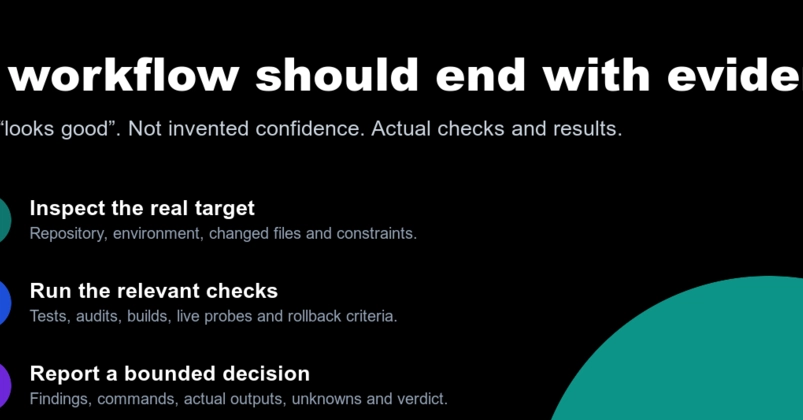
A fundamental characteristic of a trustworthy AI agent skill is its commitment to understanding the environment and the problem before attempting a solution. This means the skill should initiate a discovery phase rather than jumping directly to a guessed fix. For instance, when tasked with debugging a software issue, a reliable skill would first identify the specific repository and commit hash involved. It would then capture the exact failure, record the runtime environment and operating system, and crucially, reduce the failing input to its simplest form. Reproducing the bug reliably before making any code changes is a non-negotiable step. Similarly, for a deployment check, the skill must first identify the actual target platform, its configuration, and the current state before suggesting or executing any deployment actions. This investigative approach ensures that the agent is acting on accurate information, minimizing the risk of erroneous interventions.
2. Define Scope and Limitations Clearly
Beyond the initial discovery, a critical aspect of trust lies in understanding what an AI agent skill is designed to do and, perhaps more importantly, what it is not designed to do. Ambiguity in scope is a common pitfall that can lead to unexpected behavior. A well-defined skill will explicitly state its intended purpose, the types of problems it can address, and the boundaries of its operation. This includes specifying the programming languages, frameworks, or platforms it is compatible with. For example, a code review skill might be excellent for Python but completely unsuitable for Rust. Conversely, a content generation skill might be tailored for marketing copy and perform poorly on technical documentation. Users must be able to easily ascertain if a skill aligns with their specific needs. This clarity prevents users from applying a skill in a context where it is likely to fail or produce suboptimal results, fostering a more predictable and reliable interaction with AI agents.
3. Ensure Verifiability and Auditability
Trust is built on transparency, and AI agent skills are no exception. A skill that is a black box, where its decision-making process is opaque, breeds suspicion. Verifiable skills allow users to understand how a particular outcome was reached. This might involve logging the intermediate steps the agent took, the data it processed, and the reasoning behind its conclusions. For code-related skills, this could mean generating a diff that clearly shows the proposed changes and the justification for each alteration. For content skills, it might involve highlighting the specific AI-generated phrases or sections that were modified or added. Auditability is also key; being able to trace the actions of an agent skill after the fact is crucial for debugging, accountability, and continuous improvement. Skills that provide clear, human-readable logs or explanations of their actions are far more trustworthy than those that do not.
4. Implement Robust Safety and Validation Checks
The potential for AI agents to cause harm, whether through accidental data deletion, security vulnerabilities, or the propagation of misinformation, is significant. Therefore, any skill that interacts with sensitive systems or data must incorporate stringent safety and validation checks. This includes mechanisms to prevent destructive operations, such as requiring explicit confirmation before deleting files or modifying critical configurations. For skills that generate code or content, validation checks should ensure that the output conforms to established standards, security best practices, and stylistic guidelines. Think of it like a safety harness on a construction worker; it’s an essential layer that prevents catastrophic failure. If a skill proposes to make a significant change, it should ideally include a rollback mechanism or a clear revert path. The skill should also be designed to fail gracefully, alerting the user to potential issues rather than proceeding blindly.
5. Test for Edge Cases and Failure Modes
A skill that performs flawlessly under ideal conditions might crumble when faced with unexpected inputs or scenarios. Thorough testing, particularly for edge cases and potential failure modes, is indispensable. This involves deliberately probing the skill with unusual data, malformed inputs, or situations outside its primary design parameters. How does the skill react when it encounters an error it wasn't programmed to handle? Does it crash, provide a cryptic error message, or attempt to recover gracefully? A trustworthy skill will exhibit predictable behavior even when confronted with the unexpected. This might involve returning a clear error message indicating the limitation, or attempting a safe, non-destructive fallback operation. Developers should actively seek out or build skills that have undergone such rigorous testing, ensuring they are resilient and reliable in real-world, often messy, operational environments.
6. Consider the Source and Community Feedback
Finally, as with any software component, the origin and community reception of an AI agent skill provide valuable indicators of its trustworthiness. Is the skill developed by a reputable individual or organization? Is the code open-source, allowing for community inspection and contribution? Are there clear documentation and support channels available? Equally important is the feedback from other users. Has the skill been widely adopted and positively reviewed? Are there documented issues or complaints regarding its reliability, safety, or performance? A vibrant community around a skill often signifies active maintenance, prompt bug fixes, and a higher level of overall quality and trustworthiness. Conversely, a skill with limited adoption, poor reviews, or a lack of active development should be approached with extreme caution. The collective experience of other users can be an invaluable guide in assessing a skill's true utility and safety.