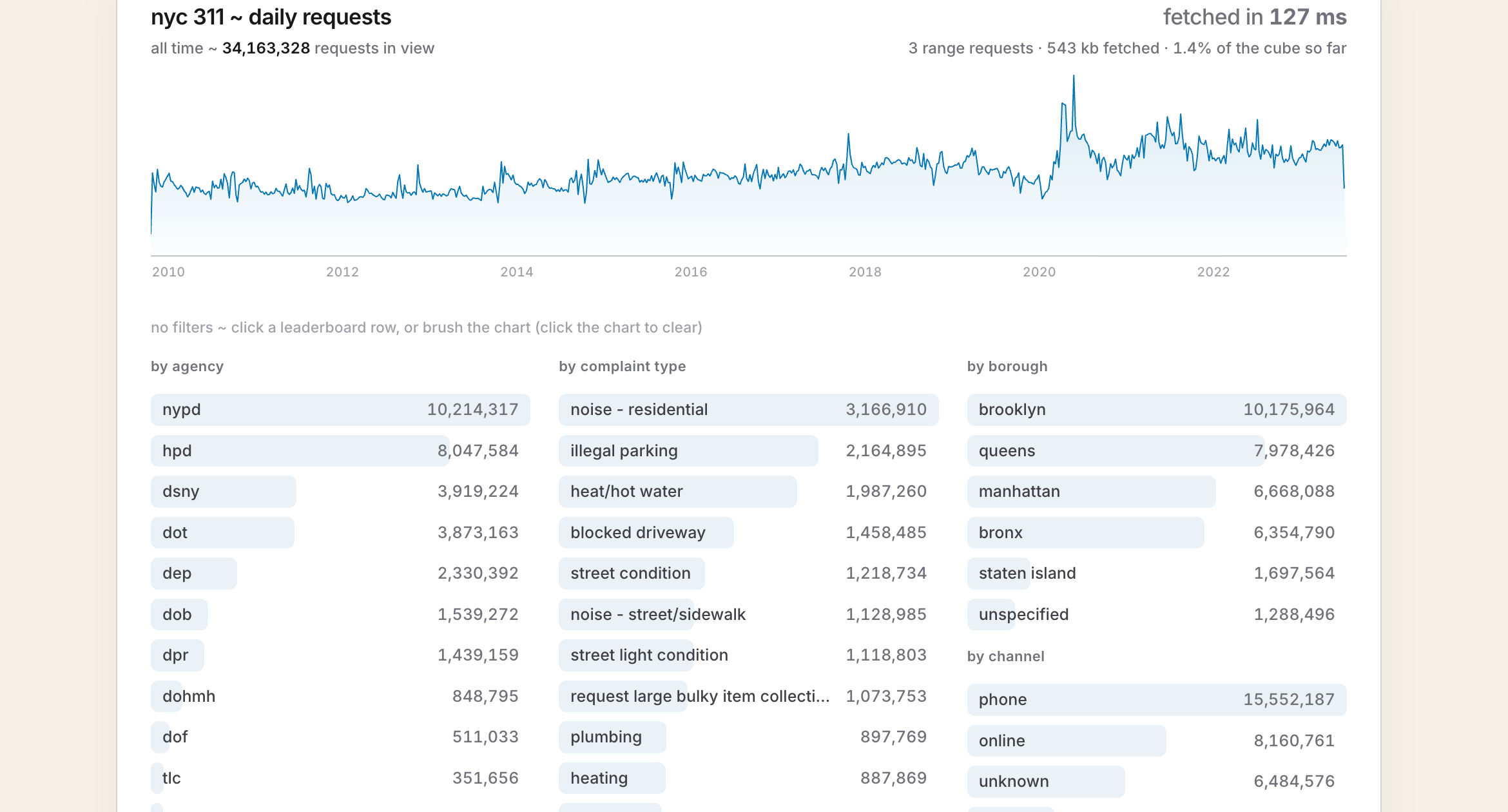
The Challenge of Interactive Dashboards
Traditional business intelligence and analytics workflows often involve complex ETL (Extract, Transform, Load) pipelines. Data is typically moved from its source into a data warehouse or data lake, then processed, aggregated, and indexed before it can be queried for dashboarding. This process can be time-consuming, resource-intensive, and introduce latency. For many organizations, especially smaller ones or those dealing with rapidly changing data, this overhead is a significant barrier to achieving timely insights. The need for fast, interactive drilldowns into data without the heavy infrastructure is a persistent challenge.
Consider a scenario where a marketing team needs to analyze campaign performance in near real-time. They might have terabytes of event data logged daily. Moving this data through a traditional BI stack could mean a delay of hours, if not days, between data generation and actionable insights. By the time the dashboard is ready, the campaign might have already shifted, making the analysis less relevant. This is where approaches that streamline the data path become critical.
Introducing the Single Parquet File Approach
A novel approach is emerging that bypasses much of this traditional complexity by leveraging the capabilities of the Parquet file format and modern query engines. The core idea is to store analytical data in a single, highly optimized Parquet file and query it directly, enabling fast drilldown dashboards. This sidesteps the need for a full-blown data warehouse or complex OLAP cubes for certain use cases.
Parquet is a columnar storage file format designed for efficient data compression and encoding schemes. Its columnar nature means that queries only need to read the specific columns required for analysis, drastically reducing I/O. When combined with techniques like predicate pushdown (filtering data at the storage level) and efficient indexing, Parquet files can offer surprisingly fast query performance, even on large datasets.
The key innovation lies not just in using Parquet, but in how it's structured and queried for interactive dashboarding. Instead of a multitude of smaller files or a distributed database, the data is consolidated into one, or a few, large, well-organized Parquet files. These files are then queried by engines optimized for this type of access, such as Apache Arrow, DuckDB, or even specialized libraries built on top of these.
How it Works: Key Components
Several components are essential for this pattern to be effective:
Data Preparation and Optimization
The process begins with preparing the data. This involves:
- Columnar Conversion: Ensuring data is converted into Parquet format.
- Schema Design: Designing a schema that is optimized for analytical queries. This might involve denormalization and careful selection of data types.
- Partitioning (within the file): While not traditional file-level partitioning, internal structures within the Parquet file can be organized to facilitate faster reads.
- Compression and Encoding: Applying appropriate compression (e.g., Snappy, Gzip) and encoding (e.g., dictionary encoding, run-length encoding) to minimize file size and improve read efficiency.
- Sorting: Sorting the data within the file by frequently filtered columns can significantly speed up predicate pushdown.
Query Engine and Execution
A performant query engine is crucial. Engines like DuckDB or Apache Arrow DataFusion are designed to query data directly from files like Parquet with high efficiency. They support:
- Predicate Pushdown: The engine pushes filter conditions down to the Parquet reader, allowing it to skip reading entire row groups or columns that do not match the filter criteria.
- Columnar Execution: Operations are performed on columns rather than rows, which aligns perfectly with the Parquet format.
- In-Memory Processing: Many of these engines leverage in-memory processing for speed, especially when dealing with datasets that can fit into available RAM.
- SQL Interface: Providing a familiar SQL interface makes it accessible to a wide range of analysts and developers.
Dashboarding Layer
The final piece is the dashboarding tool. Instead of connecting to a traditional database, the dashboarding tool or its backend connects directly to the Parquet file(s) via the chosen query engine. This could be a custom application, a BI tool with direct Parquet/Arrow support, or a serverless function querying the file.
The workflow looks like this: Data is generated -> Data is written to a single, optimized Parquet file -> A query engine reads directly from this file to serve dashboard requests.
Use Cases and Benefits
This pattern offers several compelling benefits:
- Simplicity: Drastically reduces infrastructure complexity. No need for a full-blown data warehouse, distributed file system management, or complex ETL orchestration for many scenarios.
- Cost-Effectiveness: Lower infrastructure costs due to reduced hardware and software needs.
- Speed: Enables very fast query performance for interactive dashboards, especially for datasets that are not astronomically large or when specific query patterns are known.
- Data Freshness: Data can be updated more frequently, potentially in near real-time, by simply rewriting the Parquet file.
- Developer Productivity: Easier for developers to set up and manage analytical capabilities.
This approach is particularly well-suited for:
- Customer-facing analytics platforms.
- Internal dashboards for startups or smaller teams.
- Ad-hoc data exploration where infrastructure setup is a bottleneck.
- Situations where data volume is manageable (tens to hundreds of GBs, or even low TBs depending on query patterns and hardware).
Limitations and Considerations
While powerful, this pattern is not a silver bullet. It has limitations:
- Concurrency: Handling high levels of concurrent read requests can be challenging compared to a dedicated database.
- Data Volume: Extremely large datasets (petabytes) or those requiring complex joins across many disparate tables might still necessitate a more traditional data warehousing solution.
- Data Updates: Frequent, granular updates to individual records within a Parquet file are inefficient. Rewriting the entire file or large portions of it is often necessary, making it better suited for append-heavy or batch-updated data.
- Schema Evolution: Managing schema evolution across very large, single files requires careful planning.
The surprising detail here is not the existence of Parquet or fast query engines, but the direct application of these technologies to replace entire data warehousing layers for interactive dashboarding. It challenges the long-held assumption that a robust data infrastructure is a prerequisite for performant analytics.
The Future of Data Access
This trend aligns with a broader movement towards simplifying data stacks and making powerful analytical capabilities more accessible. As query engines become more sophisticated and file formats like Parquet continue to evolve, we can expect to see more solutions that blur the lines between raw data storage and analytical processing. For many teams, the era of the monolithic data warehouse may not be over, but it is certainly being challenged by more agile, file-centric approaches.
If you are a founder or a developer looking to quickly spin up customer-facing analytics or internal dashboards without a massive infrastructure investment, exploring tools that leverage DuckDB or Arrow DataFusion with Parquet files is a highly practical next step.