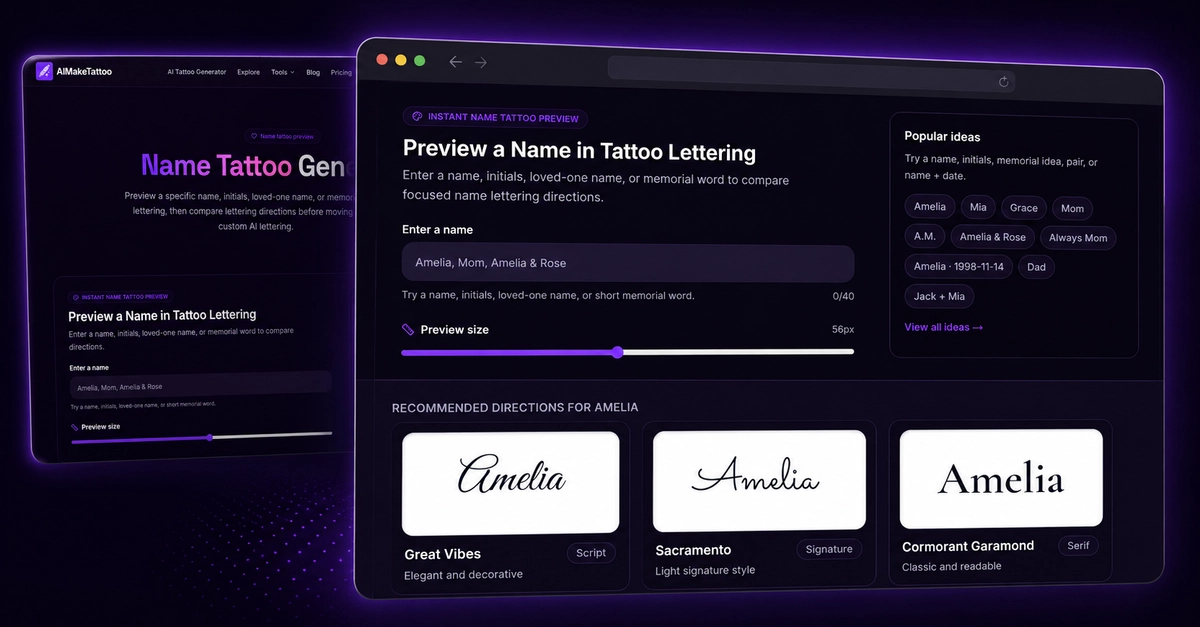
The Problem: Diverse User Inputs, One Tool
Rebuilding a name tattoo tool presented a familiar challenge: how to handle varied user text inputs. Initially, the tool treated all input the same: text string goes in, a set of lettering styles comes out. This works for straightforward names like Emma. However, the reality of user input is far more complex. Consider these examples:
EmmaA.M.Jack + MiaAmelia · 1998-11-14Anna-MarieForever Dad
Presenting the same lettering style recommendations for each of these disparate inputs felt insufficient. The developer recognized a need to classify these inputs to offer more tailored suggestions.
The Initial AI Hypothesis
The immediate instinct for many developers, including the author, would be to leverage AI. Given the prevalence of AI tools and the author's existing use of AI elsewhere in the product, integrating another AI model call for input classification seemed like a straightforward solution. The thought process was: input text goes into an LLM, the LLM classifies it, and then the tool presents styles based on that classification. This approach aligns with the current trend of applying machine learning to solve classification problems, especially those involving natural language.
The Tiny Classification Problem Revealed
However, a deeper dive into the actual requirements revealed a critical insight. Instead of abstractly thinking about 'user input classification,' the developer listed the specific cases they needed to handle. This granular approach uncovered that the problem was not a broad, ambiguous classification task, but rather a small, well-defined set of distinct input types. The variety, while present, fell into predictable patterns that didn't necessitate the complexity or overhead of a full AI model.
Defining the Rules: A More Direct Approach
The developer identified several key categories of input:
- Simple Names: Single words, like
Emma. - Initials: Short strings, often with periods, like
A.M.. - Paired Names/Phrases: Indicating multiple entities, potentially with conjunctions or symbols, like
Jack + MiaorForever Dad. - Names with Dates/Additional Info: Strings containing names alongside specific dates or other contextual data, like
Amelia · 1998-11-14. - Compound Names: Hyphenated names, like
Anna-Marie.
For each of these categories, the developer could define simple, explicit rules. For instance:
- If the input contains a '+' or '&' symbol, classify it as a paired name.
- If the input contains a date format (e.g., YYYY-MM-DD, MM/DD/YYYY), classify it as a name with additional info.
- If the input contains only uppercase letters and periods, and is short (e.g., 2-5 characters), classify it as initials.
- If the input contains a hyphen, classify it as a compound name.
- If none of the above apply and the input is a single word, classify it as a simple name.
These rules are deterministic and easy to implement using standard string manipulation and regular expressions. They directly address the observed variations without the need for probabilistic models.
Why Rules Trumped AI Here
The decision to opt for simple rules over AI was driven by several practical considerations:
Simplicity and Maintainability: Hand-coded rules are transparent and easy to understand, debug, and modify. Developers can quickly see why a specific input was classified a certain way and adjust the logic as needed. AI models, especially LLMs, can be opaque 'black boxes,' making troubleshooting more challenging.
Performance and Cost: Running an AI model, even a small one, incurs computational overhead and potentially monetary costs (API calls, hosting). Simple string matching and regular expressions are significantly faster and cheaper to execute, especially for high-volume operations. For a tool that might be used frequently, this performance difference can be substantial.
Accuracy for Well-Defined Problems: When a classification problem can be precisely defined with clear boundaries, as this one was, rule-based systems can achieve 100% accuracy. AI models are probabilistic and may introduce errors or require extensive fine-tuning to reach comparable accuracy on narrow tasks.
Development Speed: For this specific problem, defining and implementing the rules was likely faster than setting up, configuring, and testing an AI model. The developer could see the immediate impact of their code changes.
The Unanswered Question: When is AI Truly Necessary?
This experience raises a broader question for developers: when does the complexity of user input or a classification task genuinely warrant the use of AI? While AI excels at handling ambiguity, nuance, and vast, unstructured datasets, this case highlights that not every problem benefits from an AI-first approach. The danger lies in applying complex solutions to simple problems, leading to increased development time, maintenance overhead, and potential performance issues. Developers must critically assess whether the problem domain truly requires the probabilistic power of AI or if deterministic, rule-based logic can provide a more efficient and effective solution. This scenario suggests a need for a more discerning application of AI, prioritizing explicit logic when it offers a clear advantage.
Broader Implications for Developers
This anecdote serves as a valuable reminder for developers to avoid the allure of AI as a default solution. Before reaching for a sophisticated ML model, it’s crucial to first scope the problem thoroughly. Listing out the specific cases, understanding the input variations, and considering the desired output can often reveal that a simpler, more direct approach, like rule-based classification, is not only sufficient but superior. This principle applies across various domains, from input validation and data processing to simple content moderation. Prioritizing clarity, performance, and maintainability with well-defined rules can lead to more robust and efficient software, reserving AI for the complex, ambiguous tasks where it truly shines.