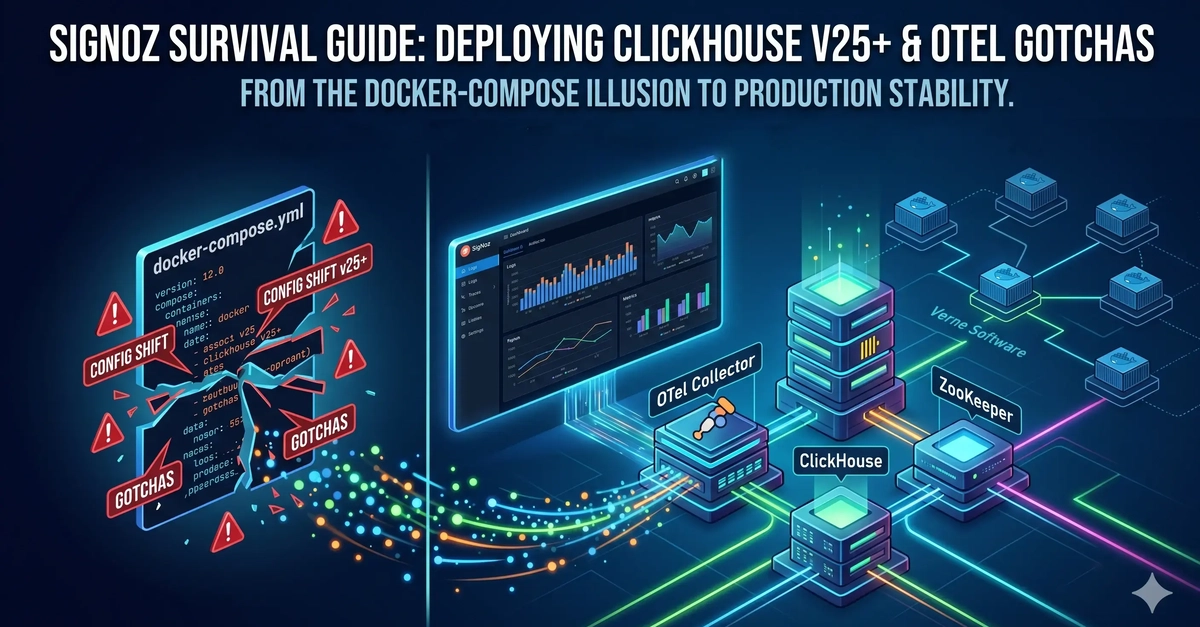
The Promise vs. The Reality of Self-Hosting SigNoz
In the modern B2B SaaS landscape, robust observability is not an option—it's a fundamental requirement for survival. Whether managing distributed cron jobs, processing high volumes of webhook deliveries, or overseeing intricate microservice architectures, understanding internal operations is paramount. Verne Software's experience architecting its infrastructure led to a strategic decision: complete control over telemetry data through self-hosting SigNoz.
The allure of SigNoz is its promise of a straightforward deployment. The official repository suggests a simple docker-compose up command, implying a quick setup that allows developers to return to core business logic. However, this streamlined view often overlooks the rapid evolution of underlying technologies, particularly major architectural shifts in Docker images and their dependencies. What appears to be a ten-minute setup can quickly devolve into an extensive investigation into the finer points of configuration and compatibility.
The official documentation, while a valuable starting point, frequently lags behind the bleeding edge of architectural changes. This gap means that a seemingly simple deployment can become a complex undertaking, requiring developers to go far beyond the basic instructions. This guide focuses on the critical considerations for successfully deploying and managing SigNoz in 2026, specifically addressing the complexities introduced by ClickHouse v25+ and nuanced OpenTelemetry (OTel) configurations.
Navigating ClickHouse v25+ Dependencies
By 2026, SigNoz deployments will almost certainly rely on ClickHouse v25 or later. This version introduces significant architectural changes and new features that directly impact SigNoz's performance and stability. The default Docker images provided by SigNoz may not immediately support the latest ClickHouse versions, necessitating manual image building or the use of specific, pre-release, or custom-built ClickHouse images.
Key areas of concern with ClickHouse v25+ include:
- Storage Engine Changes: Newer ClickHouse versions might deprecate or alter default storage engines. SigNoz's data model and query patterns are optimized for specific ClickHouse configurations. Incompatibilities can lead to performance degradation, data corruption, or outright failures. Understanding the new default engine (e.g., MergeTree variations) and ensuring SigNoz's schema and queries are compatible is crucial.
- Query Performance Tuning: ClickHouse v25+ may introduce new query planning mechanisms or change the behavior of existing ones. Default SigNoz query templates might not leverage these new optimizations, leading to slower trace, metric, and log aggregation. This requires deep analysis of query execution plans and potential modifications to SigNoz's internal query structures.
- Configuration Parameters: ClickHouse configuration files (
config.xml,users.xml) are extensive. Newer versions often introduce new parameters or deprecate old ones. SigNoz's default configuration might not be optimal or even valid for v25+, requiring careful review and adjustment of memory allocation, network settings, and replication configurations. - Data Ingestion Rates: As ClickHouse evolves, its ingestion capabilities may change. Ensuring that SigNoz's data producers can keep pace with ClickHouse's latest ingestion throughput capabilities, and that ClickHouse is configured to handle these rates efficiently, is vital. This involves understanding buffer settings, compression codecs, and parallel processing capabilities.
Deploying SigNoz with ClickHouse v25+ requires a proactive approach. It is not uncommon to need to compile custom Docker images for both ClickHouse and potentially SigNoz itself to ensure seamless integration. This deviates significantly from the "one-click" setup and demands a higher level of Kubernetes or Docker expertise.
OpenTelemetry (OTel) Configuration Gotchas
OpenTelemetry is the backbone of SigNoz's data collection. While OTel has matured significantly, its configuration remains a common source of deployment friction, especially in complex, production environments. By 2026, OTel SDKs and the OTel Collector will have undergone numerous updates, introducing new features, deprecating old ones, and altering best practices.
Potential OTel gotchas include:
- SDK Version Compatibility: Different services within a distributed system might use varying versions of OTel SDKs. These versions must be compatible with the OTel Collector version deployed by SigNoz. Incompatibilities can manifest as dropped telemetry data, malformed spans, or unexpected errors during export. Ensuring a consistent and compatible set of SDKs across all instrumented applications is paramount.
- Collector Configuration Complexity: The OTel Collector is incredibly powerful but also notoriously complex. Its configuration involves multiple components: receivers, processors, exporters, and extensions. Default SigNoz Collector configurations are often basic. For production, you'll likely need to customize processors for batching, retries, data sampling, filtering, and attribute manipulation. For instance, implementing efficient data sampling strategies can drastically reduce the volume of data sent to ClickHouse, managing costs and performance.
- Resource Detection and Auto-Instrumentation: While auto-instrumentation simplifies getting started, it can lead to performance overhead or miss critical instrumentation points if not configured correctly. Understanding how OTel detects resources (e.g., Kubernetes pod names, container IDs) and ensuring accurate metadata is attached to telemetry is vital for effective correlation and troubleshooting.
- Protocol and Format Standards: OTel supports multiple protocols (gRPC, HTTP) and data formats (OTLP, Prometheus, Jaeger). Ensuring that all telemetry sources, the OTel Collector, and SigNoz's backend are speaking the same protocol and using compatible formats is essential. Misconfigurations here can lead to data not appearing in SigNoz at all.
- Security and Authentication: Securing the telemetry pipeline is critical. This involves configuring TLS for OTLP endpoints, implementing authentication mechanisms for telemetry sources sending data to the Collector, and ensuring the Collector itself is securely configured.
The OTel Collector's flexibility means that a deep understanding of its configuration language (YAML) and the capabilities of each component is necessary. Debugging OTel Collector issues often involves intricate log analysis and potentially running the Collector in debug mode.
Beyond `docker-compose up`: Production-Ready Deployments
For any serious production deployment in 2026, relying solely on docker-compose is insufficient. Modern infrastructure demands more robust orchestration, scaling, and management capabilities. Kubernetes has become the de facto standard, and SigNoz deployments should leverage its features.
Key considerations for production deployments include:
- Kubernetes Operator: If a SigNoz Kubernetes Operator becomes available and mature, it will be the preferred deployment method. Operators abstract away much of the complexity of managing stateful applications like SigNoz and ClickHouse on Kubernetes, handling updates, scaling, and configuration management automatically.
- Helm Charts: In the absence of a fully mature operator, well-maintained Helm charts are the next best option. They provide templated configurations for deploying SigNoz components, ClickHouse, and associated services (like Kafka if used for buffering) in a Kubernetes environment. Customizing these charts for specific ClickHouse versions and OTel Collector configurations is still necessary.
- Scalability and High Availability: For production, SigNoz and its components must be highly available and scalable. This involves configuring ClickHouse for replication and sharding, potentially using a message queue like Kafka or Pulsar for buffering between the OTel Collector and ClickHouse, and ensuring SigNoz's query engine can handle the load.
- Monitoring the Monitor: It's a classic DevOps paradox: how do you monitor your monitoring system? You need a separate, independent observability stack (perhaps a smaller instance of SigNoz, or a different tool) to monitor the health, performance, and resource utilization of your primary SigNoz deployment. Alerting on ClickHouse query failures, OTel Collector errors, and SigNoz API latency becomes critical.
- Cost Management: Storing large volumes of telemetry data incurs significant storage and compute costs. Implementing effective data retention policies, downsampling, and sampling strategies within the OTel Collector and ClickHouse is essential for managing expenses.
The journey from a simple Docker Compose setup to a resilient, scalable SigNoz deployment is substantial. It requires a firm grasp of distributed systems, database management (specifically ClickHouse), and the intricate ecosystem of OpenTelemetry.
The Unanswered Question: Long-Term ClickHouse Compatibility
While this guide addresses the immediate challenges of deploying SigNoz with ClickHouse v25+, a larger question looms: how will SigNoz maintain compatibility with ClickHouse's rapid development cycle long-term? ClickHouse is a powerful, fast-moving project. As it introduces breaking changes or fundamentally alters its architecture, SigNoz will need to adapt quickly. The current model, where SigNoz's official releases might lag behind ClickHouse's latest stable versions, creates an ongoing challenge for self-hosting users who want to leverage the newest database features or security patches. This dependency creates a continuous need for vigilance and potential custom integration work, a reality that users must factor into their operational overhead.