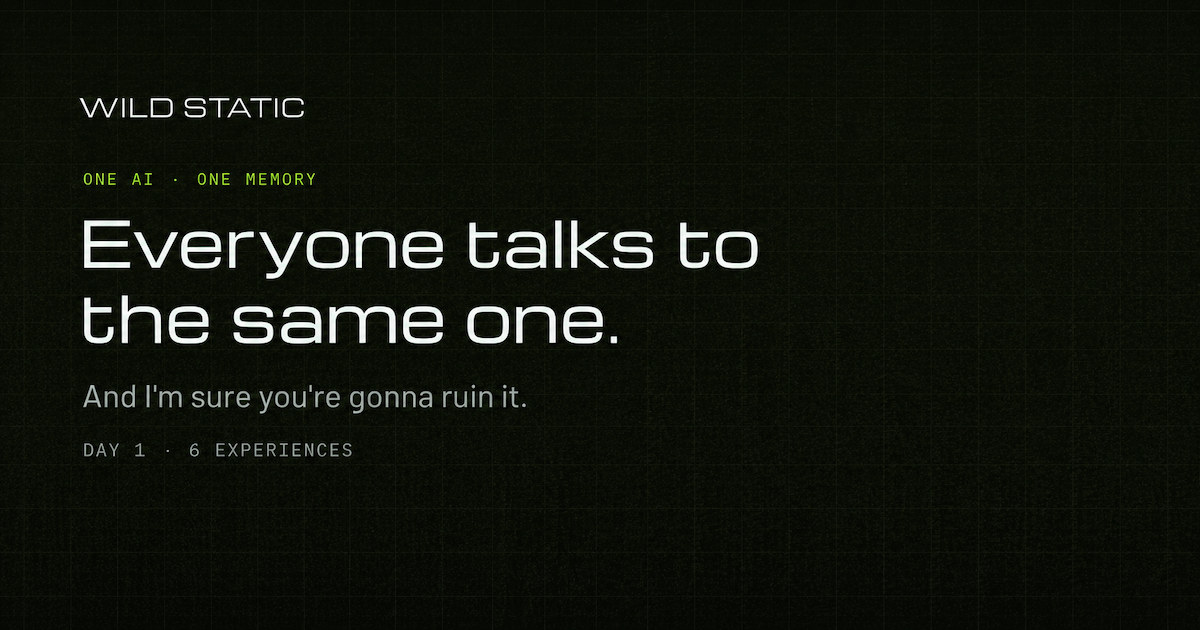
Introducing a Collective AI Intelligence
A new AI project, presented on Hacker News as a "Show HN," introduces a novel concept: an artificial intelligence whose memory is not confined to individual conversations but is shared and persistent across all its users. This means that every interaction, every piece of information learned, contributes to a single, evolving knowledge base that every user can access and build upon. The implications for how we interact with and develop AI are significant.
Unlike traditional chatbots or personal AI assistants that operate in isolated sessions, this AI remembers previous interactions with other users. This creates a truly collaborative intelligence, where the collective experience of all users shapes the AI's understanding and responses. Think of it less like a private journal and more like a shared, living encyclopedia that learns from every entry and every reader's feedback, instantly and perpetually.
How It Works: Shared Memory Architecture
The core innovation lies in its memory architecture. While specific technical details are sparse in the initial announcement, the premise is that user interactions are not discarded after a session. Instead, they are processed and integrated into a central memory store. This store then informs future responses and learning for all subsequent users. This approach fundamentally alters the AI's learning dynamic, moving from a model trained on static datasets to one that learns continuously from real-time, collective human input.
The potential benefits are substantial. For users, this means a richer, more context-aware AI that can draw on a vast, shared history of interactions. A question asked by one user could be answered by the AI based on information or context provided by a completely different user days or weeks prior. This creates a powerful network effect for knowledge acquisition and problem-solving. For developers, it presents an opportunity to build applications that leverage this shared, persistent memory, creating more sophisticated and contextually aware AI experiences.
Potential Applications and Use Cases
The possibilities for an AI with shared, persistent memory are vast and span numerous domains. In education, it could function as a continuously updated, interactive textbook where student questions and insights enrich the learning material for everyone. In research, it could serve as a collaborative knowledge-building tool, where researchers contribute findings and query a system that remembers and synthesizes all prior contributions.
For creative endeavors, imagine an AI that remembers stylistic preferences or plot points established in previous creative sessions, assisting writers, artists, or game designers with a consistent, context-aware collaborator. Customer support could be revolutionized, with an AI that remembers common issues and their solutions across all customer interactions, leading to faster and more accurate support.
The shared memory model also opens doors for more sophisticated AI agents that can maintain long-term goals and context across multiple user interactions, enabling more complex task completion and personalized assistance over time. This is not just about remembering what you said; it's about remembering what everyone has said and learned, and applying that collective wisdom to your current query.
Challenges and Considerations
Despite the exciting potential, this approach also presents significant challenges. The most immediate concern is data privacy and security. How is user data anonymized and protected when it contributes to a shared memory? What safeguards are in place to prevent malicious actors from polluting the AI's memory with misinformation or harmful content? The team behind the project will need robust mechanisms for content moderation, data sanitization, and user consent management.
Scalability is another major hurdle. As the shared memory grows with every interaction, the computational resources required to store, retrieve, and process this information will increase exponentially. Efficient indexing, retrieval, and updating mechanisms will be critical for maintaining performance. Furthermore, the potential for bias amplification is a serious consideration. If a significant portion of users exhibit biased behavior or knowledge, this bias could become deeply embedded in the AI's shared memory, affecting all users.
The question of how to handle conflicting information or evolving knowledge within the shared memory also needs careful consideration. If one user provides information that is later proven incorrect by another, how does the AI resolve this conflict? Does it prioritize newer information, more frequently corroborated information, or employ a more nuanced approach? These are not trivial problems and will require sophisticated algorithms and ongoing human oversight.
The Future of Collective AI
This project represents a fascinating step towards a more collaborative and emergent form of artificial intelligence. By moving beyond individual, ephemeral conversations, it taps into the power of collective human knowledge and experience. If the developers can successfully navigate the significant technical and ethical challenges, this shared memory model could pave the way for AI systems that are not just tools, but true partners in learning, creation, and problem-solving.
What nobody has addressed yet is what happens to the AI's Referenced Sources