The Rise of AI-Generated Content on Hacker News
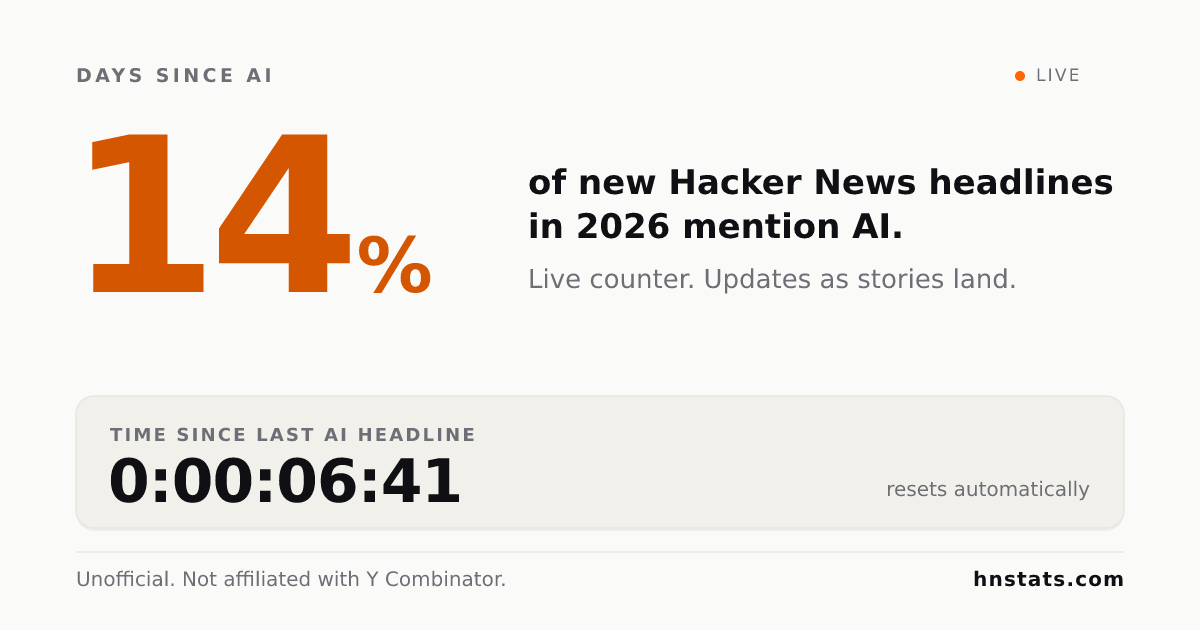
A recent "Show HN" post on Hacker News has brought to light a surprising and potentially concerning trend: the increasing presence of AI-generated content on the platform. The analysis, conducted by a user who goes by the handle 'ai_stats_user', suggests that approximately 15% of all submissions to Hacker News may be machine-generated. This figure, while an estimate, points to a broader shift in content creation and distribution, where artificial intelligence is rapidly becoming a tool for generating articles, blog posts, and even code snippets that are then shared on developer-focused platforms.
The methodology behind the analysis involved examining a large dataset of Hacker News submissions, looking for patterns indicative of AI authorship. While the exact techniques used are not fully detailed in the initial post, they likely include checks for linguistic anomalies, predictable sentence structures, and the absence of unique human insights or experiences. The goal was to identify content that, while potentially informative, lacks the distinct voice and perspective typically associated with human authors. This trend is not unique to Hacker News; similar observations have been made across various online platforms where content is king, and the ability to rapidly produce large volumes of text is a significant advantage.
The implications of this AI-driven content surge are multifaceted. For developers and tech enthusiasts who frequent Hacker News, it raises questions about the authenticity and value of the information they consume. If a substantial portion of the content is machine-generated, it could dilute the signal-to-noise ratio, making it harder to find genuinely insightful discussions and original ideas. It also presents a challenge to the community's ethos, which has historically valued human expertise and firsthand experience.
The analysis is particularly relevant in the current landscape where AI models like GPT-3, GPT-4, and others have become incredibly adept at producing human-like text. These models can be fine-tuned to mimic specific writing styles or to generate content on virtually any topic with remarkable speed and coherence. This accessibility means that individuals, or even automated systems, can generate a vast amount of content with minimal effort, potentially flooding platforms with low-quality or repetitive material.
What Constitutes AI-Generated Content?
Defining what constitutes "AI-generated content" is crucial for understanding the scope of this issue. In the context of Hacker News, it likely refers to articles or posts primarily authored by large language models (LLMs) without significant human editing or original input. This can range from articles that are direct outputs of prompts fed into an AI, to more sophisticated pieces where AI is used as a co-author or research assistant. The challenge lies in distinguishing between content that is genuinely helpful, even if AI-assisted, and content that is merely produced for the sake of quantity or to game platform algorithms.
The 'ai_stats_user' post highlights that identifying AI-generated content is not a perfect science. There is a spectrum of AI involvement, from fully automated creation to human-curated AI outputs. The 15% figure is an estimate, and the true number could be higher or lower depending on the strictness of the criteria applied. However, even as an estimate, it serves as a strong indicator that AI is becoming a significant contributor to the content ecosystem on platforms like Hacker News.
One of the key concerns is that AI-generated content, if not properly disclosed or curated, can mislead readers. It might present information as factual or expert opinion when it is merely a synthesis of existing data, potentially lacking the critical analysis or novel insights that human experts provide. For a community like Hacker News, which thrives on in-depth technical discussions and the sharing of cutting-edge ideas, the influx of unverified or superficial AI content could undermine its core value proposition.
Consider it this way: imagine a library where a significant portion of the books are now written by an automated system that has read all the other books. While some of these new books might be well-written and informative, they might also lack the unique voice, personal experience, or groundbreaking new ideas that come from human authors who have lived and felt the subjects they write about. The danger is that these AI-generated texts could become so ubiquitous that they start to overshadow the human-authored works, changing the character of the library itself.
Referenced Sources
- verified