
Automated CUDA Kernel Optimization with AI Agents
A new open-source project, dubbed the Agentic CUDA Kernel Optimizer, aims to automate the complex and time-consuming task of optimizing CUDA kernels for NVIDIA GPUs. Developed by Bertaye, this tool leverages AI agents to explore the vast search space of kernel parameters, aiming to discover configurations that yield significant performance improvements. Traditional CUDA optimization often requires deep expertise, extensive manual profiling, and iterative testing, making it a bottleneck for many developers and researchers looking to maximize their GPU's potential.
The core idea behind the Agentic CUDA Kernel Optimizer is to treat the optimization process itself as an agentic task. Instead of a human manually tweaking parameters like block size, shared memory usage, and register allocation, AI agents are deployed to systematically explore these options. These agents can learn from previous optimization attempts, adapt their strategies based on observed performance metrics, and converge on more optimal solutions faster than brute-force or purely random search methods.
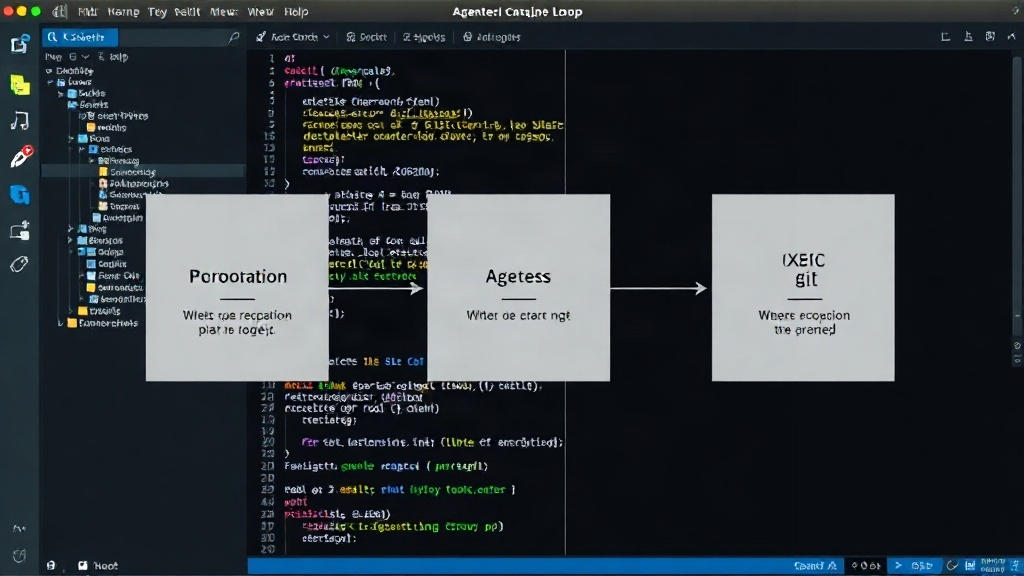
How the Agentic Optimizer Works
The optimizer operates through a loop that involves several key components:
- Kernel Representation: The CUDA kernel is parsed and represented in a format that the agents can understand and manipulate. This might involve abstracting away specific code details while retaining the parameters that affect performance.
- Parameter Space Exploration: The agents define and explore a multi-dimensional parameter space. Each dimension corresponds to a tunable aspect of the CUDA kernel, such as thread block dimensions (e.g., `blockDim.x`, `blockDim.y`), shared memory configurations, register usage, and loop unrolling factors.
- Performance Profiling: For each set of explored parameters, the optimizer compiles and runs the kernel on the target GPU. It then profiles the execution time, memory bandwidth, occupancy, and other relevant metrics using tools like NVIDIA's Nsight Compute or nvprof.
- Agentic Decision Making: Based on the profiling results, the AI agents make decisions about which parameters to adjust next. This could involve techniques like reinforcement learning, evolutionary algorithms, or Bayesian optimization, where agents learn to prioritize promising regions of the parameter space and avoid redundant exploration.
- Iterative Refinement: The process repeats, with agents iteratively refining the kernel parameters. The goal is to converge towards a configuration that achieves the best balance of performance metrics for the specific kernel and hardware.
The project's GitHub repository provides the source code and instructions for users to integrate their own CUDA kernels into the optimization framework. While the initial release focuses on demonstrating the concept, the underlying architecture is designed to be extensible, allowing for the integration of more sophisticated AI models and profiling techniques.
Potential Impact and Use Cases
The Agentic CUDA Kernel Optimizer has the potential to democratize GPU optimization. Developers working on high-performance computing (HPC) applications, deep learning frameworks, scientific simulations, and graphics rendering often spend considerable time fine-tuning their CUDA code. This tool could significantly reduce that overhead, enabling faster iteration cycles and unlocking performance gains that might otherwise be missed.
For instance, a researcher developing a novel scientific simulation might use this tool to automatically find the optimal thread block size for their core computation kernels, potentially speeding up simulations by double-digit percentages without requiring them to become CUDA optimization experts. Similarly, a deep learning framework developer could use it to optimize the performance of fundamental operations like matrix multiplication or convolution, benefiting all users of the framework.
The surprising detail here is not the existence of automated optimization tools, but the application of *agentic* AI models to this problem. Previous approaches often relied on predefined search heuristics or manual tuning. By employing agents that can learn and adapt their search strategy, this tool promises a more intelligent and potentially more efficient exploration of the optimization landscape. It moves beyond simply trying combinations to actively learning how to find the best combinations.
Challenges and Future Directions
Despite its promise, the Agentic CUDA Kernel Optimizer faces several challenges. The effectiveness of the optimization is highly dependent on the quality of the parameter space definition and the sophistication of the AI agents. Exploring an enormous parameter space can still be computationally intensive, requiring significant GPU time for profiling. Furthermore, optimizing for one specific GPU architecture might not translate directly to optimal performance on another, necessitating architecture-specific tuning.
Future development could focus on several areas:
- Broader Hardware Support: Extending support beyond NVIDIA GPUs to other architectures like AMD ROCm.
- Advanced AI Models: Incorporating more advanced reinforcement learning or meta-learning techniques for faster convergence and better generalization.
- Automated Kernel Generation: Moving beyond parameter tuning to automatically generate optimized kernel code variations.
- Integration with ML Frameworks: Developing plugins or direct integrations with popular deep learning and HPC frameworks.
The project is currently open-source on GitHub, inviting contributions and feedback from the community. The journey from a 'Show HN' post to a widely adopted optimization tool will depend on its ability to deliver tangible performance gains and ease of use for a broad range of CUDA applications.