The Problem: Overwhelmed E-commerce Support
A Shopify store faced a significant challenge: approximately 150 support messages per week, with a staggering 80% of them revolving around the same 10 recurring questions. This volume of repetitive inquiries consumed over 20 hours of the support team's weekly capacity, leading to slow response times, increased operational costs, and team burnout. The client needed a scalable solution to handle these common queries efficiently.
The core issue was not the total number of tickets, but the high proportion of identical, easily answerable questions. This inefficiency directly impacted customer satisfaction and the bottom line. Addressing this bottleneck required an automated system capable of understanding and responding to common customer needs without human intervention.
The Solution: An AI-Powered Chatbot Stack
To tackle this problem, a custom AI chatbot was developed, leveraging a combination of modern AI and web technologies. The primary engine for natural language understanding and response generation was OpenAI's GPT-4 API. This powerful large language model (LLM) provided the intelligence needed to interpret customer queries and formulate accurate, context-aware answers.
The backend infrastructure was built using Node.js and the Express.js framework, providing a robust and scalable environment for the chatbot's operations. Crucially, the Shopify REST API was integrated to allow the chatbot to access live, real-time data from the store. This integration was key to providing dynamic and personalized support, moving beyond static, pre-programmed responses.
Workflow automation was handled by n8n, an open-source tool that facilitated the orchestration of different API calls and logic flows. This allowed for complex processes, such as fetching order details or product information, to be managed seamlessly. The entire system was designed to act as a first line of defense, intercepting common questions and providing immediate resolutions.
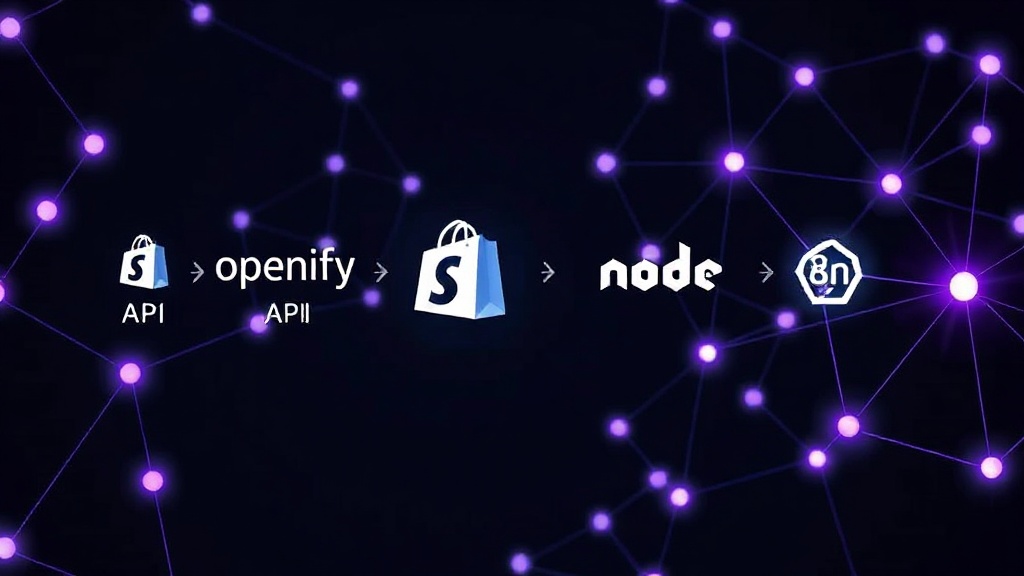
Key Technologies and Integrations
The choice of technology was deliberate, aiming for efficiency, scalability, and the ability to provide rich, contextual support. OpenAI's GPT-4 was selected for its advanced reasoning and generation capabilities, enabling it to handle a wide range of customer inquiries. The ability of GPT-4 to understand nuanced language and generate human-like text was paramount.
Node.js and Express.js provided the lightweight and efficient server-side environment necessary to handle API requests from Shopify and responses from OpenAI. This stack is well-suited for real-time applications and microservices, making it an ideal choice for an interactive chatbot.
The Shopify REST API integration was perhaps the most critical component for enhancing the chatbot's utility. Instead of relying solely on a knowledge base, the chatbot could query live order status, shipping information, product availability, and more. This meant that if a customer asked, "Where is my order?" the chatbot could fetch the exact tracking number and status directly from Shopify and present it to the user instantly.
n8n served as the connective tissue, enabling the developer to define workflows that triggered actions based on incoming messages. For example, a workflow could be set up to: 1. Receive a customer query. 2. Identify keywords indicating an order status request. 3. Use the Shopify API to retrieve order details based on customer-provided information (like order ID). 4. Pass this information to GPT-4 to craft a polite, informative response. 5. Deliver the response to the customer.
The Results: Quantifiable Improvements
The implementation of the AI chatbot yielded dramatic improvements across key customer support metrics. Before the chatbot, only about 20% of tickets were resolved without human intervention. After deployment, this figure surged to over 80%.
The average response time plummeted from 4 hours to virtually instant. This rapid turnaround significantly enhances customer experience, addressing the common frustration of long wait times for support.
Financially, the impact was equally profound. The monthly support cost, which was around $1,200 prior to the chatbot, dropped to approximately $200. This represents an 83% reduction in operational expenses for customer support, freeing up significant capital and resources for the business.
| Metric | Before Chatbot | After Chatbot |
|---|---|---|
| Tickets resolved without human | 20% | 80%+ |
| Avg response time | 4 hours | Instant |
| Monthly support cost | $1,200 | ~$200 |
Lessons Learned: Context and Trust
The most significant learning from this project is the critical importance of context. A chatbot that can access and utilize live data, such as order status or product inventory, is exponentially more effective than one limited to static information. This live data integration transforms the chatbot from a simple FAQ reader into a functional assistant that can perform real-time lookups and provide personalized information.
Another crucial takeaway is the necessity of building an "escape hatch" or escalation path. Customers need to trust that they can reach a human agent if the chatbot cannot resolve their issue or if the situation is complex. Implementing a clear and accessible flow for escalating conversations to human support agents builds this trust and ensures that no customer is left without adequate assistance. This layered approach, where the AI handles the bulk of common queries and humans manage exceptions, proved highly effective.
Finally, the developer emphasized that effective prompt engineering is more critical than often assumed. The way queries are framed for GPT-4 directly influences the quality and accuracy of the responses. Carefully crafted prompts ensure that the LLM understands the user's intent, accesses the correct data, and generates a helpful and appropriate answer. This highlights the human element still required in designing and maintaining sophisticated AI systems.