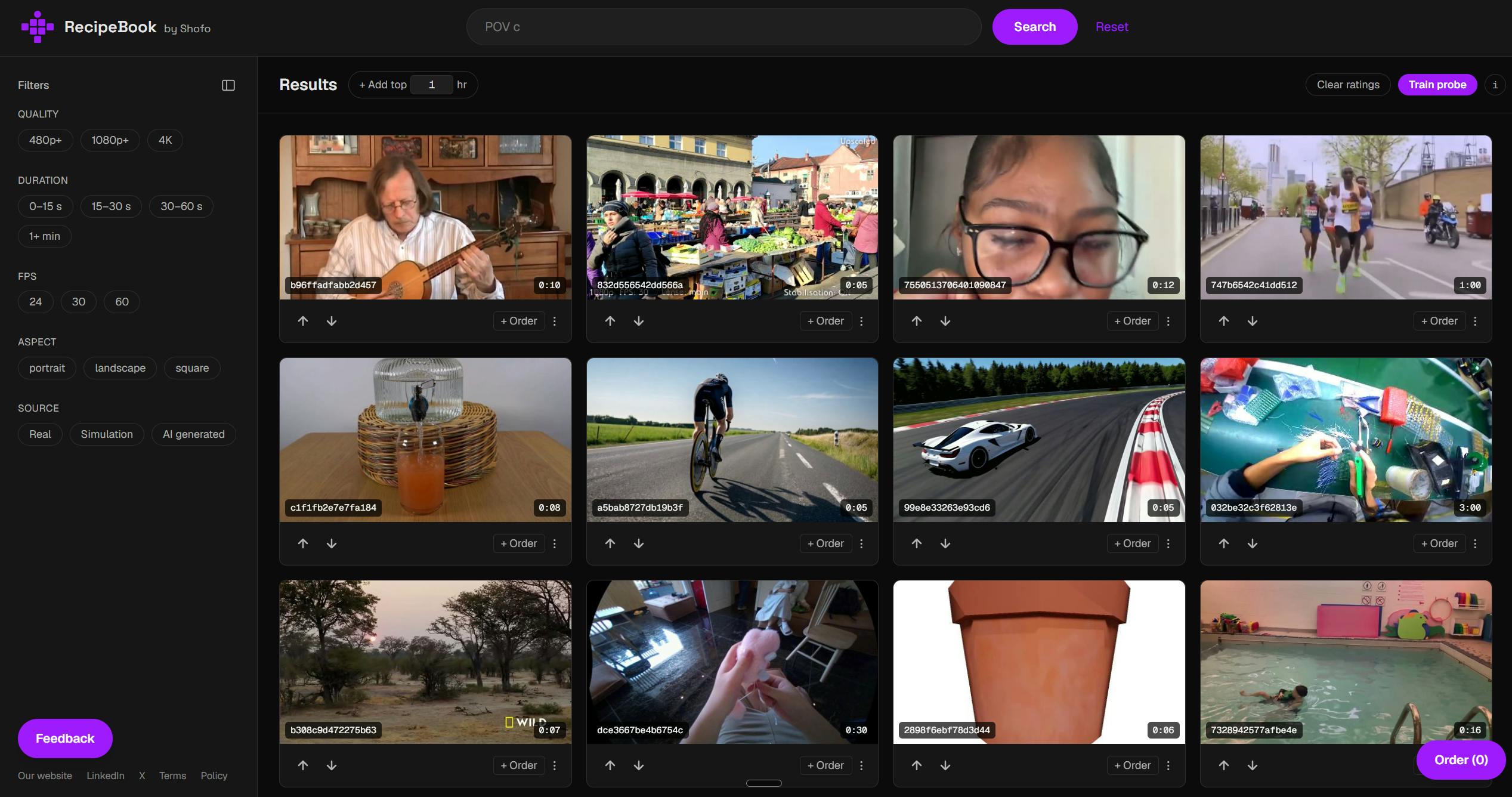
Shofo Enters AI Training Data Market with RecipeBook
Shofo, a company previously known for its work in AI-powered creative tools, has launched RecipeBook, a new platform designed to address the growing demand for high-quality video training data. The service offers access to a vast library of over 25 million video clips, catering specifically to developers and organizations building and refining artificial intelligence models. This move positions Shofo directly within the competitive landscape of AI data providers, a sector crucial for the advancement of machine learning technologies, particularly in areas like computer vision and autonomous systems.
The core offering of RecipeBook is its extensive catalog of video data, curated to meet the rigorous requirements of AI training. Users can purchase this data by the hour, a pricing model that aims to provide flexibility and cost-effectiveness for various project scales. This hourly model is designed to appeal to a broad spectrum of clients, from individual researchers and small startups to large enterprises with substantial data needs. The sheer volume of 25 million clips suggests a commitment to providing a comprehensive resource that can support a wide array of AI applications, from object recognition and scene understanding to behavioral analysis and synthetic data generation.
Understanding the Value Proposition of RecipeBook
The artificial intelligence industry's progress is intrinsically linked to the availability and quality of training data. As AI models become more sophisticated, the need for diverse, accurately labeled, and contextually rich datasets intensifies. Video data, in particular, offers a dynamic and complex form of information that is essential for training models to understand sequences, motion, and real-world interactions. RecipeBook aims to simplify the acquisition of such data by providing a centralized, accessible marketplace.
Shofo’s entry into this market is not without precedent. Numerous companies have emerged, offering specialized datasets for AI training, ranging from image collections to text corpora and, increasingly, video. The challenge for any new entrant like RecipeBook is to differentiate itself through data quality, breadth of content, ease of access, and competitive pricing. The company’s claim of over 25 million clips suggests a significant investment in data acquisition and processing, aiming to provide a breadth that can serve a multitude of AI use cases. The hourly pricing structure is a key differentiator, potentially allowing clients to scale their data acquisition efforts precisely with their project's development cycle and budget constraints.
Consider the process of training a self-driving car’s perception system. Such a system needs to learn to identify pedestrians, other vehicles, traffic signs, and road boundaries under various lighting and weather conditions, and importantly, to understand their movement and predict their trajectories. This requires vast amounts of video data capturing these scenarios from multiple perspectives and in real-time. RecipeBook’s offering of purchasable video data by the hour directly addresses this need, providing a resource that can be continuously replenished or expanded as the AI model’s requirements evolve. This is akin to a chef having access to a pantry stocked with every imaginable ingredient, allowing them to experiment and create any dish on demand, rather than being limited by a fixed menu.
The Competitive Landscape and Shofo's Strategy
The market for AI training data is robust and growing, with established players and emerging startups vying for market share. Companies like Scale AI, Amazon SageMaker Ground Truth, and Google Cloud's Data Labeling Service offer comprehensive solutions, often integrated with broader cloud platforms. The niche for specialized video data providers is also active, with platforms focusing on specific types of video content or industries. Shofo’s strategy with RecipeBook appears to be focused on providing a large, general-purpose video dataset with a straightforward, hourly purchasing model.
This approach may appeal to a segment of the market that finds existing solutions too complex, too expensive, or too narrowly focused. By offering data by the hour, RecipeBook offers a granular way for users to acquire data, potentially reducing upfront investment and allowing for more agile development cycles. The success of this strategy will likely hinge on the perceived quality and diversity of the video clips, the accuracy of any associated metadata or labels (though not explicitly detailed in the initial announcement), and the robustness of the platform’s delivery and management systems.
What’s Next for RecipeBook and AI Data
The launch of RecipeBook by Shofo signifies a continued expansion of specialized services within the AI ecosystem. As AI models become more pervasive and capable, the demand for high-quality, accessible training data will only increase. The company's focus on video data, a particularly rich and complex modality, suggests an awareness of the evolving needs of AI development. The challenge ahead for Shofo will be to demonstrate that RecipeBook can consistently deliver value through its data offerings and pricing model, thereby carving out a significant space in this critical market.
What remains to be seen is how Shofo plans to address the critical aspect of data annotation and labeling. While the announcement emphasizes the availability of video clips, the utility of this data for AI training is heavily dependent on accurate labels that identify objects, actions, and scenes within the videos. Future iterations or service expansions may well include advanced labeling services or partnerships to provide fully annotated datasets, further enhancing RecipeBook’s value proposition.