
Rethinking Real-Time: When WebSockets Aren't the Answer
The term "real-time" often triggers an immediate jump to WebSockets. This powerful bidirectional protocol is ideal for applications where clients and servers engage in constant, rapid communication, such as chat applications or multiplayer online games. However, many common real-time use cases do not require this level of complexity. Consider live metrics dashboards, stock tickers, or news feeds. In these scenarios, the primary communication pattern is unidirectional: the server needs to push updates to clients, but clients rarely need to send messages back to the server in response to these pushes.
For these specific, one-way data streams, Server-Sent Events (SSE) emerge as a more architecturally sound and significantly simpler choice. SSE leverages standard HTTP/HTTPS, eliminating the need for custom protocols, intricate proxy configurations, or firewall workarounds that often accompany WebSocket implementations. A key advantage is the browser's native support for SSE, which includes automatic reconnection capabilities should the connection drop. This means developers can build robust real-time features with less code and fewer dependencies.
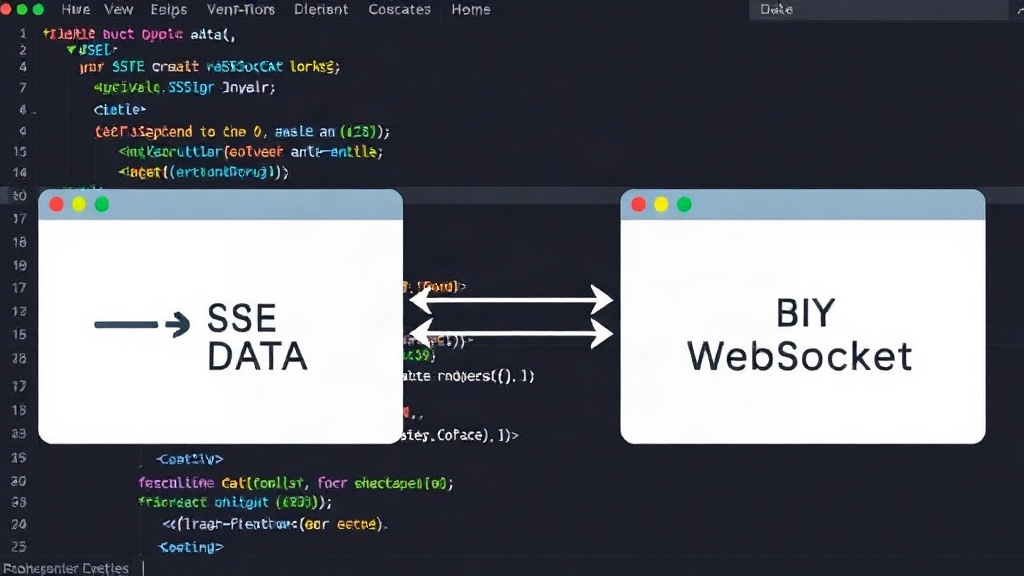
Building a Lightweight Real-Time Dashboard with SSE
To illustrate the simplicity and effectiveness of SSE, let's consider building a lightweight, real-time server dashboard. This example uses Node.js on the backend and native browser APIs for the frontend, demonstrating that no heavy libraries are required to achieve real-time functionality for one-way data feeds.
The core of an SSE implementation involves setting up an HTTP endpoint on the server that responds with specific headers. The `Content-Type` must be set to `text/event-stream`, and a `Cache-Control` header with `no-cache` and `no-store` is crucial to prevent caching of the event stream. The server then continuously sends data by writing messages in a specific format: `data: [your message] `. Each message must end with two newline characters (` `) to signal the end of an event.
On the client-side, JavaScript's native `EventSource` API is used. An `EventSource` object is instantiated with the URL of the SSE endpoint. Event listeners can then be attached to handle incoming messages. The `onmessage` event fires when a message arrives, and custom event types can be handled using `addEventListener('custom-event-name', handler)`. The `onerror` handler is vital for monitoring connection issues and triggering reconnection logic if needed, although the `EventSource` API handles basic auto-reconnect by default.
This approach contrasts sharply with WebSockets. While WebSockets offer full duplex communication, they introduce overhead. Establishing a WebSocket connection involves an HTTP handshake that upgrades the connection, requiring specific server support and potentially more complex client-side logic. Managing multiple WebSocket connections, especially at scale, can also strain server resources more than managing HTTP streams for SSE.
The Advantages of SSE for Data Tickers and Dashboards
SSE's reliance on standard HTTP makes it inherently more resilient in enterprise environments. Firewalls and proxies that might block or interfere with WebSocket traffic typically allow standard HTTP/HTTPS traffic without issue. This seamless integration simplifies deployment and reduces operational headaches.
Furthermore, the automatic reconnection feature built into the `EventSource` API is a significant development advantage. When the connection to the server is interrupted, the browser automatically attempts to re-establish it, maintaining the flow of real-time data with minimal developer intervention. This resilience is critical for applications like financial tickers or monitoring dashboards where continuous data is paramount. The browser also keeps track of the last received event ID, allowing the server to resume the stream from where it left off, preventing data loss during temporary network disruptions.
Consider a live stock ticker. A WebSocket would require the client to poll for updates or maintain an open, bidirectional channel. With SSE, the server simply streams price updates as they occur. The client listens, parses the data, and updates the UI. The code is cleaner, and the resource utilization on both client and server is generally lower for this specific pattern. The same logic applies to real-time analytics dashboards, system monitoring tools, or even live sports score updates.
The choice between SSE and WebSockets boils down to the communication pattern required. If your application needs true, real-time, bidirectional communication—think collaborative editing or gaming—WebSockets are the right tool. But for the vast majority of applications that primarily need to broadcast data from a server to multiple clients, SSE offers a simpler, more robust, and often more performant alternative. By embracing SSE for unidirectional data streams, developers can build more efficient, maintainable, and scalable real-time features.