The Power of Limited Labels: An Introduction to Semi-Supervised Learning
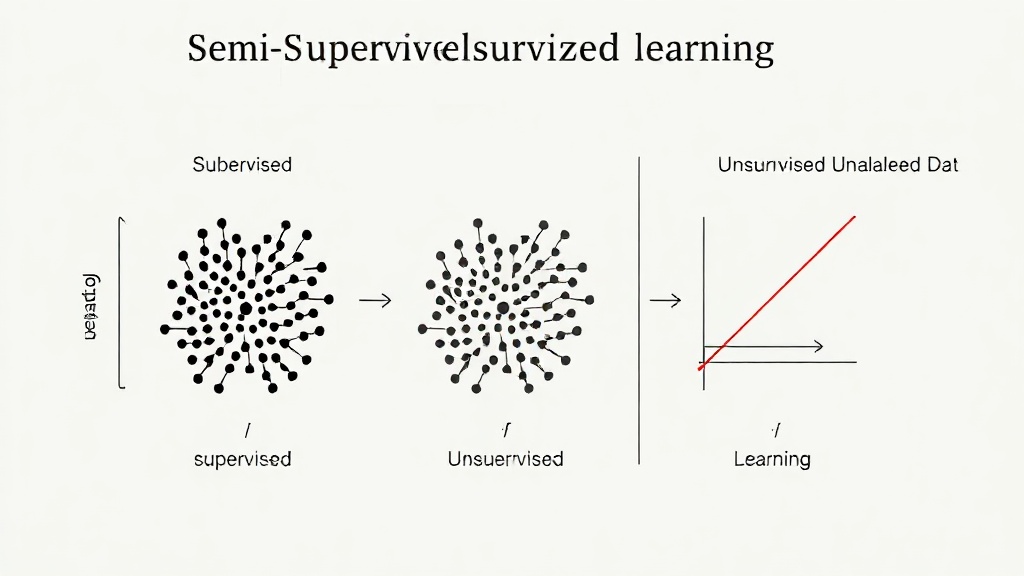
In the realm of machine learning, obtaining large, meticulously labeled datasets is often the most significant bottleneck. The process of manual annotation is not only time-consuming and expensive but also prone to human error. This is where Semi-Supervised Learning (SSL) emerges as a critical paradigm. SSL sits between supervised learning, which relies entirely on labeled data, and unsupervised learning, which uses only unlabeled data. It aims to harness the vast ocean of readily available unlabeled data by using a small set of labeled examples to guide the learning process.
Imagine you are trying to teach a child to identify different types of fruits. You might show them a few labeled pictures: 'This is an apple,' 'This is a banana.' But what if you also have a huge stack of fruit images without any labels? Semi-supervised learning is like showing the child those few labeled examples and then letting them look at the unlabeled stack, inferring that fruits with similar shapes and colors might belong to the same category. It’s about making intelligent guesses based on limited ground truth and abundant raw material.
Core Concepts and Motivation
The fundamental motivation behind SSL is to achieve performance comparable to supervised learning methods while drastically reducing the need for labeled data. This is particularly relevant in domains where labeling is difficult or costly, such as medical imaging, natural language processing (NLP), and audio recognition. The underlying assumption in SSL is that the structure of the unlabeled data (e.g., clusters, manifolds) contains valuable information about the underlying data distribution that can help improve model performance.
The success of SSL hinges on the smoothness assumption, the cluster assumption, and the manifold assumption. The smoothness assumption posits that if two data points are close in a high-density region of the input space, their corresponding output labels should also be close. The cluster assumption suggests that data points belonging to the same cluster are likely to have the same label. The manifold assumption posits that the high-dimensional data lies on a lower-dimensional manifold, and points on the same manifold should share similar properties or labels.
Key Approaches and Algorithms
Several algorithmic approaches have been developed within the SSL framework, each leveraging these assumptions in different ways:
Self-Training
Self-training is one of the simplest and most intuitive SSL methods. It starts by training a model on the limited labeled data. This model is then used to predict labels for the unlabeled data. The most confident predictions are added to the labeled dataset, and the model is retrained on this augmented dataset. This process is iterated, gradually increasing the size of the labeled set. A crucial aspect of self-training is the confidence threshold; selecting predictions that are too uncertain can introduce noise and degrade performance.
Co-Training
Co-training extends self-training by using multiple views of the data or multiple distinct models. Each model is trained on the labeled data and then used to label the unlabeled data. The most confident predictions from one model are used to augment the training set for another model, provided the models are conditionally independent given the label. This approach is effective when data can be naturally split into independent feature sets (views), such as text documents with different feature representations (e.g., bag-of-words and hyperlinks).
Generative Models
Generative SSL methods model the joint probability distribution P(x, y), where x is the input features and y is the label. By learning this distribution from both labeled and unlabeled data, the model can make predictions. Expectation-Maximization (EM) algorithm is a classic example. In the E-step, it estimates the expected labels for unlabeled data given the current model parameters. In the M-step, it updates the model parameters to maximize the expected log-likelihood of the data. Gaussian mixture models are often used in this context.
Graph-Based Methods
Graph-based methods represent the data as a graph where nodes are data points and edges represent the similarity between them. Labels are then propagated from labeled nodes to unlabeled nodes through the graph structure. Algorithms like Label Propagation and Label Spreading fall under this category. The strength of these methods lies in their ability to capture complex data structures and relationships inherent in the unlabeled data, effectively assuming that similar points should have similar labels.
Consistency Regularization
This is a more modern and highly effective class of SSL techniques. The core idea is to encourage the model to produce consistent predictions for perturbed versions of the same unlabeled data point. Perturbations can include adding noise, data augmentation, or applying dropout. Methods like Π-Model, Temporal Ensembling, and Mean Teacher are prominent examples. For instance, the Mean Teacher model maintains an exponential moving average of the model's weights, and it enforces consistency between the predictions of the student model (the current model) and the teacher model (the EMA model) on augmented unlabeled data.
Limitations and Challenges
Despite its promise, SSL is not a silver bullet. The assumptions underpinning SSL methods (smoothness, cluster, manifold) might not always hold true for real-world data. If these assumptions are violated, using unlabeled data can actually degrade performance compared to using only labeled data. For example, if a cluster of unlabeled data points actually contains multiple classes, a model trained with SSL might incorrectly assign a single label to the entire cluster.
Furthermore, the effectiveness of SSL algorithms can be sensitive to hyperparameter tuning, such as the confidence thresholds in self-training or the regularization strength in consistency regularization. The quality and representativeness of the unlabeled data are also critical. Biased or noisy unlabeled data can lead to biased or noisy model predictions.
The Future of Semi-Supervised Learning
As the demand for data-hungry AI models continues to grow, the importance of efficient learning paradigms like SSL will only increase. Ongoing research focuses on developing more robust algorithms that are less sensitive to assumption violations and hyperparameter settings. Techniques combining SSL with other learning paradigms, such as transfer learning and reinforcement learning, are also showing promising results. The ability to unlock the potential of readily available unlabeled data remains a key frontier in making AI more accessible, efficient, and scalable.