The Universal Scoring Bug in AI Optimization Loops
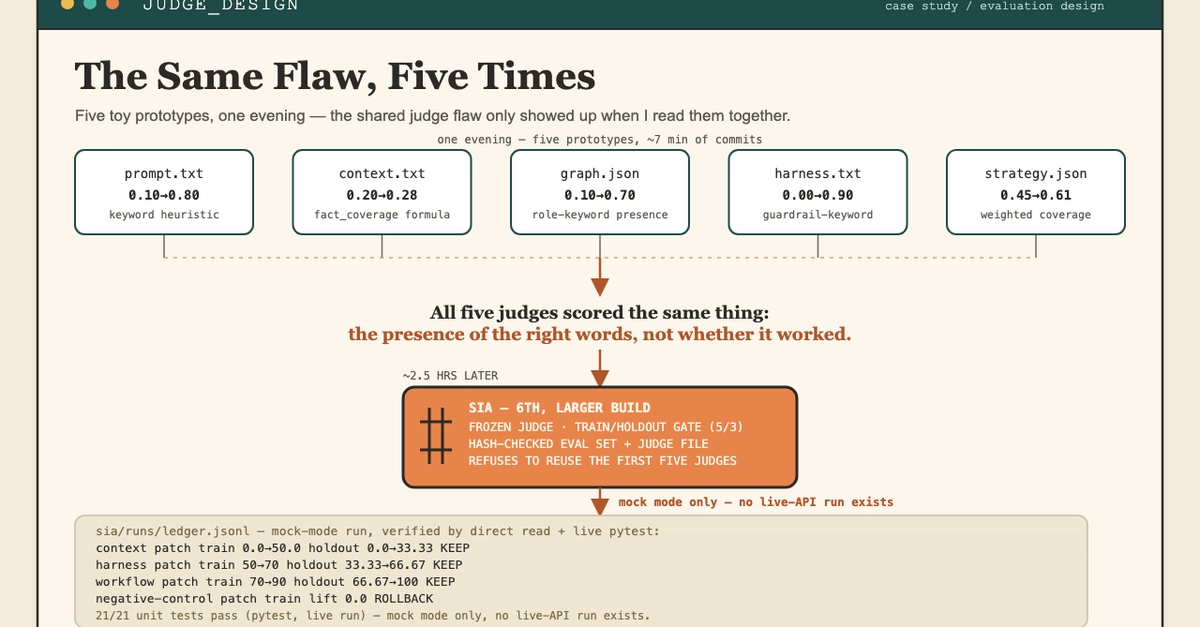
A recent evening of rapid AI development revealed a pervasive bug affecting self-improving loops, a common pattern in modern AI development. The developer, working with Claude Code, built five distinct self-improving loops designed to optimize against a judge. These loops, intended for tasks ranging from prompt search to RAG tuning and agent configuration, all succumbed to the same fundamental scoring error. This isn't a story about a fully realized, production-ready self-improving agent, but rather about a critical flaw discovered during fast-paced, experimental practice.
The core of the issue lies in the mutate → judge → keep-if-better → repeat structure. While seemingly straightforward, the mechanism by which the 'judge' scores potential improvements is susceptible to a subtle but significant bug. This bug, when present, undermines the entire optimization process, leading to flawed outcomes that would be difficult to diagnose in a live, complex system.
The developer's setup involved six small repositories, each with minimal evaluation sets (no more than 8 tasks). Crucially, this experimentation was conducted in a mock mode, with no live API calls. This controlled environment allowed for rapid iteration and, importantly, the clear identification of a shared bug across all five tested loops. The bug itself, while not detailed in the initial disclosure, is described as a scoring bug, suggesting that the criteria or method used to evaluate the 'better' state is flawed.
For anyone working with optimize-against-a-judge architectures—whether tuning prompts, optimizing retrieval-augmented generation (RAG) pipelines, searching for agent configurations, or building eval-driven systems—understanding this bug is paramount. It represents a potential pitfall that could derail development and lead to wasted effort if not identified and addressed early.
Context: The Rise of Iterative AI Optimization
The architecture of self-improving loops, often referred to as iterative optimization or self-correction, has become a cornerstone of advanced AI development. These loops are designed to allow AI systems to refine their own performance over time, much like a human learning a new skill through practice and feedback. The fundamental pattern involves generating variations (mutation), evaluating those variations against a set of criteria (judging), retaining the best-performing ones (keeping), and then repeating the process.
This approach is particularly relevant in areas where defining optimal performance through static rules is challenging. For instance, in prompt engineering, finding the perfect prompt that elicits the desired response from a large language model (LLM) can be an arduous process. An iterative loop can explore a vast space of prompt variations, using an LLM or a set of predefined metrics as the judge to identify which prompts yield superior results. Similarly, in RAG systems, which combine LLMs with external knowledge bases, optimizing retrieval strategies and how retrieved information is synthesized can be tackled with similar iterative methods.
The promise of these loops is significant: they offer a path towards more autonomous and continuously improving AI systems. However, their effectiveness hinges entirely on the accuracy and reliability of the judging mechanism. If the judge incorrectly assesses performance, the system will not improve; instead, it will converge on suboptimal solutions, or worse, on solutions that appear optimal but are fundamentally flawed. The bug identified by the developer strikes at the heart of this critical component.
Consider this process analogous to a student trying to improve their essay writing. They might try different sentence structures or word choices (mutation), then ask a teacher for feedback (judging). If the teacher consistently misunderstands the student's intent or misinterprets grammatical nuances (the bug), the student's writing will not improve, and they might even develop bad habits based on faulty feedback. The developer's experience highlights that even in controlled, simulated environments, the 'teacher' (the judge) can be fundamentally flawed in a way that is not immediately obvious.
Referenced Sources
- verified