The Case for Self-Hosted PaaS in 2026
The allure of self-hosted Platform-as-a-Service (PaaS) in 2026 is strong, particularly for startups feeling the pinch of escalating Heroku bills. Running your own platform layer on your own infrastructure promises to bypass the per-dyno markups that can cripple a scaling budget. Open-source options have matured significantly, offering compelling alternatives for the right teams. However, for the unprepared, these solutions can quickly morph into a full-time operational burden, effectively becoming a second job.
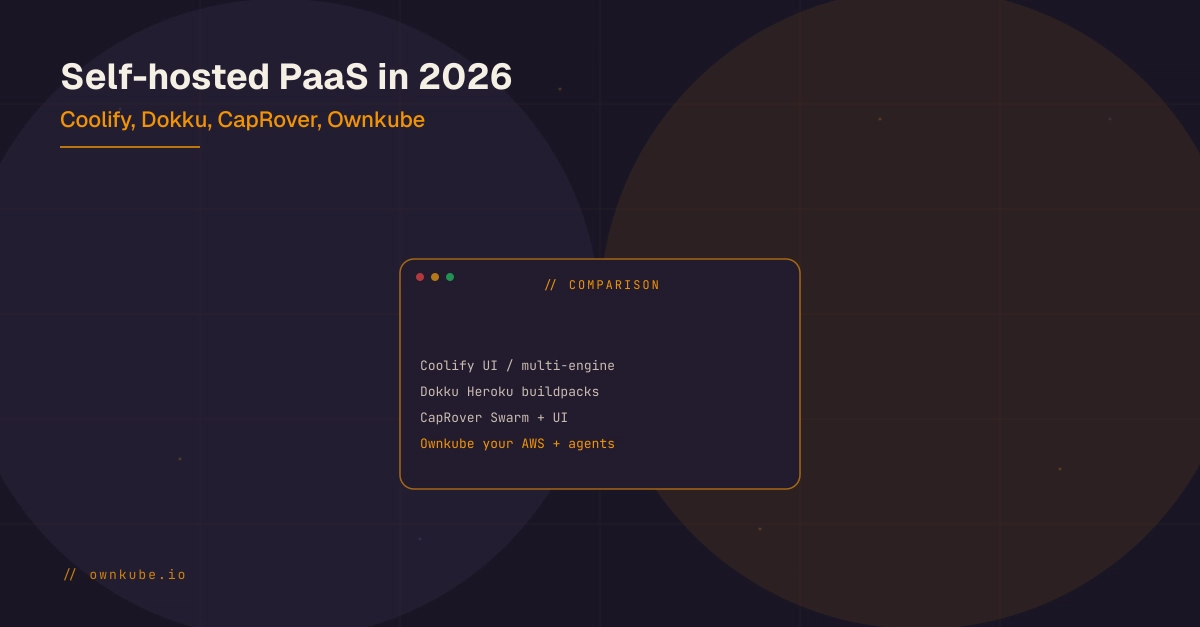
This post dissects four prominent self-hosted or self-hosted-style PaaS solutions that startups frequently consider: Coolify, Dokku, CapRover, and Ownkube. We will explore their core functionalities, ideal user profiles, scalability ceilings, and the practical trade-offs involved. For teams specifically looking to migrate from Heroku, understanding these alternatives is crucial for a smooth transition.
Coolify: Simplicity and Developer Experience
Coolify positions itself as a user-friendly, open-source PaaS designed to abstract away the complexities of server management. Its primary goal is to offer a Heroku-like experience on your own hardware. Installation is straightforward, often involving a single script that sets up the necessary components, including Docker, Nginx, and a database if needed.
Coolify excels in its intuitive web UI, making deployment and management accessible even to developers less experienced with deep infrastructure. It supports common application stacks, including Node.js, Python, Ruby, and Docker containers. Key features include:
- One-click application deployment.
- Automatic SSL certificate management via Let's Encrypt.
- Integrated database management.
- Built-in monitoring and logging.
- Support for custom domains.
The ceiling for Coolify is generally found in very large-scale, highly complex distributed systems. While it handles typical startup workloads with ease, managing thousands of microservices or extremely high-throughput applications might require more specialized tooling. Its strength lies in its opinionated approach, which simplifies setup but can limit deep customization for advanced use cases.
Dokku: The Minimalist Heroku Clone
Dokku is perhaps the most direct open-source Heroku clone available. It uses Docker to run applications and leverages Git for deployments, mimicking Heroku's `git push` workflow. Dokku is designed for single-server deployments and emphasizes a minimalist, plugin-based architecture.
Installation is typically done via a script, and configuration is primarily managed through the command line, though some community-developed UIs exist. Dokku's plugin system is its superpower; it allows developers to extend its functionality to support databases, background workers, and other services. This extensibility makes it highly adaptable.
Core advantages of Dokku include:
- True Git-push deployment workflow.
- Extensive plugin ecosystem for adding features.
- Lightweight and efficient resource usage.
- Strong community support.
Dokku's main limitation is its single-server focus. While technically possible to scale horizontally, it requires significant manual effort and external orchestration tools. It’s ideal for small teams, solo developers, or projects where a single, robust deployment target is sufficient. Developers who are comfortable with the command line and appreciate a bare-bones, yet extensible, platform will find Dokku compelling.
CapRover: Powerhouse with a GUI Focus
CapRover aims to provide a powerful, yet user-friendly, self-hosted PaaS solution with a strong emphasis on its graphical user interface. It simplifies the deployment and management of containerized applications, abstracting away much of the underlying Docker complexity.
CapRover's installation is straightforward, and its web UI is comprehensive, offering features for managing applications, databases, nodes, and SSL certificates. It supports a wide range of applications and allows for easy scaling of services by adding more nodes to a cluster. Its built-in marketplace of applications further simplifies the setup of common services like databases and monitoring tools.
Key features include:
- Intuitive web-based dashboard for all management tasks.
- One-click deployment of applications from Docker Hub or custom images.
- Clustering capabilities for multi-node deployments.
- Built-in application marketplace.
- Automated SSL management.
CapRover offers a good balance between ease of use and powerful features. It's suitable for teams that prefer a GUI-driven experience but still need robust deployment capabilities, including basic clustering. The ceiling might be reached in scenarios requiring highly sophisticated orchestration or custom networking configurations beyond its built-in abstractions.
Ownkube: Enterprise-Grade Control and Automation
Ownkube presents a more enterprise-focused approach to self-hosted PaaS, emphasizing automation, multi-tenancy, and robust control over deployments. While it can be used by smaller teams, its architecture is built to handle more complex organizational needs.
Ownkube operates on Kubernetes, providing a layer of abstraction over its complexity. This means that while you are managing Kubernetes, Ownkube simplifies the process of deploying and managing applications within it. It offers features like GitOps integration, advanced CI/CD pipelines, and granular access control, making it suitable for larger teams or organizations with strict compliance requirements.
Distinguishing features of Ownkube:
- Built on Kubernetes for scalability and resilience.
- Advanced CI/CD and GitOps capabilities.
- Multi-tenancy support for managing multiple projects or clients.
- Comprehensive logging and monitoring integration.
- API-driven control for automation.
Ownkube's primary trade-off is its complexity. Requiring a foundational understanding of Kubernetes, it has a steeper learning curve than solutions like Coolify or CapRover. However, for teams that need to manage numerous applications, enforce strict policies, or integrate deeply with existing DevOps workflows, Ownkube offers a powerful and scalable solution. Its ceiling is very high, limited primarily by the underlying Kubernetes cluster's capacity.
Choosing the Right PaaS for Your Team
The