The Problem with Modern SaaS Support Widgets
Integrating AI into customer support is rapidly becoming standard practice for SaaS products. However, most readily available solutions come with significant drawbacks: monthly subscription fees, vendor lock-in, and limited customization. For developers building smaller products or personal websites, these costs and constraints can be prohibitive. The desire for complete ownership and control over the customer support experience is a recurring theme for many builders.
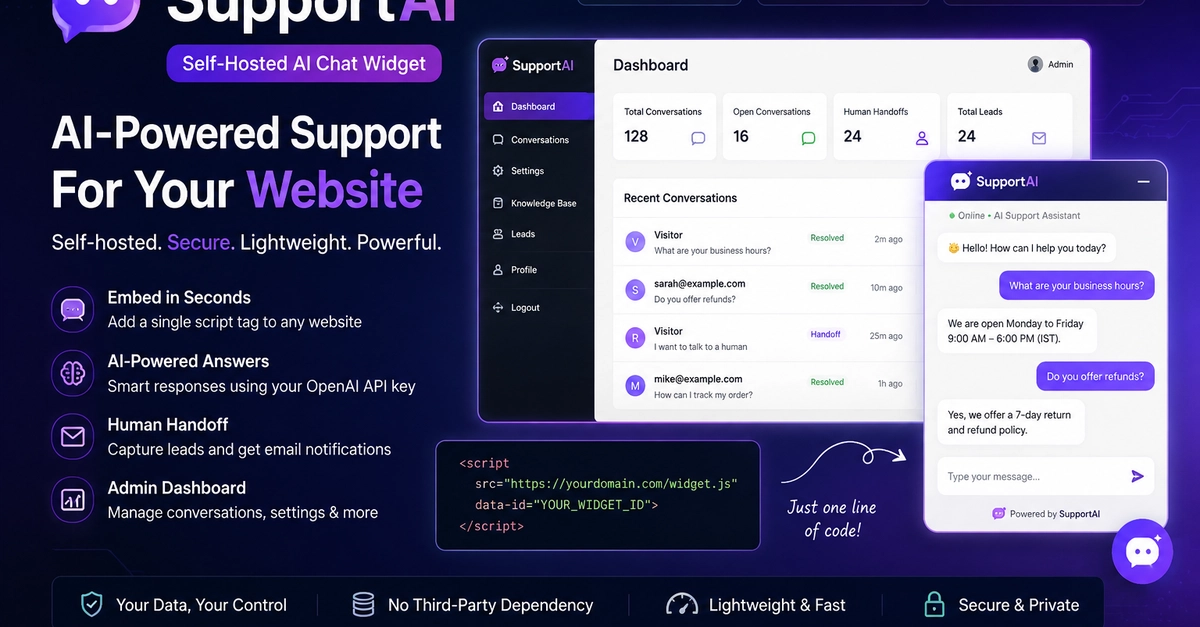
This frustration led one developer to build their own solution. The goal was clear: create an AI support widget that could be deployed on personal servers, utilize a private OpenAI API key, and offer full customization. The outcome is a self-hosted AI support widget built with Spring Boot and Vanilla JavaScript, designed to be embedded into any website with a simple script tag, eliminating recurring SaaS costs.
Architecting a Self-Hosted AI Support Solution
The core of this self-hosted widget relies on two main components: a backend service built with Spring Boot and a frontend JavaScript widget. The Spring Boot application serves as the central hub, handling all communication with the OpenAI API and managing the logic for generating responses. This approach ensures that sensitive API keys remain on the developer's server, not exposed to the client-side.
The Spring Boot backend is designed to expose a simple API endpoint that the frontend widget can call. When a user types a query into the widget on a website, the JavaScript code sends that query to the Spring Boot backend. The backend then forwards this query to OpenAI's API, processes the response, and sends it back to the frontend. This architecture provides a seamless experience for the end-user, who interacts with the widget as if it were a standard SaaS product, unaware of the self-hosted infrastructure behind it.
The choice of Spring Boot for the backend offers several advantages. Its robust ecosystem provides tools for building RESTful APIs quickly and securely. Dependency injection, aspect-oriented programming, and comprehensive testing support make it a powerful framework for enterprise-grade applications, even for smaller, self-hosted projects. For this specific use case, Spring Boot simplifies the management of API interactions, request handling, and potential future extensions, such as logging or user authentication.
Frontend Integration and Customization
On the frontend, Vanilla JavaScript is used to create a lightweight, embeddable widget. This avoids adding heavy framework dependencies to the target website, ensuring minimal impact on page load times. The JavaScript code is responsible for:
- Rendering the chat interface within a designated HTML element on the host website.
- Capturing user input from the chat window.
- Making asynchronous requests (e.g., using `fetch` or `XMLHttpRequest`) to the Spring Boot backend's API endpoint.
- Displaying the AI's responses in a conversational format.
- Handling the visual styling and user experience of the chat widget.
The widget is designed to be integrated into any website by simply including a single script tag in the HTML. This script dynamically creates the chat interface and connects it to the backend. Customization is a key feature. Developers can modify the JavaScript code to change the widget's appearance, add specific prompts or instructions to the AI's behavior, or even integrate custom data sources for the AI to reference. This level of control is typically not available with off-the-shelf SaaS solutions.
The decision to use Vanilla JavaScript prioritizes performance and ease of integration. Without the overhead of large frontend frameworks, the widget remains small and fast. This is crucial for user experience, as slow-loading support widgets can frustrate users and negatively impact conversion rates. The direct DOM manipulation capabilities of JavaScript allow for flexible rendering and updating of the chat interface.
The Benefits of a Self-Hosted Approach
The primary motivation behind building a self-hosted solution is the elimination of recurring monthly fees. By deploying the Spring Boot application on a personal server or a cost-effective VPS, developers pay only for the underlying infrastructure and their OpenAI API usage, which is often significantly cheaper than SaaS subscriptions, especially at scale. This makes advanced AI support accessible even for projects with limited budgets.
Beyond cost savings, self-hosting offers complete data ownership and privacy. All customer interactions and data remain within the developer's control, adhering to stricter privacy policies and reducing reliance on third-party data handling practices. This is particularly important for businesses dealing with sensitive customer information.
Furthermore, the ability to customize every aspect of the widget provides a unique branding opportunity and allows for a support experience tailored precisely to the product's needs. Developers can fine-tune the AI's persona, knowledge base, and response style to perfectly match their brand voice and product documentation. This deep integration fosters a more cohesive and professional user experience. The control extends to deployment flexibility; the widget can be hosted on any server, on-premises, or even within a containerized environment, offering maximum operational freedom.
Future Considerations and Potential Enhancements
While the current implementation focuses on core AI chat functionality, several enhancements could be considered. Integrating a database to log conversations could provide valuable insights into user queries and common issues, aiding product development and support strategy. Implementing user authentication could allow for personalized support experiences or tracking of customer issues over time.
For more advanced use cases, the Spring Boot backend could be extended to integrate with other internal systems, such as CRM or ticketing platforms. This would enable a more comprehensive support workflow. Another avenue for improvement could be exploring alternative AI models or local LLMs, further reducing external dependencies and potentially offering even greater cost efficiencies or offline capabilities. The modular nature of the Spring Boot framework makes such expansions feasible.
The surprising detail here is not the technical complexity, but the fundamental shift in philosophy: moving from a consumption model (monthly SaaS) to an ownership model. This project demonstrates that with modern frameworks like Spring Boot and accessible AI APIs, building sophisticated, custom solutions is well within reach for individual developers and small teams.