The Concrete Problem with Current Security Fixes
When a security vulnerability is reported, the typical response is a code change, often submitted as a pull request. Developers and automated systems review this change. Unit tests pass, scanners stop flagging the issue, and the pull request is merged. On the surface, the vulnerability appears fixed. However, this process often overlooks a critical distinction: the difference between fixing the *symptom* and fixing the *attack path*.
A security pull request can appear green for all the wrong reasons. Unit tests might pass because they don't cover the specific edge case exploited. A vulnerability scanner might stop reporting the original finding because the vulnerable endpoint now returns a different HTTP status code, or perhaps it only checks for the exact input that was initially identified. None of these outcomes definitively prove that the attacker's capability has been neutralized.
Consider this: the same identity might still reach the sensitive action through an entirely different route. They could inherit a broader, more permissive token than originally intended, or trigger an equivalent workflow with slightly modified input that bypasses the patched logic. In essence, the fix might be superficial, leaving the underlying vulnerability exploitable through alternative means.
This becomes particularly problematic when automated tools are involved in proposing or reviewing these fixes. An automated system can verify that code changes have been made and that certain tests pass. It can even confirm that a specific scanner no longer reports the original finding. However, a plausible patch explanation or a passing test suite does not equate to behavioral evidence that the attack has been thwarted. The automated tool, and often the human reviewer, still needs to know precisely which identity was used in the attack, which preconditions were established, which specific requests were made, where privilege was gained *before* the fix was applied, and at which exact step the patched build finally denied the malicious action.
Without this granular trace, declaring a vulnerability “fixed” becomes an assertion about code correctness rather than an observation of the attack path being definitively closed. It’s like patching a leaky pipe by simply painting over the rust; the underlying structural weakness remains.
The Need for Behavioral Verification
The core issue is the reliance on static analysis and superficial checks over dynamic, behavioral verification. To truly confirm a security fix, we need to demonstrate that the *attacker's capability* is gone, not just that a specific code line has changed or a particular scanner has been silenced. This requires a shift in how we approach and validate security patches.
Imagine an attacker trying to access a user's private data. The vulnerability might lie in an API endpoint that doesn't properly validate authorization when a specific parameter is manipulated. A superficial fix might add a check for that exact parameter. However, if the same endpoint uses a session token that is too broadly scoped, or if another endpoint directly exposes the same sensitive data without the same authorization checks, the attacker can simply switch tactics. The original fix is useless in this scenario.
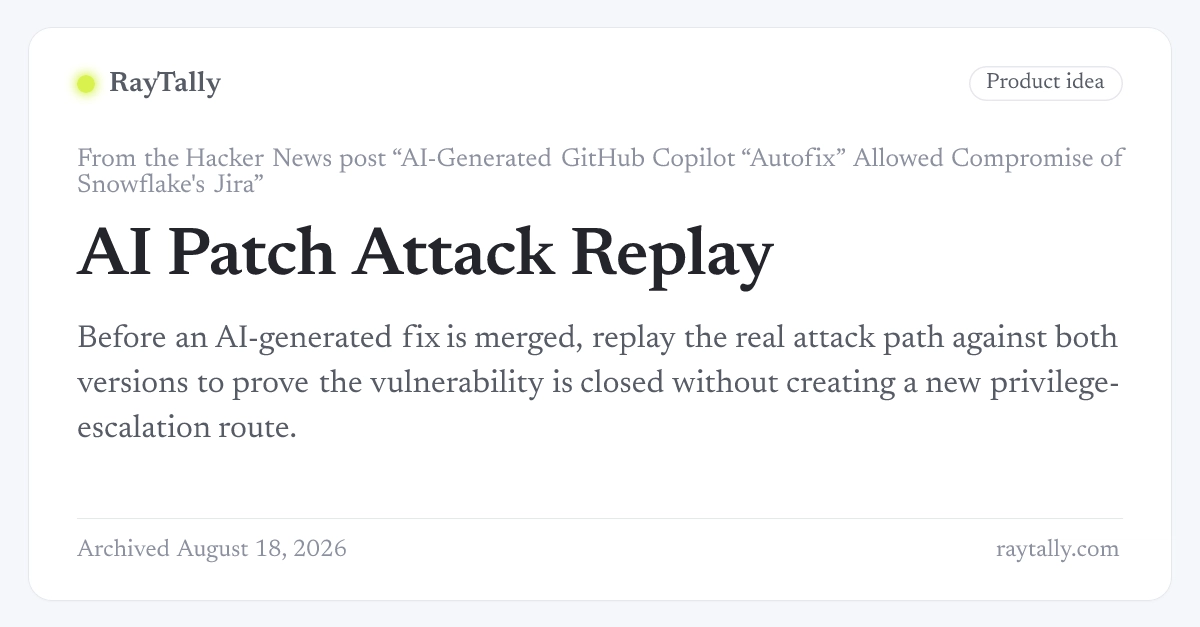
What is missing is a robust method to replay or simulate the original attack, but against the *patched* system, and observe the outcome. This isn't just about running the same unit tests. It's about using the attacker's perspective: What identity did they use? What sequence of actions did they perform? What privileges did they gain at each step? And crucially, at what point did the patched system *actually* prevent the unauthorized action?
This implies a need for better tooling and processes that can capture and replay attack sequences. Security teams should be able to provide a detailed trace of an exploit, including network requests, authentication tokens, and the sequence of operations. The patched system should then be subjected to this trace to confirm that the malicious activity is blocked at the precise point where the fix was implemented, or earlier if the fix has broader preventative effects.
This approach moves beyond simply checking if the vulnerable code is present. It verifies that the *exploit chain* has been broken. It’s the difference between saying “I changed the lock” and saying “I watched someone try the old key and the new key, and only the new key worked.”
Bridging the Gap: From Code Change to Attack Interruption
The ideal security fix validation process would involve:
- Detailed Attack Trace Capture: Tools that can record the full context of an exploit, including network traffic, session information, and user actions. This goes beyond simple request logging.
- Policy-Driven Verification: Defining security policies and expected outcomes for specific attack scenarios. The validation process then checks if the patched system adheres to these policies under attack simulation.
- Attacker-Centric Replay: Using the captured trace to simulate the attack against the patched environment. This replay must be intelligent enough to adapt to minor changes in the system while still attempting to execute the original exploit logic.
- Outcome Verification: Confirming that the simulated attack is blocked at the appropriate stage, and that no unauthorized actions are completed. This includes verifying that the attacker's capabilities are demonstrably lost.
This level of verification is not trivial. It requires sophisticated security testing platforms and a deeper understanding of attack vectors than is often present in standard development workflows. However, the alternative is a false sense of security, where vulnerabilities are declared fixed when they remain exploitable through slightly altered means.
The surprising detail here is not the complexity of implementing such verification, but how readily we accept a lack of proof. We have invested heavily in automated code analysis and vulnerability scanning, yet we often lack the equivalent rigor in validating that our fixes actually work against real-world attack methodologies. We are essentially trusting that a code change will have the desired effect, without observing that effect directly.
What nobody has addressed yet is the significant investment required in tooling and training to implement this level of verification across all software development lifecycles. While the benefits are clear—a more secure software ecosystem—the practical challenges of integrating deep, behavioral security testing into fast-paced development cycles remain substantial.
The Path Forward
For developers and security professionals, this means a call to action: don't just submit a code change and assume it's fixed. Provide evidence. If possible, include a test case that *demonstrates* the attacker's capability being blocked. For reviewers, push for more than just a code review. Ask: "How do we know the attacker can't just do this another way?"
For platform builders and tool vendors, there is a clear opportunity to develop and integrate solutions that provide this behavioral verification. Tools that can capture attack traces and replay them against patched systems, providing concrete proof of remediation, would be invaluable. This could involve enhanced logging, more sophisticated security testing frameworks, or even AI-driven adversarial simulation.
Ultimately, a security fix should be more than just a line of code. It should be a demonstrable interruption of an attack path. Until we demand and provide this level of proof, our systems will remain vulnerable, masked by the illusion of security.