Application Initialization and Lifecycle
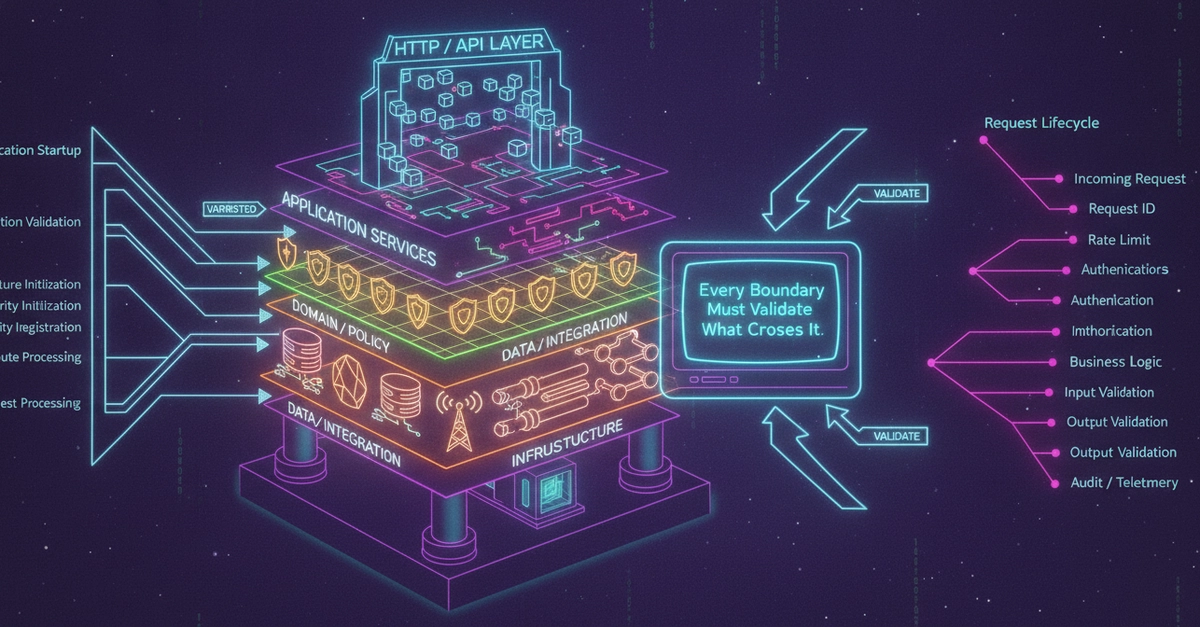
The Secure AI Platform's core boundaries, defined in Chapter 102, are now implemented through its backend foundation. This backend serves as the critical nexus connecting users, application logic, databases, AI providers, object storage, message queues, payment systems, and administrative functions. A compromised backend can undermine even the most sophisticated security measures. Therefore, a secure backend demands a well-defined and predictable lifecycle. This lifecycle begins with application startup, progresses through configuration validation and infrastructure initialization, integrates security measures, registers application routes, processes incoming requests, executes business logic, generates responses, and finally, incorporates observability mechanisms.
The application startup sequence is paramount. It initiates the entire operational flow. Following startup, configuration validation ensures that all necessary parameters and settings are correctly defined and accessible. This prevents the application from starting with erroneous or insecure configurations. Once validated, infrastructure initialization sets up essential resources and connections, such as database pools or external service clients. Security initialization follows, establishing authentication, authorization, and encryption layers. Route registration then maps incoming request paths to their corresponding handlers. The core of the operation involves request processing, where incoming data is parsed and validated. Business logic is then executed, performing the necessary operations. Finally, a response is generated and sent back to the client, with observability mechanisms like logging and metrics collection running concurrently throughout the process to monitor performance and identify potential issues.
Module Architecture and API Structure
A well-defined module architecture is crucial for maintainability, scalability, and security. Each module should encapsulate a specific set of functionalities, adhering to the principle of separation of concerns. This modularity allows for independent development, testing, and deployment of different parts of the backend. For instance, a dedicated module for user authentication, another for data persistence, and a third for external API integrations. This compartmentalization limits the blast radius of any potential security vulnerability; a breach in one module is less likely to compromise the entire system.
The API structure complements the module architecture. A clean, consistent, and well-documented API is essential for both internal service communication and external client interactions. RESTful principles or GraphQL schemas should be adopted to define clear endpoints, request/response formats, and HTTP methods. Versioning of the API is also critical to manage changes without disrupting existing clients. Security considerations must be baked into the API design. This includes input validation at the API gateway level, proper use of HTTP security headers, and consistent error handling that avoids revealing sensitive information.
Configuration Loading and Validation
Effective configuration management is a cornerstone of a secure backend. Configurations, which often include sensitive information like database credentials, API keys, and secret tokens, must be loaded securely and validated rigorously. Externalizing configuration from the codebase is a best practice, allowing for environment-specific settings without code changes. This can be achieved through environment variables, configuration files (e.g., YAML, JSON), or dedicated configuration management services.
The validation process must be comprehensive. Upon loading, configurations should be checked against a predefined schema to ensure all required parameters are present and have the correct data types. Sensitive values should be treated with extreme care, potentially using secrets management tools to encrypt and decrypt them only when needed. For instance, instead of storing plaintext database passwords, use a system that retrieves them from a secure vault at runtime. Any discrepancies or missing critical configurations should halt the application startup or trigger immediate alerts, preventing the system from running in a potentially insecure state. This proactive validation acts as an early warning system against misconfigurations that could lead to security breaches.
Validation and Error Handling
Robust input validation is non-negotiable for backend security. Every piece of data received from external sources—whether from user input, API requests, or other services—must be validated to ensure it conforms to expected formats, types, and constraints. This prevents common vulnerabilities like SQL injection, cross-site scripting (XSS), and buffer overflows. Validation should occur at multiple layers, starting at the API gateway and continuing within the specific business logic modules.
Error handling is the counterpart to validation. When validation fails or unexpected errors occur, the backend must respond gracefully without exposing internal details. Generic error messages should be returned to the client, while detailed error information, including stack traces and sensitive data, should be logged securely on the server-side for debugging and auditing purposes. A consistent error response format across the API simplifies client-side error management and prevents information leakage. For example, instead of returning a detailed database error message when a query fails, return a generic "Internal Server Error" and log the specific database error for internal review. This approach maintains system stability and protects sensitive implementation details.
Observability and Continuous Improvement
Observability—the ability to understand the internal state of the system from its external outputs—is vital for maintaining a secure and reliable backend. This encompasses logging, metrics, and tracing. Comprehensive logging captures significant events, errors, and security-relevant activities. Metrics provide quantitative insights into system performance and health, such as request latency, error rates, and resource utilization. Distributed tracing allows developers to follow requests as they propagate through various services, aiding in debugging complex interactions and identifying performance bottlenecks.
The data gathered through observability is not just for reactive troubleshooting; it's a proactive tool for security and improvement. Security teams can analyze logs for suspicious patterns, detect anomalies, and respond to incidents faster. Performance metrics can highlight areas where optimization is needed, potentially reducing resource exhaustion vulnerabilities. By continuously monitoring and analyzing these outputs, developers and security professionals can identify emerging threats, refine security controls, and improve the overall resilience of the backend foundation. This iterative feedback loop, powered by observability, ensures the backend evolves securely alongside the platform's requirements.