The Screenshot Mirage in AI Agent Debugging
Pull requests often feature screenshots of execution trees, seemingly useful for understanding AI agent behavior. However, these images present a facade of clarity while hiding critical details. A reviewer looking at a screenshot is left with a host of unanswered questions. Which specific trace generated this visual? Was the trace altered after capture? What redaction policy was applied, and did it inadvertently remove crucial warnings? Most importantly, can the reviewer inspect the failing step directly without burdening the author with a reproduction request? A screenshot, by its nature, preserves only pixels; it offers no insight into provenance or the full context of the execution flow. This fundamental limitation makes it an inadequate tool for rigorous debugging.
The alternative, raw JSONL logs, presents its own set of problems. While it can provide more data, it often contains sensitive identifiers, attributes, or bounded previews that are unsuitable for sharing outside the developer's secure environment. Distributing these raw logs broadly, especially in a collaborative setting like a pull request, introduces significant security and privacy risks. The data might contain personally identifiable information (PII), proprietary business logic, or internal system details that should remain confidential. This forces a trade-off between providing enough detail for effective review and maintaining necessary security boundaries.
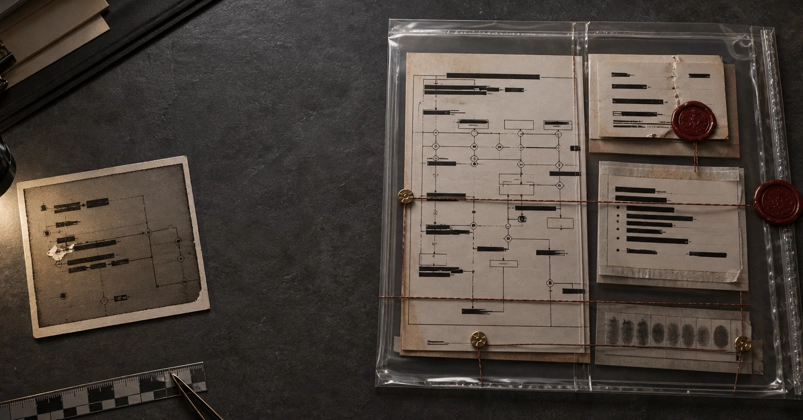
The practical unit for handoff and review in the context of AI agent failures is neither a static screenshot nor an unredacted raw trace. It must be a derived, reviewable evidence artifact. This artifact should encapsulate the necessary information for debugging while abstracting away sensitive or irrelevant details. Think of it less like a photograph of a crime scene and more like a meticulously documented case file. The file contains authenticated evidence, witness statements, and expert analyses, all organized to allow independent verification and understanding without compromising the integrity of the original event or the privacy of individuals involved.
The Evidentiary Gap: Why Pixels Aren't Enough
The core issue with using screenshots is their lack of an evidence chain. A screenshot captures a single moment in time, a static representation of a dynamic process. It cannot convey the sequence of operations, the intermediate states, or the context in which the failure occurred. This is akin to reviewing a single frame from a movie and expecting to understand the entire plot. The reviewer is forced to infer, guess, or rely entirely on the author's interpretation, which defeats the purpose of an independent review.
Consider the questions a skeptical reviewer must ask:
- Trace Origin: Which specific trace produced this visual representation? Without this, the screenshot is disconnected from its source data.
- Data Integrity: Was the trace modified after capture? A screenshot offers no way to verify if the displayed information accurately reflects the original execution.
- Redaction Policy: What redaction policy was applied to the data? Sensitive information might have been masked, but the process itself is opaque in a screenshot.
- Information Sufficiency: Did the cropping of the screenshot intentionally or unintentionally remove critical warnings or context? The boundaries of the image can be as misleading as its content.
- Reproducibility: Can I inspect the failing step myself without requiring the author to reproduce the entire scenario? Interactive debugging requires more than a static image.
These questions highlight the chasm between what a screenshot shows and what is needed for a robust debugging process. The visual might be appealing, but it lacks the verifiable data points essential for trust and thorough analysis.
The Case for a Derived Evidence Artifact
The solution lies in creating a new class of artifact: a derived, reviewable evidence package. This package would be generated specifically for the purpose of debugging and collaboration. It would be more than just raw data; it would be curated, structured, and potentially anonymized information designed to be understood and acted upon by reviewers.
Imagine an evidence package as a digital time capsule for a specific agent execution. It contains:
- Authenticated Trace Data: The original trace, or a verifiable subset, with cryptographic signatures to ensure its integrity.
- Applied Redaction Information: A clear record of which redaction policies were applied and how, allowing reviewers to understand what data was intentionally removed.
- Interactive Elements: Links or embedded viewers that allow reviewers to step through the execution flow, inspect intermediate states, and drill down into specific failing steps without requiring the author to reproduce the bug.
- Contextual Metadata: Information about the agent version, environment, input data, and any relevant configuration settings at the time of execution.
This approach moves beyond simple data dumps or static images. It provides a rich, yet controlled, environment for debugging. The focus shifts from mere presentation to verifiable evidence. This is crucial for building trust in AI agent development and for enabling efficient collaboration among developers, QA teams, and security professionals.
What Happens to Raw Logs and Screenshots?
Screenshots will likely persist as informal communication tools, quick visual aids for conveying a general idea of a problem. However, they should never be considered the primary artifact for debugging or code review. Raw logs, while valuable for deep system analysis, are often too sensitive and voluminous for routine collaboration. They might be archived for forensic purposes or used internally by the original developer, but they are not the ideal unit for sharing.
The derived evidence artifact is the missing link. It strikes a balance between the informativeness of raw logs and the controlled sharing necessary for collaborative development. It ensures that reviewers have access to sufficient, verifiable information to make informed decisions without compromising sensitive data. This shift in artifact definition is essential for the maturation of AI agent development practices, moving towards a more rigorous, secure, and efficient debugging workflow.
The surprising detail here is not that screenshots are insufficient, but the implicit assumption that they are even a reasonable starting point for debugging complex AI agent failures. They are akin to sending a postcard of a complex machine malfunction instead of the diagnostic logs and an access key to the machine itself.
The Path Forward: Standardizing Evidence Artifacts
For the AI agent development ecosystem to mature, a standard for these derived evidence artifacts is necessary. This standard would define the structure, content, and security protocols for these packages. It would enable tooling to automatically generate, consume, and manage these artifacts, streamlining the debugging process across different teams and projects. Without such standardization, the current ad-hoc approaches will continue to lead to inefficiencies, security risks, and a lack of trust in AI agent behaviors.
If you are a developer building or debugging AI agents, start thinking about how you can package execution evidence. Consider what information is truly necessary for a reviewer and how to present it securely and interactively. The tools and practices for this are still emerging, but the need is immediate. The future of reliable AI agent development depends on moving beyond the limitations of static screenshots.