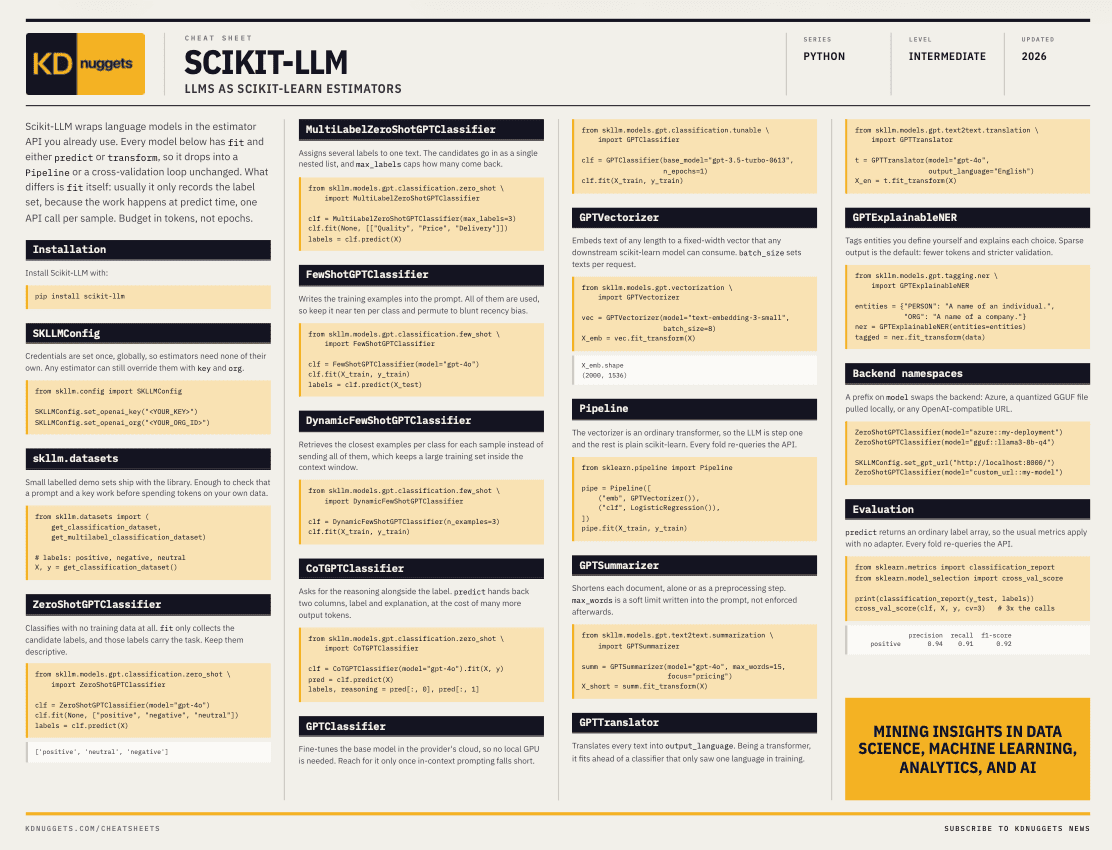
Scikit-LLM: Bridging LLMs and Traditional ML
The machine learning landscape is rapidly evolving, with large language models (LLMs) like GPT-3, BERT, and T5 demonstrating remarkable capabilities in natural language understanding and generation. However, integrating these powerful models into existing machine learning workflows, particularly those built around the ubiquitous scikit-learn library, has presented a significant challenge. Scikit-LLM emerges as a solution, providing a robust wrapper that allows developers to treat LLMs as first-class estimators within the scikit-learn API. This integration means LLMs can now seamlessly slot into pipelines, undergo cross-validation, and be fine-tuned using familiar scikit-learn tools, democratizing advanced NLP capabilities for a broader developer audience.
Core Concept: LLM Estimators
At its heart, Scikit-LLM's innovation lies in its ability to abstract the complexities of interacting with various LLMs behind the standardized scikit-learn estimator interface. This interface, familiar to millions of developers, consists of methods like fit(), predict(), and transform(). By adhering to this API, Scikit-LLM ensures that LLMs can be used interchangeably with traditional scikit-learn models. For instance, an LLM can now serve as a component in a scikit-learn Pipeline, allowing for sequential application of preprocessing steps, feature extraction, and LLM-based prediction or generation. This drastically simplifies the development of complex NLP applications, where tasks like sentiment analysis, text summarization, or question answering can be built with a consistent and predictable structure.
Key Components and Functionality
Scikit-LLM offers several key estimators tailored for different LLM functionalities:
Text Generation Estimators
For tasks involving the creation of new text, Scikit-LLM provides estimators that leverage LLMs for generation. These can be used for a variety of creative and practical applications, from writing marketing copy to generating code snippets. The underlying LLM is configured with parameters such as temperature, top-p sampling, and maximum token length, all accessible through the scikit-learn API. This allows for fine-grained control over the generated output, making it possible to balance creativity with coherence and relevance.
Text Classification Estimators
Classifying text into predefined categories is a fundamental NLP task. Scikit-LLM wraps LLMs to perform this function, treating the LLM as a classifier. The process typically involves prompting the LLM to assign a label to a given text input. This approach is particularly powerful for zero-shot or few-shot classification, where the LLM can classify text into categories it hasn't been explicitly trained on, simply by understanding the category descriptions provided in the prompt. This significantly reduces the need for large, labeled datasets for many classification tasks.
Text Embedding Estimators
Generating meaningful numerical representations (embeddings) of text is crucial for many downstream tasks, including similarity search, clustering, and input to other machine learning models. Scikit-LLM includes estimators that utilize LLMs to produce these embeddings. These embeddings often capture semantic nuances that traditional methods might miss, leading to improved performance in tasks that rely on understanding the meaning of text.
Prompt Engineering and Management
A critical aspect of working with LLMs is effective prompt engineering. Scikit-LLM acknowledges this by providing tools and structures that facilitate prompt management. While the library itself focuses on the estimator API, it encourages best practices in prompt design that are essential for maximizing LLM performance. Developers can easily experiment with different prompts within their scikit-learn pipelines, treating prompt variations as hyperparameters that can be tuned during model selection or cross-validation.
Seamless Integration with Scikit-learn Pipelines
The true power of Scikit-LLM lies in its seamless integration with scikit-learn.pipeline.Pipeline. A pipeline allows you to chain multiple estimators together, ensuring that data is processed consistently through each step. Imagine a workflow where you first clean and preprocess text using scikit-learn's built-in transformers (like TfidfVectorizer or custom text cleaners), and then feed the processed text into an LLM estimator for sentiment analysis or summarization. This is now straightforward. The pipeline handles the sequential application of these steps, making the entire workflow more robust, reproducible, and easier to manage. This is akin to having a highly organized assembly line where each station performs a specific task, culminating in a finished product, but with the flexibility to swap out any station with an equivalent one.
Cross-Validation and Hyperparameter Tuning
Beyond pipelines, Scikit-LLM estimators are compatible with scikit-learn's robust cross-validation and hyperparameter tuning tools, such as GridSearchCV and RandomizedSearchCV. This means you can rigorously evaluate the performance of LLM-based models, tune their internal parameters (like prompt templates or specific LLM configurations), and compare them against other models using standard practices. This level of integration was previously difficult, often requiring custom scripting to manage LLM interactions within evaluation loops. Now, developers can leverage the same tools they use for traditional models to optimize their LLM applications.
Supported LLM Backends
Scikit-LLM is designed to be backend-agnostic, supporting a range of popular LLM providers and models. This includes interfaces to OpenAI's GPT models, Hugging Face's Transformers library, and potentially others. This flexibility allows developers to choose the LLM that best suits their needs in terms of performance, cost, and availability, while still benefiting from the unified Scikit-LLM API. The ability to switch between different LLM providers without significant code refactoring is a major advantage for production environments and experimentation.
The Future of LLMs in ML Workflows
Scikit-LLM represents a significant step forward in making advanced LLM capabilities accessible to the broader machine learning community. By abstracting LLMs into the scikit-learn estimator paradigm, it lowers the barrier to entry for developers who are already proficient in scikit-learn. This allows for more rapid prototyping, easier experimentation, and more robust deployment of LLM-powered applications. As LLMs continue to advance, tools like Scikit-LLM will be crucial in integrating them effectively into the established ML development lifecycle, fostering innovation across a wide range of industries.