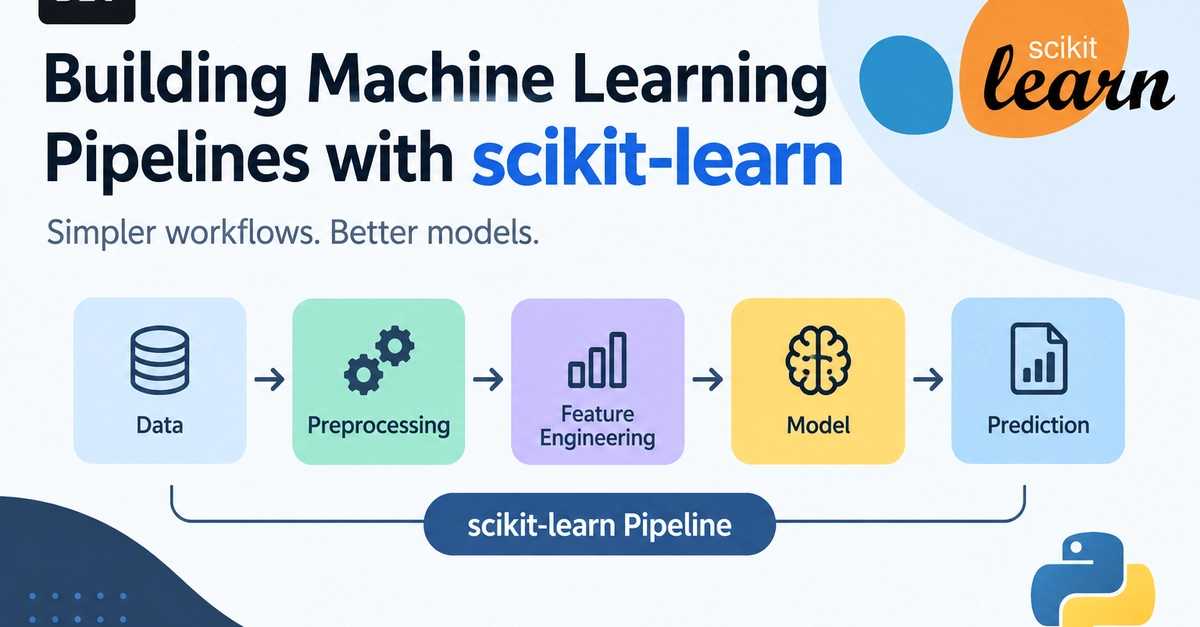
Introduction to Data Preprocessing Challenges
Real-world datasets are rarely pristine. They often contain errors, missing values, and inconsistencies, making them unsuitable for direct analysis or model training. Before any machine learning model can be applied, a series of data preprocessing steps are necessary. These typically include cleaning the data, handling missing values, transforming features (like scaling numerical columns or encoding categorical ones), and feature selection. Each of these steps must be applied consistently, especially when dealing with multiple batches of data or when retraining models.
Manually performing these operations on raw data is not only time-consuming but also highly prone to errors. A mistake in one step, or inconsistent application across different data subsets, can lead to skewed results, poor model performance, and difficulty in reproducing findings. This iterative process of cleaning, transforming, and modeling data is a core part of the machine learning workflow, and its manual execution presents a significant bottleneck.
The Scikit-learn Pipeline Solution
Scikit-learn's Pipeline object offers an elegant solution to these challenges. It allows users to chain together multiple data preprocessing steps and a final estimator (like a classifier or regressor) into a single, cohesive object. This single pipeline object encapsulates the entire workflow, from raw input data to the final prediction or classification. When you call a method like fit or predict on the pipeline, it automatically applies each step in sequence to the data, ensuring that all transformations are learned and applied correctly.
Think of a scikit-learn pipeline like an automated assembly line for your machine learning model. Raw materials (your data) enter at one end. Each station on the assembly line performs a specific task: cleaning, shaping, painting (preprocessing steps). Finally, the finished product (your trained model) emerges at the other end, ready for deployment or prediction. This structured approach dramatically simplifies the end-to-end machine learning process.
Key Benefits of Using Pipelines
The adoption of scikit-learn Pipelines brings several critical advantages to the machine learning workflow:
- Prevents Data Leakage: This is perhaps the most crucial benefit. Steps like feature scaling (e.g., using
StandardScaler) or imputation (e.g., usingSimpleImputer) learn their parameters (like mean, standard deviation, or imputation values) exclusively from the training data during thefitphase. Whentransformis called on subsequent data (validation or test sets), these learned parameters are applied. This prevents information from the test set from inadvertently influencing the training process, a common source of overly optimistic performance estimates. - Cleaner and More Organized Code: Instead of scattering multiple function calls for preprocessing and then a separate model training call, a pipeline consolidates everything into a single object. This makes the code more readable, maintainable, and less prone to configuration errors. You manage one object instead of a sequence of operations.
- Simplified Hyperparameter Tuning: When you want to tune hyperparameters for your entire workflow (e.g., the regularization strength of a logistic regression and the `max_iter` of a `StandardScaler`), scikit-learn's tools like
GridSearchCVandRandomizedSearchCVcan be applied directly to the pipeline. They will efficiently search the hyperparameter space, fitting and evaluating the entire pipeline for each combination. - Improved Reproducibility: By defining the entire process from raw data to model in a single, serializable object, pipelines ensure that the exact same preprocessing steps and model are applied every time. This is vital for debugging, validating results, and deploying models reliably.
Constructing a Scikit-learn Pipeline
Creating a pipeline involves defining a list of (name, estimator) tuples. Each tuple represents a step in the workflow. The 'name' is a string identifier for that step, and the 'estimator' is a scikit-learn object that implements fit and transform (for preprocessing steps) or just fit (for the final estimator). The order of these tuples dictates the order in which the steps are executed.
For example, consider a common scenario involving numerical and categorical features. You might need to scale numerical features and one-hot encode categorical features before feeding them into a classifier.
A typical pipeline construction might look like this:
from sklearn.pipeline import Pipeline
from sklearn.preprocessing import StandardScaler, OneHotEncoder
from sklearn.compose import ColumnTransformer
from sklearn.linear_model import LogisticRegression

# Define preprocessing steps for numerical and categorical features
numerical_features = ['age', 'income']
categorical_features = ['city', 'gender']

# Create transformers for numerical and categorical data
numerical_transformer = Pipeline(steps=[('scaler', StandardScaler())])
categorical_transformer = Pipeline(steps=[('onehot', OneHotEncoder(handle_unknown='ignore'))])

# Combine transformers using ColumnTransformer
preprocessor = ColumnTransformer(
    transformers=[
        ('num', numerical_transformer, numerical_features),
        ('cat', categorical_transformer, categorical_features)
    ])

# Create the full pipeline including the preprocessor and the final estimator
full_pipeline = Pipeline(steps=[
    ('preprocessor', preprocessor),
    ('classifier', LogisticRegression(solver='liblinear'))
])
In this example, the preprocessor itself is a ColumnTransformer, which is a powerful tool for applying different transformations to different columns. This preprocessor is then treated as a single step within the larger full_pipeline. The final step is the LogisticRegression classifier.
Using the Pipeline
Once constructed, the pipeline is used like any other scikit-learn estimator. You fit it to your training data and use it to make predictions on new data.
# Assuming X_train, y_train are your training data and labels
full_pipeline.fit(X_train, y_train)

# Assuming X_test is your test data
predictions = full_pipeline.predict(X_test)

# You can also get probabilities if your model supports it
probabilities = full_pipeline.predict_proba(X_test)
The fit method trains all the preprocessing steps using the training data and then trains the final classifier. The predict method applies the learned transformations to the input data and then passes the transformed data to the trained classifier's predict method. This ensures that the entire process is consistent and reproducible.
Beyond Basic Pipelines
Scikit-learn's pipeline functionality extends to more complex scenarios. For instance, you can create pipelines of pipelines, or use custom transformers. The make_pipeline function is a convenient shorthand for creating pipelines without explicitly naming each step; scikit-learn will infer names from the estimator classes.
The ability to integrate pipelines with hyperparameter tuning tools like GridSearchCV is a significant productivity booster. Instead of manually creating parameter grids for each step and then combining them, you define a parameter grid for the pipeline, referencing parameters using the step name and a double underscore (e.g., 'classifier__C': [0.1, 1, 10]). This allows for comprehensive optimization of the entire machine learning process.
What remains to be seen is how deeply integrated these pipeline concepts will become with MLOps platforms. While pipelines are fundamental to scikit-learn, effectively serializing, versioning, and deploying complex pipelines as part of larger CI/CD workflows still requires robust MLOps tooling. The seamless transition from local development with pipelines to production-ready deployment is an ongoing area of development in the MLOps ecosystem.