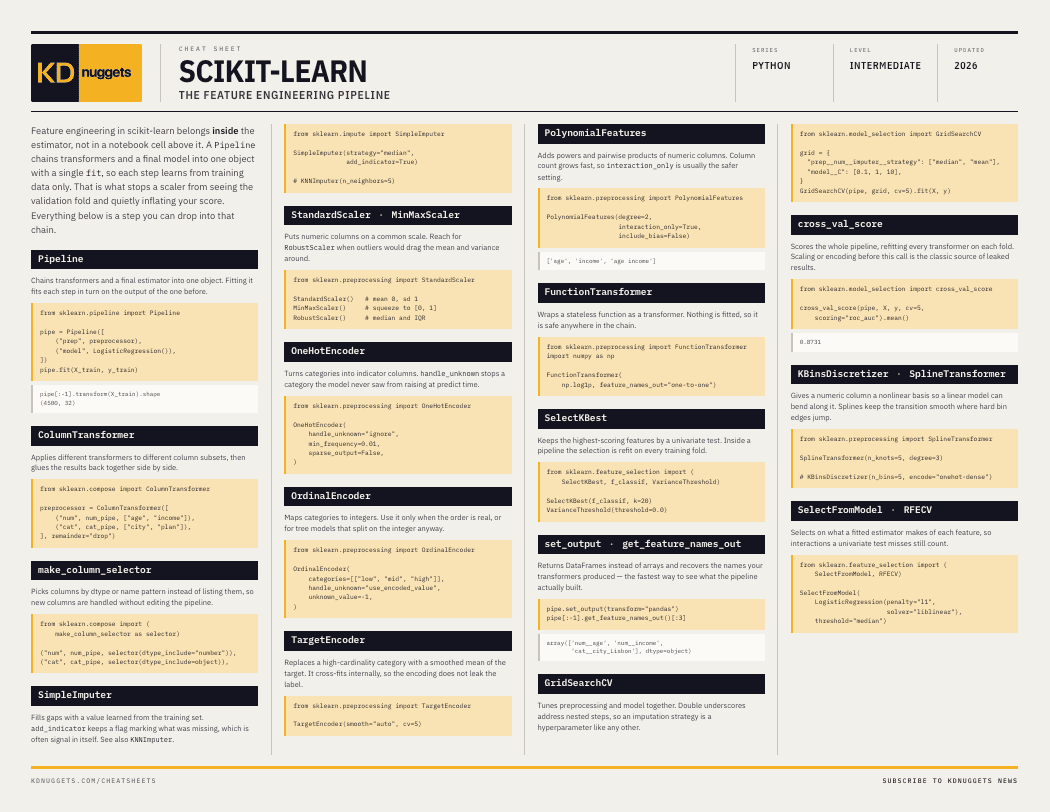
The Importance of Integrated Feature Engineering
Feature engineering is a critical step in the machine learning pipeline. It involves transforming raw data into features that better represent the underlying problem to predictive models, resulting in improved accuracy and performance. However, performing feature engineering manually outside of a structured framework like Scikit-Learn's Pipeline can lead to significant issues, most notably data leakage. When feature transformations are applied independently after model training, the model might inadvertently learn from information present in the test set during the transformation phase, leading to overly optimistic performance metrics that do not generalize to unseen data. This is akin to a student seeing the exam answers before taking the test – they might perform perfectly on that specific exam, but their true understanding of the subject remains untested and potentially weak.
The KDnuggets cheat sheet focuses on a best practice: encapsulating all feature engineering steps within a Scikit-Learn Pipeline. This ensures that each transformation is fitted *only* on the training data. When the pipeline is later applied to new data (either for validation or prediction), the fitted transformations are used without refitting, preventing data leakage and providing a more realistic assessment of the model's performance. This integration is not merely about convenience; it's fundamental to building reliable and deployable machine learning systems.
Core Concepts of Scikit-Learn Pipelines
A Scikit-Learn Pipeline is a sequence of data transformations and a final estimator (like a classifier or regressor). It allows you to chain multiple processing steps together. Each step in the pipeline is an object that implements a fit() and a transform() method (or just fit() for the final estimator). When you call fit() on a pipeline, it sequentially calls fit_transform() on all but the last step, and then calls fit() on the last step. When you call predict() or transform() on a pipeline, it sequentially calls transform() on all but the last step, and then calls predict() or transform() on the last step.
The primary advantage of using pipelines for feature engineering is that it bundles preprocessing and modeling into a single object. This simplifies the workflow, reduces the chances of errors, and makes it easier to apply the same sequence of operations to different datasets. For feature engineering specifically, this means that steps like imputation, scaling, encoding categorical variables, or creating polynomial features can all be defined as distinct steps within the pipeline. Each of these steps will be correctly applied – fitted on training data and then transformed on both training and test data.
Common Feature Engineering Techniques within Pipelines
The KDnuggets cheat sheet highlights several common feature engineering techniques that can be seamlessly integrated into Scikit-Learn pipelines. These include:
Handling Missing Values (Imputation)
Missing data is a ubiquitous problem. Pipelines can incorporate imputation strategies to fill these gaps. Common imputers include SimpleImputer (for filling with mean, median, mode, or a constant) and more advanced strategies like IterativeImputer (which models each feature with missing values as a function of other features).
Scaling Numerical Features
Many machine learning algorithms are sensitive to the scale of input features. Techniques like standardization (StandardScaler, which centers data around the mean with a unit standard deviation) and normalization (MinMaxScaler, which scales features to a given range, typically [0, 1]) are essential. Including these in a pipeline ensures they are fitted correctly on the training data and then applied to all subsequent data splits.
Encoding Categorical Features
Categorical data, such as text labels or categories, needs to be converted into numerical representations. Pipelines can employ encoders like OneHotEncoder (for nominal categories) and OrdinalEncoder (for ordinal categories). Using these within a pipeline prevents issues like accidentally encoding unseen categories during model evaluation.
Feature Creation and Transformation
Beyond basic imputation and scaling, pipelines can accommodate custom feature creation. This might involve creating polynomial features (PolynomialFeatures) to capture non-linear relationships or applying custom transformations using FunctionTransformer. For instance, one could create interaction terms between existing features or apply logarithmic transformations to skewed data.
Building and Using Feature Engineering Pipelines
Constructing a pipeline involves defining a list of (name, estimator) tuples. For example, a pipeline might start with an imputer, followed by a scaler, and then a model. The make_pipeline() function is a convenient way to create a pipeline without explicitly naming each step.
Consider the following conceptual example:
from sklearn.pipeline import Pipeline
from sklearn.impute import SimpleImputer
from sklearn.preprocessing import StandardScaler, OneHotEncoder
from sklearn.compose import ColumnTransformer
from sklearn.linear_model import LogisticRegression

# Define preprocessing for numerical and categorical features
numerical_features = ['age', 'income']
categorical_features = ['gender', 'city']

numerical_transformer = Pipeline(steps=[('imputer', SimpleImputer(strategy='median')),
                                      ('scaler', StandardScaler())])

categorical_transformer = Pipeline(steps=[('imputer', SimpleImputer(strategy='most_frequent')),
                                          ('onehot', OneHotEncoder(handle_unknown='ignore'))])

# Create a column transformer to apply different transformations to different columns
preprocessor = ColumnTransformer(
    transformers=[
        ('num', numerical_transformer, numerical_features),
        ('cat', categorical_transformer, categorical_features)])

# Create the full pipeline including preprocessing and the model
model_pipeline = Pipeline(steps=[('preprocessor', preprocessor),
                                 ('classifier', LogisticRegression())])

# Now, fit the entire pipeline on your training data
# model_pipeline.fit(X_train, y_train)

# And use it for predictions on new data
# predictions = model_pipeline.predict(X_test)
The use of ColumnTransformer within the pipeline is particularly powerful. It allows for applying different preprocessing steps to different subsets of columns (e.g., numerical vs. categorical) before combining them. This modularity is key to managing complex feature engineering tasks effectively.
Benefits of Pipeline Integration
Integrating feature engineering into Scikit-Learn pipelines offers several key advantages:
- Prevents Data Leakage: As emphasized, fitting transformations only on training data is the most significant benefit, ensuring realistic model evaluation.
- Reproducibility: The entire workflow, from raw data to predictions, is encapsulated in a single object. This makes the process repeatable and easier to debug.
- Simplified Workflow: Complex preprocessing chains become manageable. You can experiment with different feature engineering steps by simply modifying the pipeline configuration.
- Cross-Validation Compatibility: Pipelines work seamlessly with Scikit-Learn's cross-validation tools (e.g.,
cross_val_score). The pipeline is refit for each fold, ensuring that each fold's test set is protected from leakage. - Easier Deployment: A trained pipeline can be saved and loaded, making it straightforward to deploy the entire preprocessing and modeling logic to production environments.
The KDnuggets cheat sheet serves as a practical guide for developers to adopt these best practices. By internalizing feature engineering within pipelines, practitioners can build more robust, reliable, and performant machine learning models.