SAFi: Shifting Governance to the Operational Core
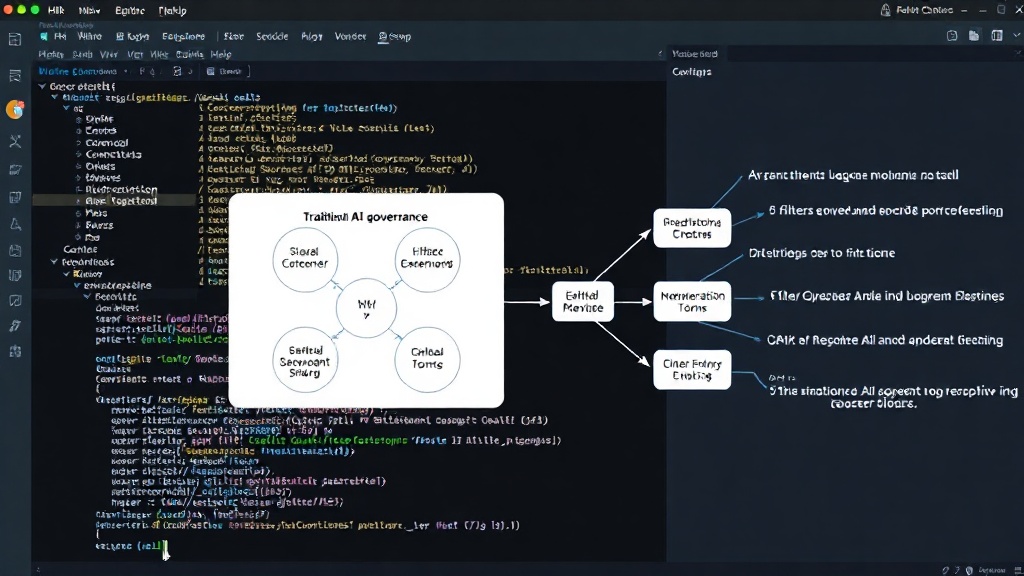
The prevailing approach to AI governance treats it as an afterthought – a layer of filters, classifiers, and guardrails applied after an AI model has generated its output. This conventional architecture places the model at the center, with a perimeter of checks designed to catch undesirable behavior. However, this model is fundamentally limited. It doesn't govern the AI agent's operational process, only its final output. This is where SAFi, a new framework, aims to redefine AI governance by embedding it directly into the runtime operations of an AI agent.
The distinction between shaping model behavior and governing agent operation is critical. An AI agent is more than just a language model that produces text. It encompasses a complex system that interprets requests, reasons about potential responses, makes decisions about actions, interacts with tools, accesses and potentially modifies data, and ultimately produces an answer that must be accountable to the deploying organization. SAFi addresses this by moving governance from a peripheral add-on to an intrinsic part of the agent's execution.
Beyond RLHF and Constitutional AI
Comparisons to techniques like Reinforcement Learning from Human Feedback (RLHF) and Constitutional AI are useful but incomplete. RLHF primarily focuses on aligning model outputs with human preferences, essentially refining the model's behavior. Constitutional AI introduces explicit principles into the generation and evaluation process, offering a closer conceptual parallel. However, both RLHF and Constitutional AI primarily shape how a model behaves. SAFi, on the other hand, governs how an AI agent operates.
Consider an AI agent tasked with managing customer support tickets. In a traditional setup, the language model might draft a response, which then passes through content filters for politeness and safety, and perhaps a classifier to check for policy adherence. If a problem arises, it's usually a failure of these post-hoc checks. SAFi would integrate governance into the agent's decision-making loop. Before acting, the agent might consult its operational policies (its 'runtime governance') to determine if a specific action, like modifying a customer's account details, is permissible based on the request, user role, and current system state. It's about building the rules into the agent's reasoning and action-selection process, not just reviewing its final communication.
The SAFi Architecture: Governance Integrated
SAFi's core innovation is its architectural shift. Instead of a perimeter defense, it proposes a system where governance logic is interwoven with the agent's core functions. This means that before an AI agent can perform an action—whether it's retrieving sensitive data, executing a command, or even generating a specific type of response—it must first consult and adhere to its embedded governance rules. This is akin to an organization having its internal policies and compliance officers not just review documents after they're written, but actively participate in the decision-making process leading to those documents.
This runtime governance approach has several key implications:
- Proactive Compliance: Instead of reacting to potential violations, SAFi enables agents to proactively ensure compliance at every step.
- Accountability: By integrating governance into the operational flow, it becomes clearer which decisions led to specific outcomes, enhancing accountability.
- Flexibility and Adaptability: Governance rules can be updated and managed as part of the agent's operational configuration, allowing for more agile policy adjustments than retraining a model or overhauling a complex filtering system.
- Reduced Risk: By preventing unauthorized or unsafe actions before they occur, SAFi significantly reduces the risk surface for AI deployments.
The challenge for organizations deploying AI agents is to ensure these systems operate safely, ethically, and in alignment with business objectives. SAFi offers a paradigm shift from reactive safety nets to proactive, integrated operational control. This isn't just about preventing a model from saying the wrong thing; it's about ensuring the entire AI agent operates within defined boundaries, making it a more reliable and trustworthy component of any business process.
The Future of AI Operations
The move towards runtime governance signifies a maturation of AI deployment practices. As AI agents become more autonomous and integrated into critical business functions, the need for robust, inherent control mechanisms becomes paramount. SAFi's approach moves governance from a bolted-on feature to a foundational element, recognizing that true AI safety and accountability are built, not merely filtered.
The question remains: how will organizations effectively translate complex, evolving regulatory landscapes and internal policies into the structured, executable governance rules that SAFi requires? The success of this paradigm hinges on the development of intuitive tools and methodologies for defining and managing these runtime governance policies. For developers and operators, this means a new skillset will be required, focusing on the intersection of AI logic and operational policy definition, moving beyond prompt engineering and model tuning to architecting responsible AI operations from the ground up.