The Problem: AI Agents and Dangerous Actions
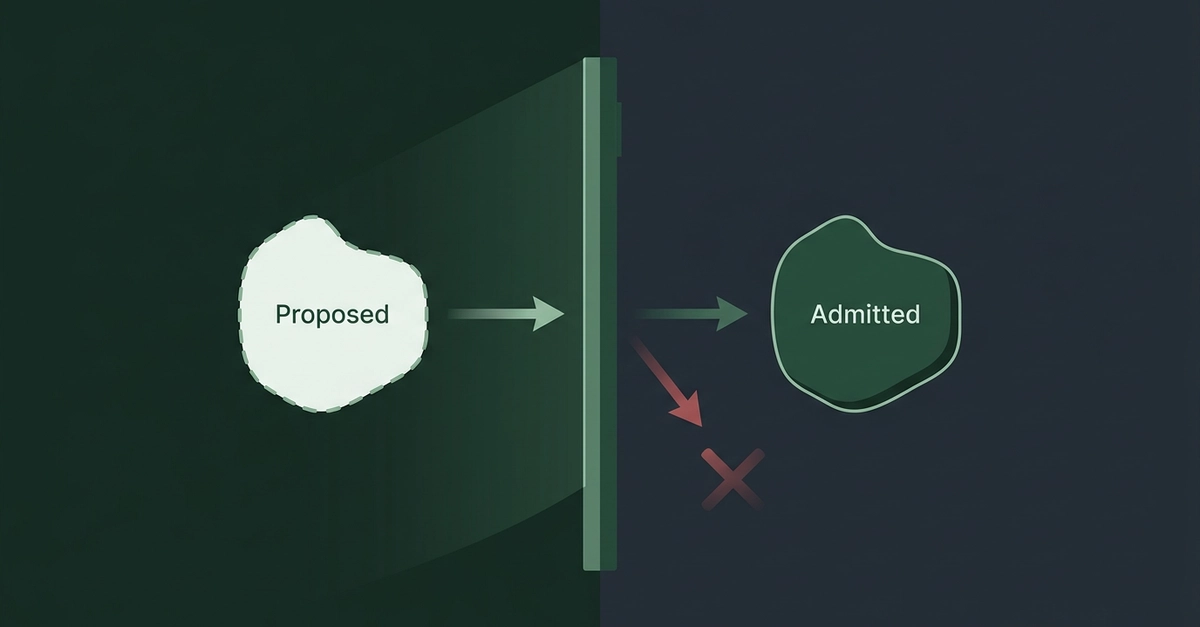
AI agents are increasingly tasked with real-world actions, moving beyond simple data retrieval to operations like writing to databases, sending emails, approving refunds, or modifying production configurations. Each step up this spectrum introduces greater risk. The conventional approach to managing this risk involves runtime guardrails: an agent proposes an action, which is then validated, policy-checked, and either allowed or denied before execution. This system, while functional, relies on the agent correctly identifying potential dangers and the guardrail logic accurately assessing risk in real-time. A failure at any point can lead to unintended and potentially severe consequences.
Consider the simple act of deleting a record. An agent might propose this action. A guardrail would then check if the agent has permission, if the record is critical, or if a backup exists. If all checks pass, the deletion proceeds. But what if the agent misunderstands the context, or the guardrail logic has a subtle bug? The record is gone, and the damage is done. This reactive, runtime-based safety net feels akin to a self-driving car only applying brakes after it detects an obstacle directly in front of it, rather than being programmed to avoid known hazards from the outset.
A New Paradigm: Unrepresentable Actions with Rust
The article proposes a fundamental shift: instead of trying to *detect* unsafe actions at runtime, we should aim to make them *unrepresentable* at compile time using Rust's powerful type system. This means designing the agent's action interfaces so that unsafe operations simply cannot be expressed or called within the agent's code unless explicitly permitted and correctly handled.
Rust's strength lies in its guarantees. It enforces memory safety and thread safety at compile time, eliminating entire classes of bugs before the code even runs. The same principle can be applied to AI agent actions. Imagine an agent's capabilities defined not as a free-form string of commands, but as a structured set of types. For instance, the ability to read data might be represented by a type that can only produce read-only data structures. Writing to a durable state could be a different type, requiring specific permissions and perhaps returning a success or failure status that the agent *must* handle.
The core idea is to encode the safety constraints directly into the Rust types that represent an agent's capabilities. An agent designed for low-risk tasks would simply not have access to types that represent dangerous actions like deleting production data. If an agent *needs* to perform a sensitive action, its type definition would have to explicitly include the capability for that action, along with any associated prerequisites or handling requirements. This is not about adding more runtime checks; it's about the compiler preventing the *possibility* of an unsafe call.
How Rust Enables Compile-Time Safety
Rust's type system, ownership, and borrowing rules provide the foundation for this approach. By carefully defining data structures and function signatures, developers can create an API for agent actions that is inherently safe.
- Strong Typing: Every piece of data and every capability is strictly typed. An action that modifies state would have a return type that mandates explicit error handling, unlike a simple `void` or success/fail boolean that could be ignored.
- Ownership and Borrowing: These concepts ensure that mutable access to critical resources is carefully managed. An agent can only borrow mutable access to data it's explicitly granted permission to modify, and that permission is encoded in its type.
- Traits and Generics: These allow for flexible yet safe abstraction. Capabilities can be defined as traits, and agents can be generic over the capabilities they possess. This means an agent can be constrained to only implement specific sets of safe traits.
- Enums for States and Outcomes: Instead of relying on runtime boolean flags, Rust's enums can represent discrete states or outcomes. For example, an action might return an enum `ActionResult { Success(SavedData), Failure(ErrorType), RequiresConfirmation(ConfirmationDetails) }`. The compiler would force the agent to handle all possible variants.
This compile-time enforcement acts like a meticulous editor reviewing your code before publication. It catches potential errors – like an agent attempting an action it shouldn't have access to – before they can ever manifest in a running system. The dangerous action is not just flagged; it's rendered impossible to call within the current context.
The Unanswered Question: Migration and Legacy Systems
While this compile-time safety model is compelling for new agent development, a significant challenge remains: how does this apply to existing systems and agents built without these strict Rust-based constraints? What happens to the vast ecosystem of agents and AI tools that rely on more traditional, runtime-checked safety mechanisms? Migrating complex, stateful AI agents to a system that relies on compile-time guarantees could be a monumental undertaking. Furthermore, how do we integrate Rust-based safe agents with legacy systems that cannot offer the same level of compile-time assurance? The path from a runtime guardrail world to a type-unrepresentable world is not yet clear and will likely require sophisticated bridging mechanisms or phased adoption strategies.
Beyond Guardrails: A Shift in Mindset
The real power of this Rust-based approach lies in its philosophical shift. Instead of building more complex runtime checks to police increasingly sophisticated AI behavior, we leverage the compiler to enforce safety proactively. This is akin to designing a physical lock so that it's impossible to insert the wrong key, rather than relying on a guard to stop someone from trying. The goal is to make the *design* of the system inherently safe, so that unsafe actions are not just discouraged, but impossible to implement accidentally.
This approach demands a deeper understanding of the AI agent's intended capabilities and a more rigorous design process. Developers must think about the 'what' and 'how' of an agent's actions at the type level. For instance, an agent that can only read user profiles might have a type like `ReadOnlyUserAgent`. An agent that can *also* update user profiles would need a different, more permissive type, perhaps `ReadWriteUserAgent`, and its functions would clearly reflect this increased capability. The compiler then acts as the enforcer, ensuring that a `ReadOnlyUserAgent` instance never has access to functions that could modify user data.
The implications extend beyond just preventing accidental deletions or unauthorized modifications. This paradigm could also help in reasoning about the agent's overall behavior and its potential attack surface. If an action is unrepresentable, it cannot be exploited. This shifts the burden of proof from runtime verification to static analysis and type design, a trade-off that often leads to more robust and secure systems.
Conclusion: A Future of Compile-Time Assured AI Actions
The promise of using Rust's type system to make unsafe AI agent actions unrepresentable is significant. It offers a path toward building AI systems that are not only intelligent but also fundamentally safer by design. By encoding safety constraints into the very types that define an agent's capabilities, we can prevent a vast array of potential errors at compile time, rather than trying to catch them at runtime. While challenges in migration and integration with legacy systems exist, the shift toward compile-time assurance represents a powerful evolution in AI safety engineering, moving from reactive guardrails to proactive, unrepresentable safety.