
The Challenge of Tail Calls in Rust
Tail-call optimization (TCO) is a compiler optimization that allows a function to reuse the call stack frame of its caller when making a recursive call. This is particularly useful in functional programming languages and for implementing interpreters, as it prevents stack overflows for deeply recursive operations. However, Rust, by default, does not guarantee tail-call optimization. This is a deliberate design choice, primarily to ensure predictable stack behavior and to avoid complexities that could arise in manual memory management scenarios within the language's safety guarantees.
While Rust's standard compiler (rustc) does not perform TCO, it doesn't mean it's impossible to achieve similar benefits. The primary approach involves manual implementation of tail-recursive patterns, often by transforming recursive calls into loops or by using explicit stack data structures. For interpreters, which often rely heavily on recursive descent or trampolining, this can be a significant hurdle. The goal is to simulate the effect of TCO without relying on the compiler to perform the optimization automatically.
Simulating Tail Calls with Interpreters
Interpreters often process abstract syntax trees (ASTs) or bytecode. A naive recursive implementation might look like this:
fn interpret_node(node: &Node) -> Value {
    match node {
        Node::Literal(v) => *v,
        Node::Add(left, right) => {
            let left_val = interpret_node(left);
            let right_val = interpret_node(right);
            left_val + right_val
        },
        Node::RecursiveCall(inner) => {
            // This is where TCO would be beneficial
            interpret_node(inner)
        }
        // ... other node types
    }
}
In the case of a tail-recursive call, like Node::RecursiveCall(inner), the result of interpret_node(inner) is directly returned without any further computation. In a language with TCO, this would reuse the current stack frame. In Rust, this recursive call would push a new frame onto the stack, potentially leading to a stack overflow for deep recursion.
To overcome this, developers often resort to explicit loops and a managed stack. This involves transforming the recursive structure into an iterative one. The interpreter would maintain its own stack, pushing and popping frames as needed. This approach is sometimes referred to as trampolining or continuation-passing style (CPS) when applied more formally.
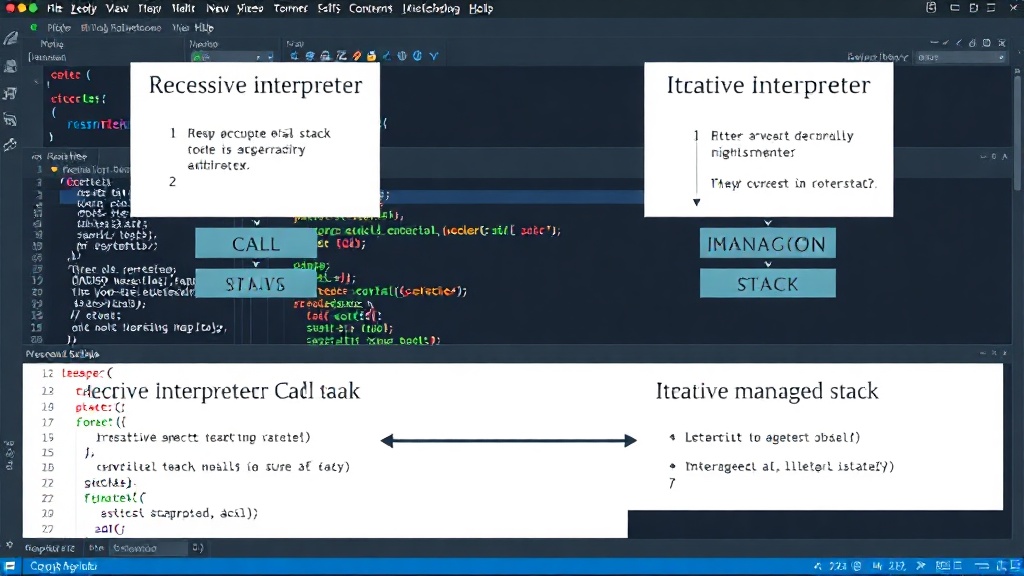
Implementing a Tail-Call-Like Interpreter in Rust
A common pattern to achieve tail-call-like behavior in Rust interpreters is to use an explicit worklist or a loop that processes statements or AST nodes. Instead of calling the interpreter function recursively for the tail call, the interpreter updates its internal state and continues the loop. This effectively unrolls the recursion into iteration.
Consider an interpreter for a simple language with functions. A function call that is not the last operation in its own function would involve pushing the current execution context onto a managed stack and then jumping to the called function's code. A tail call, however, would simply replace the current execution context with the new one, without pushing anything extra. This is precisely what a loop can achieve.
Let's outline a loop-based approach:
- Maintain a stack of execution frames. Each frame would contain the current instruction pointer, local variables, and the AST node being processed.
- The main interpreter loop continues as long as there are frames on the stack.
- When a function is called (not a tail call), push a new frame onto the stack.
- When a tail call is encountered, instead of pushing a new frame, replace the current frame with the new one. This can be done by popping the current frame and pushing the new one, or more efficiently, by directly modifying the current frame's state before the next loop iteration.
- Handle return values: when a function returns, pop its frame and resume execution in the caller's frame.
This pattern is conceptually similar to how virtual machines execute bytecode. The interpreter itself becomes a state machine, and the explicit stack manages the program's execution context. The key is that a tail call does not increase the depth of this managed stack.
Performance Implications and Trade-offs
While this manual approach avoids stack overflows, it does come with trade-offs. The overhead of managing an explicit stack can be higher than what a compiler-optimized TCO would provide. However, for many interpreter use cases, especially those dealing with potentially deep, but not infinitely deep, recursion, this iterative approach is robust and performant enough. It also offers more control over memory management and error handling.
The surprising detail here is that while Rust doesn't offer TCO out-of-the-box, the language's strengths in explicit control flow and data structure management make implementing efficient, stack-safe interpreters quite feasible. It shifts the burden from the compiler to the developer, requiring a deeper understanding of execution contexts.
The Future of TCO in Rust
There have been discussions within the Rust community about the possibility of TCO, particularly in specific contexts like WebAssembly compilation where TCO is often supported. However, as of now, the core language and its standard compiler do not guarantee it. Developers targeting these specific environments might see TCO enabled by the backend compiler (e.g., LLVM for WASM). For general-purpose Rust, the manual iterative approach remains the standard and most reliable method for building stack-safe interpreters and handling deep recursion.
If you're building a complex interpreter or a system that might hit deep recursion limits in Rust, understanding and implementing these iterative patterns is crucial. It's not about waiting for the compiler; it's about leveraging Rust's explicit control to build robust systems.