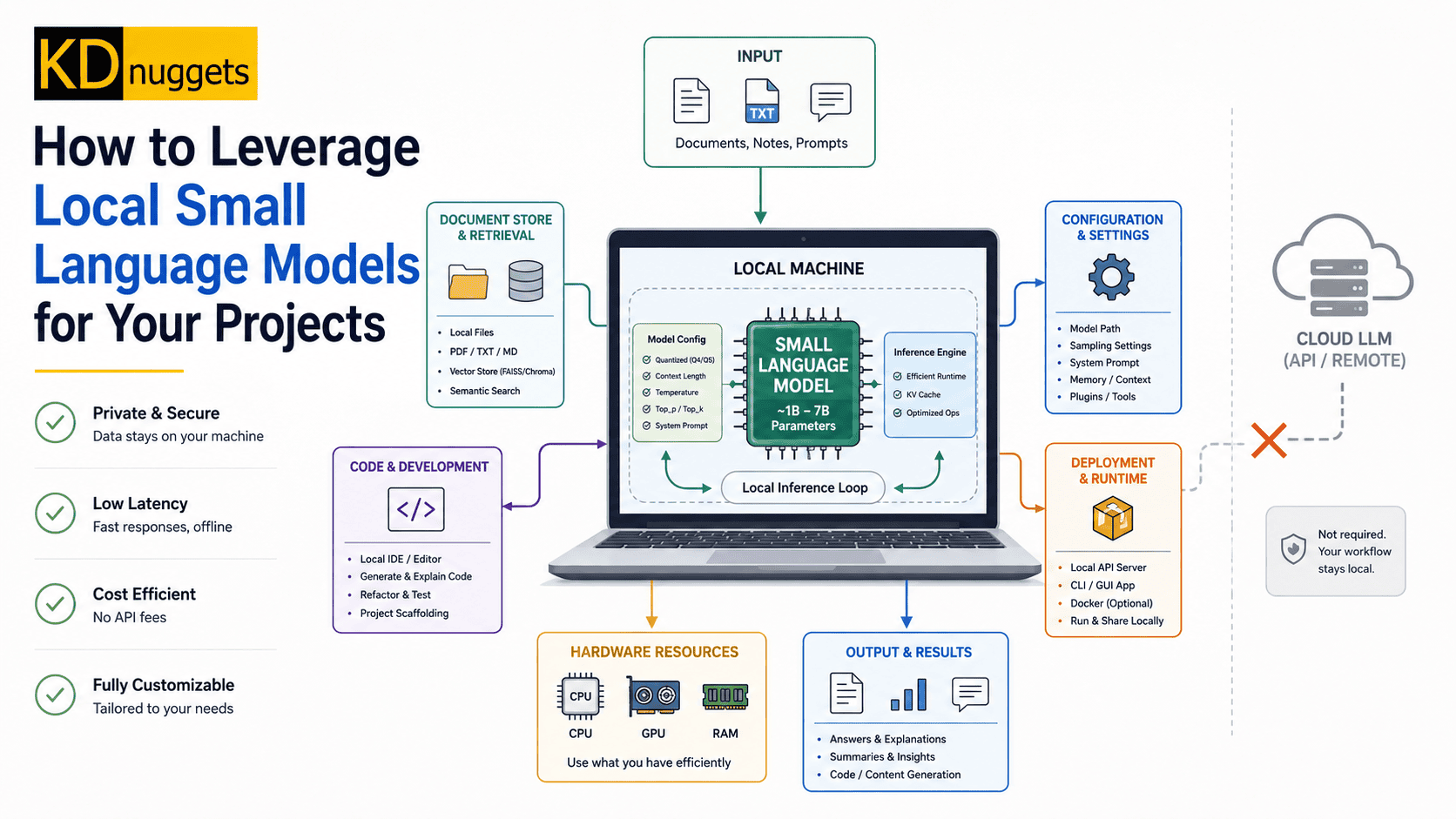
The Rise of Local Small Language Models
The artificial intelligence landscape is rapidly evolving, with large language models (LLMs) like GPT-4 and Claude dominating headlines. However, a powerful, often overlooked trend is the rise of small language models (sLLMs) that can be run locally on your own hardware. This approach offers significant advantages for developers, founders, and security professionals seeking faster, more cost-effective, and privacy-preserving AI solutions. Running LLMs locally means moving away from reliance on external APIs and cloud infrastructure, granting greater control over data, performance, and deployment.
This shift is driven by several factors. Firstly, the sheer cost of API calls to large, cloud-hosted models can quickly escalate for applications with high usage. Secondly, data privacy concerns are paramount for many businesses and individuals; sending sensitive information to third-party servers, even with strong assurances, is a non-starter for some use cases. Finally, local execution can offer superior latency, crucial for real-time applications where every millisecond counts. SLLMs, despite their smaller size, are becoming increasingly capable, often matching or exceeding the performance of their larger counterparts on specific, well-defined tasks.
Why Choose Local sLLMs? The Core Advantages
The primary benefits of leveraging local small language models boil down to three key areas: speed, cost, and privacy. For speed, consider the latency involved in sending a request to a remote server, processing it, and receiving a response. This round trip can introduce delays that are unacceptable for interactive applications like chatbots or real-time content generation. When an sLLM runs on the same machine or within the same local network as your application, this latency is dramatically reduced, often to mere milliseconds. This is akin to having a brilliant assistant sitting right next to you, ready to answer questions instantly, rather than having to send a memo across town and wait for a reply.
Cost savings are another major driver. Cloud-based LLM APIs typically charge per token, per API call, or based on compute time. For applications with millions of users or high-volume processing needs, these costs can become prohibitive. Running an sLLM locally shifts the cost model from a variable, per-use expense to a fixed upfront investment in hardware, with minimal ongoing operational costs beyond electricity and maintenance. This predictability is invaluable for startups and established companies alike.
Privacy is perhaps the most compelling reason for many. When you use a cloud-based LLM, your data – your prompts, your sensitive information – is sent to a third-party provider. While providers have privacy policies, the act of transmitting data inherently carries risk. Local sLLMs keep your data on your premises. This is critical for applications dealing with personal health information (PHI), financial data, proprietary business secrets, or any other sensitive content. The control over data residency and processing is absolute.
Key Considerations for Local LLM Deployment
While the advantages are clear, deploying sLLMs locally requires careful consideration of several technical aspects. The most significant is hardware. SLLMs, while smaller than their massive counterparts, still require substantial computational resources, particularly GPUs with sufficient VRAM. The specific hardware requirements will depend on the model size and complexity. For instance, a 7-billion parameter model might run reasonably well on a consumer-grade GPU with 8-12GB of VRAM, while larger models or those requiring higher precision may necessitate professional-grade hardware with 24GB or more.
Model selection is another critical decision. The LLM ecosystem is exploding with new models released almost daily. Tools like Hugging Face host a vast repository of open-source models, many of which are optimized for local deployment. You need to choose a model that balances performance with resource requirements. Quantization techniques, which reduce the precision of model weights (e.g., from 16-bit floating-point to 4-bit integers), can significantly decrease model size and VRAM usage with minimal impact on accuracy for many tasks. Frameworks like llama.cpp, Ollama, and LM Studio simplify the process of downloading, running, and interacting with these quantized models.
Referenced Sources
- verified