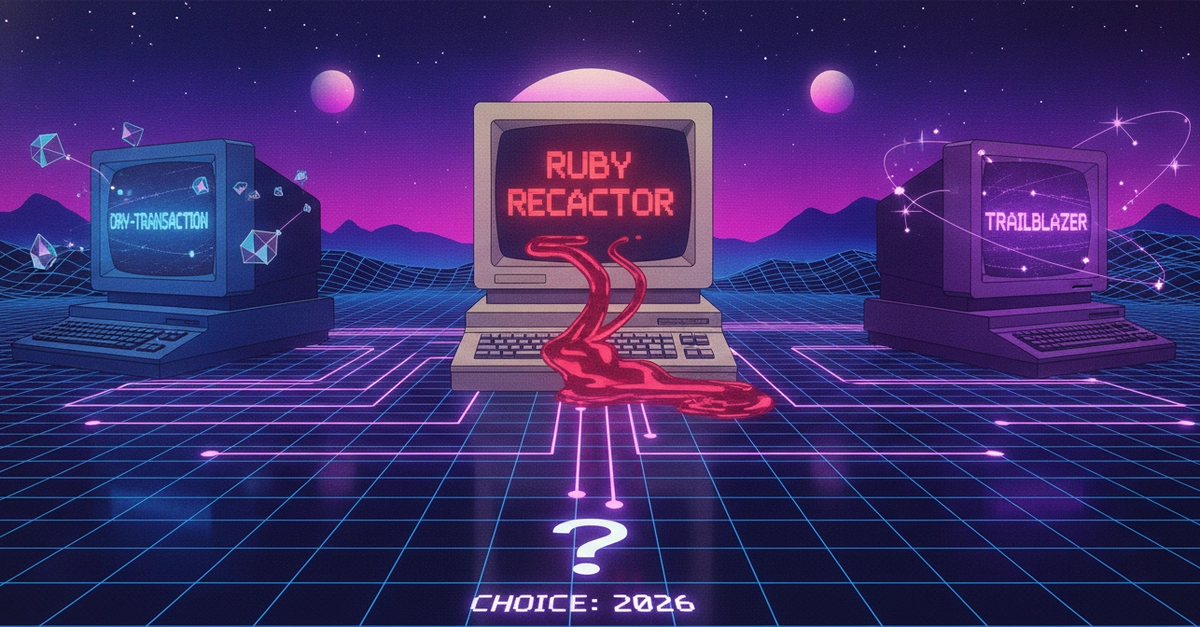
Orchestrating Business Logic in Ruby: A 2026 Landscape
Building applications often involves sequences of operations: charge a credit card, send a confirmation email, update inventory. While seemingly straightforward, the complexity escalates when considering failure scenarios. What happens if the email fails after the card is charged? How do you roll back previous steps? This is where workflow orchestration libraries become critical. In 2026, Ruby developers have several mature options to manage this complexity, each with distinct strengths and ideal use cases. The primary contenders are Ruby Reactor, dry-transaction, Trailblazer, and the ubiquitous Sidekiq for background job management. This guide maps these tools to the problems they solve, helping you select the most appropriate solution for your project.
The 30-Second Decision Matrix
If you need a quick recommendation, consider these core differentiators:
| Scenario | Best Fit | Key Characteristics |
|---|---|---|
| Simple, linear flows with optional rollback. Minimal overhead. | dry-transaction | Explicit success/failure paths, functional programming influence, lightweight. |
| Complex, multi-step processes requiring robust state management and error handling. Often involve UI interactions or significant side effects. | Trailblazer | Opinionated, comprehensive suite (Cells, Operation, Policy, Reform), strong convention-over-configuration. |
| Event-driven, asynchronous orchestration. High degree of decoupling between steps. | Ruby Reactor | Actor-based model, reactive programming principles, message passing. |
| Background processing for independent tasks, potentially with retry mechanisms. Not ideal for complex, multi-step transactional logic. | Sidekiq | Mature background job processor, distributed, reliable. Lacks built-in transactional rollback. |
Deep Dive: dry-transaction
dry-transaction, part of the dry-rb ecosystem, offers a functional approach to defining business logic. It excels at creating explicit, linear sequences of operations where each step can either succeed, passing its result to the next, or fail, halting the chain and returning an error. This makes it ideal for operations that require strict transactional integrity, similar to database transactions but for application logic.
A typical dry-transaction setup involves defining a class that inherits from `Transaction`. Inside, you define steps using methods like `step :method_name`. Each step method receives the result of the previous step and returns either a success or failure object. The library handles the flow, ensuring that if any step fails, subsequent steps are not executed, and the failure is propagated. This pattern is particularly useful for tasks like user registration (create user, send welcome email, log event) where a failure in any stage needs to be caught and handled gracefully.
The primary advantage of dry-transaction is its clarity and predictability. It enforces a clear separation of concerns and makes the flow of control easy to reason about. However, for very complex, branching logic or scenarios requiring extensive state management across many steps, it can become verbose. It's less suited for highly asynchronous or event-driven architectures where steps might not depend directly on the immediate output of the previous one.
Deep Dive: Trailblazer
Trailblazer is a comprehensive, opinionated framework for structuring application operations, policies, and forms. It aims to provide a complete solution for building complex business logic, moving beyond simple service objects or transaction scripts. Trailblazer is built around the concept of `Operation`, which encapsulates a single business use case. An operation orchestrates various components: Policies for authorization, Contracts for validation (often using `Reform`), and Transformers for data manipulation.
The power of Trailblazer lies in its convention-over-configuration approach and its ability to manage state and side effects across a series of related steps. An operation can be thought of as a mini-application within your application. It defines a sequence of execution, checks permissions via Policies, validates input using Contracts, and executes business logic. Crucially, Trailblazer operations provide robust mechanisms for handling success and failure, including rollback capabilities, although these are often implemented by the developer within the operation's steps rather than being automatically managed by the framework in the same way as `dry-transaction`'s linear model.
Trailblazer's strength is its ability to bring order to complex domains. It provides a structured way to handle authorization, validation, and execution, making large codebases more maintainable. The learning curve can be steeper due to its opinionated nature and the number of components involved. It's best suited for applications where complex business rules and state management are paramount, and where developers are willing to adopt its conventions. It is less ideal for simple, isolated tasks or for developers who prefer a more minimal, functional approach.
Deep Dive: Ruby Reactor
Ruby Reactor takes a different approach, drawing inspiration from actor-based concurrency models and reactive programming. It's designed for building systems that are highly concurrent, distributed, and event-driven. Instead of a linear flow, Ruby Reactor uses `Actors` that communicate via asynchronous messages. An `Actor` is an isolated unit of computation that can receive messages, perform actions, and send messages to other actors.
This model is particularly well-suited for scenarios where independent processes need to interact and where resilience and scalability are key. Imagine a system processing streaming data, managing IoT devices, or coordinating microservices. In such contexts, events trigger actions, and actors respond. Ruby Reactor provides a framework for defining these actors and managing their message queues and lifecycles. It offers a way to build systems that are inherently responsive and can handle a large volume of concurrent operations without blocking.
The main advantage of Ruby Reactor is its suitability for highly concurrent and distributed systems. It allows for building complex, reactive applications where components are loosely coupled. However, it introduces a different mental model compared to traditional procedural or object-oriented approaches. Debugging asynchronous message flows can be challenging, and it might be overkill for simpler, synchronous business logic that doesn't require high concurrency or event-driven design. For straightforward transactional logic with clear rollback requirements, `dry-transaction` or Trailblazer might be more appropriate.
The Role of Sidekiq
Sidekiq is the de facto standard for background job processing in Ruby. While not a workflow orchestration library in the same vein as the others, it's crucial to mention because many complex processes are broken down into individual background jobs. Developers often use Sidekiq to execute tasks asynchronously, such as sending emails, processing images, or performing long-running calculations.
Sidekiq excels at reliability, retries, and scaling background job execution. You can enqueue a job, and Sidekiq ensures it gets processed, even if the application server restarts. It provides visibility into job queues and execution status. However, Sidekiq itself does not provide built-in mechanisms for managing multi-step workflows with transactional rollbacks. If you use Sidekiq for a complex workflow, you would typically need to build the orchestration logic yourself, potentially using `dry-transaction` or Trailblazer within your jobs, or implementing custom state management and compensation logic.
For developers already heavily invested in Sidekiq, it's often the starting point. However, relying solely on Sidekiq for complex, transactional workflows can lead to brittle systems if not carefully designed. It's best used for discrete, independent background tasks rather than orchestrating intricate sequences of operations that require atomic execution or rollback.
Choosing Your Path
The decision hinges on the nature of your business logic. For linear, transactional flows with clear success/failure paths and a need for explicit rollback, dry-transaction offers a clean, functional solution. If your application involves complex use cases with intricate rules, authorization, and validation, where maintainability of large logic blocks is key, Trailblazer provides a powerful, opinionated structure. For systems demanding high concurrency, event-driven interactions, and asynchronous communication, Ruby Reactor offers a robust actor-based model. And for simple background tasks that don't require complex orchestration, Sidekiq remains the standard. Understanding your specific requirements—transactionality, complexity, concurrency, and existing architecture—will guide you to the right tool.