
The Root of the Problem: Why Root Access in Containers is Risky
Traditionally, containerization technologies like Docker have operated with a fundamental assumption: the container runtime itself runs as root, and processes within the container also run as root. This model, while convenient and powerful, introduces a significant security vulnerability. If an attacker gains control of a process inside a container, they effectively have root privileges within that container. This elevated access can then be leveraged to break out of the container and compromise the host system, especially in environments where the container runtime has broad permissions.
Consider a web server running inside a container. If an attacker finds a vulnerability in the web server software, they can exploit it to gain code execution. In a rootful container, this means they are root inside that container. From there, they might attempt to exploit kernel vulnerabilities or misconfigurations to escape the container boundary and gain root access on the host machine. This is akin to giving a burglar the master key to your entire building just because they managed to pick the lock on a single apartment door. The goal of securing services means limiting the blast radius of any single compromise.
The implications are severe. A compromised container could be used to steal sensitive data from other containers on the same host, deploy malware, disrupt services, or even use the host as a launchpad for further attacks across the network. Traditional security measures like firewalls and intrusion detection systems can help, but they often operate at a higher level and may not prevent a determined attacker with root access inside a container from finding a path to the host.
Introducing Rootless Containers: A Paradigm Shift in Security
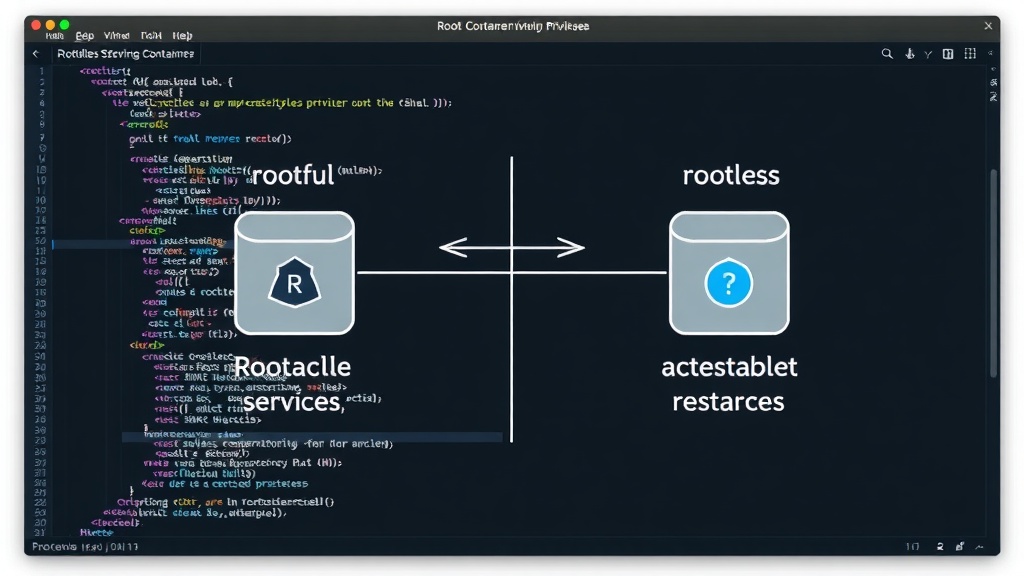
Rootless containers flip this model on its head. The core idea is to run containers without requiring root privileges, either for the container runtime itself or for the processes running inside. This means that even if an attacker successfully compromises a process within a rootless container, their privileges are confined to the unprivileged user account that launched the container. This dramatically shrinks the potential attack surface. Instead of having the master key to the building, the attacker only has the key to the apartment they initially breached, and even that key only works for that specific apartment.
Several technologies and approaches enable rootless containerization. Podman, for instance, has been a strong proponent and implementer of rootless containers. When a user runs a container in rootless mode, the container runtime and all its associated processes are executed under that user's UID. The container's filesystem is typically mounted using user namespaces, which remap UIDs and GIDs within the container to unprivileged UIDs and GIDs on the host. This isolation is crucial. A process running as UID 0 inside the container is actually running as a high-numbered, unprivileged UID on the host system.
This isolation is not just theoretical. It means that even if an attacker achieves root-equivalent privileges within the container, they cannot directly access host resources like `/etc/passwd`, `/proc/kcore`, or device nodes that are typically only accessible by the host's root user. They cannot easily modify system-wide configurations, install kernel modules, or directly manipulate network interfaces at a low level. The host system's integrity is preserved because the compromised container process operates with the same limited permissions as any other unprivileged user on the system.
Key Benefits and Use Cases for Rootless Containers
The security benefits of rootless containers are substantial. By default, they eliminate the risk of container escape to gain host root privileges. This is particularly valuable in multi-tenant environments, shared development machines, or any scenario where a single compromised container should not pose a threat to the entire system. Developers can run containers on their laptops without needing administrator privileges, simplifying setup and reducing the risk of accidental damage to their development environment.
Beyond security, rootless containers offer other advantages. They enhance portability and ease of deployment. Users don't need special permissions to run them, making it easier to deploy containerized applications on various systems. For CI/CD pipelines, running build and test jobs in rootless containers can prevent build processes from inadvertently affecting the host system or interfering with other jobs.
Furthermore, rootless containers align with the principle of least privilege, a fundamental security best practice. Every component of a system should operate with only the minimum privileges necessary to perform its function. Rootless containers embody this by ensuring that containerized applications do not inherit unnecessary root privileges from the host. This reduces the overall attack surface of the application and the infrastructure it runs on.
Technical Considerations and Limitations
While rootless containers offer significant security improvements, they are not a silver bullet and come with certain technical considerations. One of the primary challenges is the remapping of UIDs and GIDs. User namespaces allow the container to see its processes as running as root (UID 0), but these are mapped to unprivileged UIDs on the host. This mapping needs to be managed carefully. If the range of UIDs available for mapping is exhausted, new containers might fail to start.
Network configuration can also be more complex. In rootful containers, the container runtime can directly create and manage network interfaces and bind to privileged ports (below 1024). In rootless mode, the unprivileged user cannot directly manipulate network interfaces or bind to low ports. This typically requires workarounds such as using a proxy like socat or configuring the host to allow specific port forwards for the rootless user, or relying on features like the slirp4netns network stack, which has performance implications.
Certain kernel features or capabilities that are typically available to root processes might be restricted or unavailable in a rootless environment. This could include advanced networking configurations, direct hardware access, or specific system calls that require elevated privileges. Applications that heavily rely on these low-level system interactions might not function correctly out-of-the-box in a rootless container. It's essential to test applications thoroughly to ensure compatibility.
The performance of rootless containers, particularly concerning networking with slirp4netns, can sometimes be lower than their rootful counterparts. While significant progress has been made, users should benchmark their specific workloads to ensure acceptable performance. For high-throughput network services or applications requiring direct hardware interaction, rootful containers might still be the more practical choice, provided that robust security measures are in place to mitigate the inherent risks.
The Future of Container Security: Embracing Rootless
The trend towards rootless containerization is a clear indication of the industry's commitment to enhancing security. As container usage expands across more critical infrastructure and sensitive applications, the need to minimize privileges becomes paramount. Technologies like Podman, Buildah, and Skopeo are actively developing and refining rootless capabilities, making them more accessible and performant.
For developers and security professionals, adopting rootless containers should be a standard practice wherever feasible. It’s not about replacing all rootful containers, but rather about understanding the trade-offs and choosing the right tool for the job. When deploying services that do not inherently require privileged access to the host system, rootless containers offer a compelling, more secure alternative. This shift represents a move towards a more secure computing paradigm, where the default assumption is minimal privilege, thereby building more resilient and trustworthy systems.