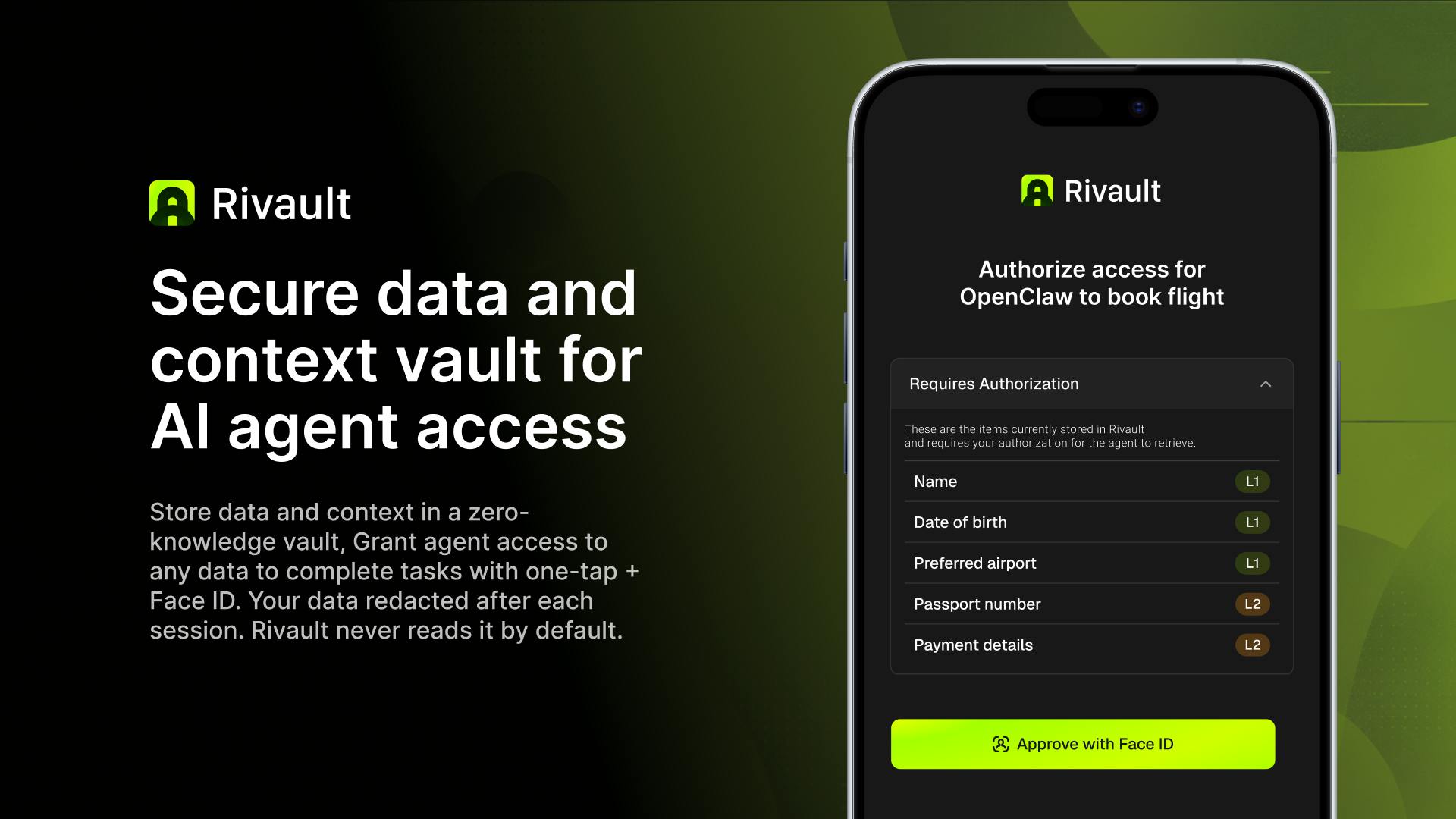
The Challenge of AI Agent Data Security
Artificial intelligence agents are rapidly evolving from simple chatbots to sophisticated tools capable of complex tasks. As these agents become more integrated into business workflows, they require access to vast amounts of data and context to function effectively. This data can include proprietary company information, sensitive customer details, and strategic plans. The challenge lies in providing this necessary information to AI agents without compromising security or privacy. Traditional methods of data management often fall short, creating potential vulnerabilities that bad actors could exploit.
Rivault emerges as a dedicated solution to this growing problem. The platform focuses on creating a secure environment for both providing and storing the data that AI agents rely on. This is not merely about access control; it's about building a trust layer for the information that fuels increasingly powerful AI systems. The core premise is that as AI agents become more autonomous and capable, the integrity and security of their operational data become paramount. Without a robust system, the very power of AI could become a significant risk vector.
Rivault's Core Functionality
Rivault's primary offering is to act as a secure intermediary for AI agent data. It allows users to safely provide the necessary context and data points that an AI agent needs to perform its tasks. This could range from specific documents for analysis to user preferences for personalized interactions. Crucially, Rivault also provides secure storage for this data, ensuring that it remains protected when not actively in use. This dual functionality—secure provision and secure storage—addresses two critical aspects of the AI data lifecycle.
The platform aims to abstract away the complexities of data security for AI applications. Instead of developers having to build custom, often insecure, solutions for managing AI agent data, Rivault offers a pre-built, secure infrastructure. This allows teams to focus on developing the AI agents themselves and leveraging their capabilities, rather than becoming cybersecurity experts in data handling for AI. The implication is a faster, safer path to deploying advanced AI agents across an organization.
Addressing the 'Black Box' Problem
One of the persistent issues with AI agents is the 'black box' nature of their decision-making processes. When an AI agent is given access to sensitive data, it can be difficult to track exactly how that data is being used or what conclusions are being drawn. Rivault seeks to bring transparency and control to this process. By managing the data input and context, the platform can potentially offer insights into what information is being fed to the agent and how it's being processed. This is akin to having a detailed logbook for an AI's 'brain,' showing what ingredients went into its 'thoughts.'
This level of oversight is critical for compliance, debugging, and building trust in AI systems. For businesses, understanding the provenance of AI-driven decisions is essential for accountability and risk management. Rivault's approach suggests a move towards more auditable and controllable AI deployments, which is a significant step forward from current, often opaque, AI operational models.
The Broader Implications for AI Adoption
The successful adoption of advanced AI agents hinges on trust and security. If organizations cannot be confident that their sensitive data is safe when used by AI, widespread adoption will remain limited. Rivault's focus on data security and context management directly addresses this barrier. By providing a reliable and secure way to handle AI agent data, platforms like Rivault can accelerate the deployment of AI across industries that are currently hesitant due to security concerns.
This also has implications for the development ecosystem. Developers can leverage Rivault to build more robust and secure AI applications without needing to implement complex security protocols from scratch. This democratizes access to secure AI data management, potentially leading to a wave of more sophisticated and trustworthy AI agents entering the market. The success of such platforms will be measured not just by their technical capabilities, but by their ability to foster confidence among users and enterprises alike.