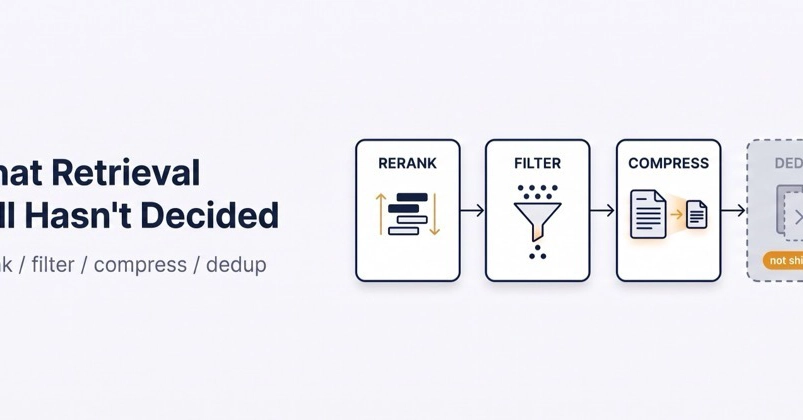
The Fuzzy Logic of Relevance
The core promise of information retrieval—finding the right documents—is often treated as a single, monolithic problem. Yet, as developers build sophisticated applications on top of retrieval systems, the limitations of this view become apparent. The process of identifying relevant information doesn't end when a list of documents is returned. Instead, it fractures into a series of distinct, often sequential, judgments that application developers must make. This is not merely about ordering search results; it's about understanding the nuanced relationship between a query, a document, and the specific information needed to satisfy the query.
Consider the scenario where a user asks a complex question. Retrieval might return a set of documents that contain the answer. However, not all returned documents are equally useful. Some might be tangential, others might contain the answer but buried deep within unrelated content, and still others might provide supporting evidence but not the direct answer itself. This complexity has led to the development of post-retrieval processing stages, each addressing a specific aspect of the information-finding puzzle.
The challenge is that these stages are not interchangeable. Applying a reranker, for instance, aims to bring the most relevant documents to the top. But what if the goal isn't just to surface a document, but to extract a specific piece of evidence from it? Or to condense a lengthy document into its most salient points? Or to ensure that the selected information isn't redundant with what's already been identified?
These are not minor distinctions. They represent different levels of understanding and different functional requirements for an AI system. The danger, as seen in the startup world, is to over-engineer systems that perfectly automate a process for which no customer yet exists. This focus on internal system perfection can distract from the fundamental need to validate the market and understand user demand.

Beyond Reranking: A Spectrum of Decisions
A practical exploration of these post-retrieval challenges reveals at least four distinct decision points:
- Document Relevance: Is this document, as a whole, related to the user's query? This is the traditional domain of retrieval and reranking. It's about scoring documents based on their overall topical similarity or perceived usefulness.
- Evidence Extraction: Does this document contain specific evidence that can be used to answer the query? This moves beyond document-level relevance to pinpointing the exact passages or sentences that serve as the answer. It requires a deeper semantic understanding of the document's content in relation to the query.
- Sentence-Level Compression/Summarization: Given the relevant evidence identified, which specific parts of it should be passed on? This stage focuses on distilling the extracted information to its most concise and informative form, removing redundancy or less critical details.
- Semantic Deduplication: Given the set of relevant information already selected, does this new piece of information add anything truly novel or is it semantically redundant? This is crucial for preventing repetitive or overlapping information from overwhelming the user and for ensuring the final output is as efficient as possible.
These stages are not necessarily sequential in implementation, but they represent distinct logical operations. A system might perform evidence extraction and then compress the extracted sentences. Or it might first rerank documents, then extract evidence from the top-ranked ones. The key is that each stage addresses a different question about the information's utility.
The Peril of Perfect Automation Without a Buyer
The drive to build sophisticated retrieval and post-retrieval systems can mirror a common startup pitfall: automating a business process before validating the existence of a paying customer for that process. It's tempting to spend weeks perfecting a booking page, crafting professional welcome emails, and ensuring data flows flawlessly between systems. The satisfaction of seeing these automated steps execute smoothly is immediate and tangible. A form is completed, a notification arrives, a task appears. This internal system perfection can create a false sense of progress.
However, this internal efficiency is meaningless if it doesn't translate into external value that customers are willing to pay for. The critical missing piece is customer acquisition and validation. You can explain your offer meticulously, build the most elegant automated workflow, and still receive no inquiries. The underlying assumption is that a perfectly automated system will inherently attract customers, but this is often not the case. The focus needs to shift from perfecting the *system* to understanding and acquiring the *customer*.
This is where the distinction between retrieval stages becomes relevant to business strategy. Just as evidence extraction is a different problem than simple reranking, finding a customer is a different problem than optimizing an internal process. A startup needs to prioritize activities that directly lead to customer validation and revenue. Building out a complex, multi-stage retrieval pipeline might be a secondary concern, or even a premature one, if the fundamental business model and customer base are not yet established.
When to Automate What: A Prioritization Framework
Deciding which aspects of retrieval, or indeed any business process, deserve automation at the outset requires a clear understanding of the immediate goals. In the early stages of a product or business:
- Prioritize Customer Discovery: Focus on activities that directly engage potential customers and validate demand for your core offering. This might involve manual outreach, user interviews, or simple, unautomated prototypes.
- Automate Only What Directly Supports Validation: If a simple automated step is necessary to *test* a hypothesis about customer value (e.g., a basic form to gauge interest), then automate it. But avoid automating complex, multi-step processes that don't directly contribute to learning about the market.
- Defer Complex Post-Retrieval Stages: Stages like sentence-level compression or semantic deduplication, while valuable for optimizing retrieval performance, are often secondary to the primary goal of returning generally relevant documents. A basic reranker might suffice initially.
- Iterate Based on Feedback: Once customer demand is validated and feedback starts flowing, then you can begin to identify specific pain points that *warrant* more sophisticated automation, such as finer-grained evidence extraction or advanced content condensation.
The temptation to build the perfect system is strong. It offers a sense of control and accomplishment. But for startups, and for any system designer grappling with the nuances of information retrieval, the most critical decisions often lie not in perfecting the internal mechanics, but in understanding the external problem and ensuring the solution actually meets a real, validated need.
What's Next for Retrieval?
The exploration into distinct post-retrieval stages like evidence filtering, sentence compression, and semantic deduplication highlights a gap in current retrieval paradigms. While reranking has become a common post-retrieval step, the other, more granular tasks are less standardized. What is missing is a unified framework or a common set of APIs that allow developers to easily chain or select these different judgment stages. The development of tools like the `jev-reranker` CLI is a step in this direction, offering practical implementations for these distinct problems. However, the broader ecosystem has yet to fully decide how these capabilities should be integrated and offered as standard components of a retrieval pipeline. This leaves application developers to reinvent these wheels, or to choose which of these crucial post-retrieval decisions they can afford to defer.