Automating Security and Quality in Restaurant Company CI
The modern software development lifecycle demands not just rapid iteration but also a fortified approach to security and code quality. For projects like the restaurant company application, this means embedding tools directly into the Continuous Integration (CI) pipeline. A recent initiative focuses on enhancing the CI process by integrating Trivy for vulnerability scanning and SonarQube for code analysis, alongside a linting stage. The goal is to create a multi-stage pipeline where each job runs independently and in parallel, offering faster feedback loops and a more comprehensive view of the project's health.
This approach is crucial for any team building applications that handle sensitive data or operate in regulated environments. By automating these checks, developers can catch issues early, reducing the cost and effort associated with fixing them later in the development cycle or, worse, in production. The choice of tools—Trivy, SonarQube, and a linter—reflects a common strategy for comprehensive code governance: static analysis for code style and potential bugs (linting), deep code quality and security vulnerability detection (SonarQube), and specialized software composition analysis (SCA) for known vulnerabilities in dependencies (Trivy).
Part 1: Manual Trivy Security Scanning
Before automating, understanding the tools in isolation is key. The project, located at ~/restaurant-company, serves as the testbed. The initial step involves performing a manual security scan using Trivy to identify vulnerabilities within the project's filesystem. The command trivy fs --scanners vuln . initiates a scan focused solely on known vulnerabilities in the application's code and dependencies that are typically discoverable through static analysis of the filesystem.
However, many vulnerabilities, particularly those related to third-party libraries, are not always apparent from a simple filesystem scan. To get a more complete picture, the scan needs to consider development dependencies as well. This is achieved by adding the --include-dev-deps flag. The command becomes trivy fs --scanners vuln --include-dev-deps .. This ensures that not only the application's core dependencies but also those used for testing, building, and development are scrutinized. This thoroughness is essential, as a vulnerability in a development dependency could potentially be exploited to compromise the build process or introduce malicious code into the final artifact.
The output of these commands provides a detailed report of identified vulnerabilities, including their severity, affected packages, and references to CVEs (Common Vulnerabilities and Exposures). For developers, this report is a prioritized list of security risks that need immediate attention. Understanding dependency trees is critical here; Trivy's ability to traverse these trees means it can identify if a vulnerable package is a direct dependency or a transitive one, affecting a broader set of the project's components.
Part 2: Building the GitHub Actions Pipeline
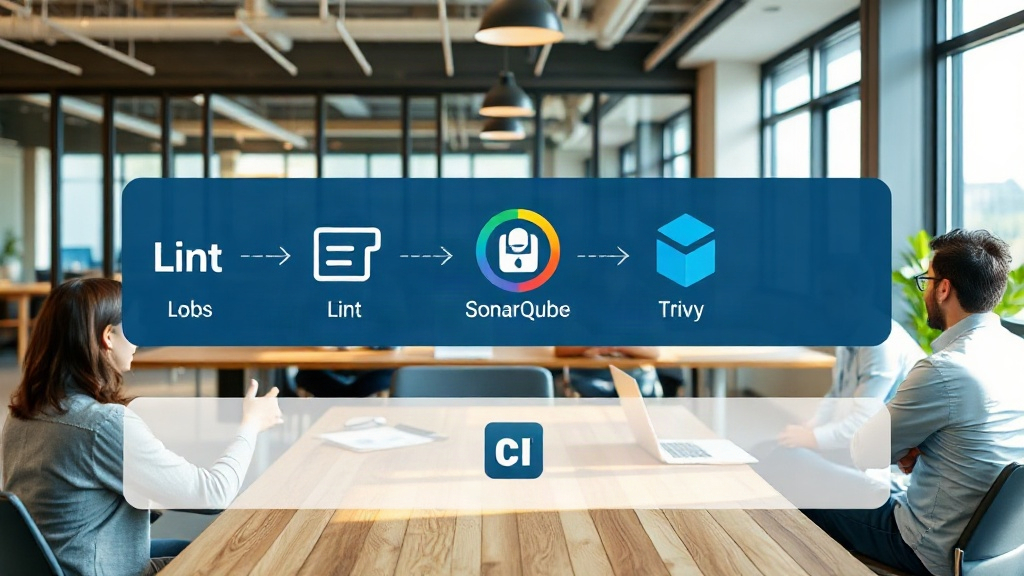
The ultimate goal is to integrate these checks into an automated CI pipeline using GitHub Actions. This pipeline is designed with three independent jobs that can run in parallel: Lint, SonarQube, and Trivy. Parallel execution significantly speeds up the CI process. Instead of waiting for one stage to complete before the next begins, all three can run concurrently, reducing the overall build time and providing faster feedback to developers.
The Lint job would typically involve running a linter specific to the project's language (e.g., ESLint for JavaScript, Pylint for Python, RuboCop for Ruby). Linters enforce coding standards, identify potential bugs, and improve code readability. Configuring this job involves setting up the correct environment, checking out the code, installing the linter, and running the linting command. Any linting errors would fail the job, halting the pipeline and indicating to the developer where code style or potential issues need to be addressed.
The SonarQube job integrates with a SonarQube server (either self-hosted or cloud-based) to perform a deep analysis of code quality and security. This includes detecting code smells, security hotspots, bugs, and vulnerabilities. Setting up this job requires configuring the SonarScanner to communicate with the SonarQube server, analyzing the project's codebase. SonarQube provides a rich dashboard with detailed reports, allowing teams to track metrics over time and enforce quality gates. Failing the pipeline based on SonarQube's quality gates ensures that code meeting certain quality standards is checked in.
The Trivy job automates the security scanning process previously performed manually. This job would leverage Trivy's capabilities to scan container images, filesystems, or Git repositories for vulnerabilities. For a typical web application project, this might involve scanning the application's dependencies, operating system packages, and potentially IaC (Infrastructure as Code) files. The job would be configured to fail if critical or high-severity vulnerabilities are detected, preventing potentially insecure code from being merged or deployed. Including development dependencies in this automated scan is paramount.
Part 3: Understanding Dependency Trees and Vulnerabilities
The effectiveness of tools like Trivy hinges on their ability to understand complex dependency trees. Modern applications often rely on a vast network of libraries and packages, many of which are themselves dependent on other libraries. A vulnerability in a single, deeply nested dependency can impact numerous parts of an application. Trivy's strength lies in its ability to traverse these trees and identify vulnerabilities at any level. This is akin to a doctor not just checking your symptoms but tracing the root cause of an illness through your body's interconnected systems.
When Trivy reports a vulnerability, it provides context: the package name, the version affected, and the CVE identifier. Developers must then consult resources like the NVD (National Vulnerability Database) or vendor advisories to understand the exploitability and impact of the CVE. The crucial step is then to remediate the vulnerability. This often involves updating the vulnerable package to a patched version. However, updating one package can sometimes cause compatibility issues with other parts of the application, necessitating careful testing and potentially refactoring.
The decision to include development dependencies in automated scans is a strategic one. While production code might be more directly exposed to external threats, compromised development tools or libraries can be used to inject malicious code during the build or deployment phases. A robust security posture considers the entire software supply chain, from the developer's machine to the production environment. Therefore, applying Trivy scans with --include-dev-deps in the CI pipeline is a best practice that strengthens the overall security of the restaurant company project.
The Broader Impact on CI/CD
Implementing such a parallelized, multi-faceted CI pipeline has significant implications. It shifts security and quality from a manual, often-postponed task to an automated, integrated part of the development workflow. Developers receive immediate feedback on their code's security and quality, enabling them to fix issues proactively. This contrasts sharply with traditional approaches where security audits might happen only before major releases, leading to last-minute rushes and potential delays.
For the restaurant company project, this means a more reliable and secure application. Competitors who lag in adopting these practices may find themselves dealing with costly security breaches or struggling with technical debt that slows down innovation. The investment in setting up these CI jobs pays dividends in reduced risk, improved code maintainability, and faster, more confident deployments. The ability to run Lint, SonarQube, and Trivy in parallel means that developers don't have to wait for lengthy sequential builds, accelerating their daily workflow. This structure is becoming the standard for professional software development, ensuring that security and quality are not afterthoughts but foundational elements of the build process.