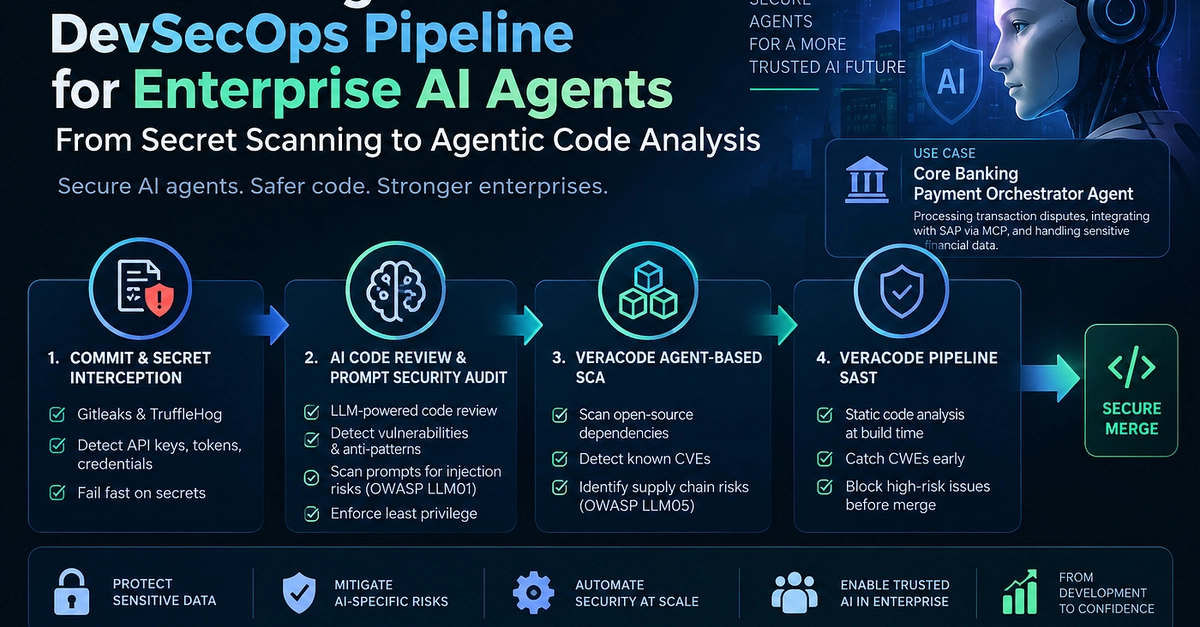
The Shifting Enterprise Software Landscape
The rapid proliferation of autonomous AI agents—systems that can dynamically invoke external APIs, generate code, and manipulate database states—fundamentally alters the enterprise software supply chain. Unlike traditional microservices with predictable execution paths, these agents operate with a degree of autonomy and emergent behavior. This shift introduces novel security challenges that traditional DevSecOps pipelines are ill-equipped to handle. The core problem lies in securing systems that are not just executing pre-defined code but actively creating and interacting with code and external services in real-time.
The traditional software supply chain often relies on static analysis of code, dependency scanning, and known vulnerability databases. However, AI agents introduce a dynamic element. Their ability to generate code on the fly, call arbitrary APIs, and modify state means that the attack surface expands exponentially and unpredictably. A vulnerability might not exist in the agent's base code but could be introduced through dynamically generated code or an API call to a compromised external service. This requires a paradigm shift from securing the build artifact to securing the runtime behavior and the agent's decision-making process.
Key Pillars of an AI Agent DevSecOps Pipeline
Architecting a resilient DevSecOps pipeline for enterprise AI agents necessitates integrating security at every stage, from development to deployment and runtime monitoring. This involves extending existing practices and introducing new ones tailored to the unique characteristics of AI agents.
1. Enhanced Secret Management
AI agents often require access to sensitive credentials, API keys, and tokens to interact with external systems. Traditional secret scanning tools, while still necessary, are insufficient. The pipeline must incorporate dynamic secret rotation, least privilege principles for agent access, and robust auditing of secret usage. Techniques like using short-lived credentials, secrets managers with fine-grained access policies, and masking secrets during agent code generation are paramount. The goal is to minimize the exposure of sensitive information and ensure that any compromise of a secret is quickly contained.
2. Agentic Code Analysis
Beyond static code analysis for the agent's core logic, there's a critical need for analyzing dynamically generated code. This involves integrating security checks into the agent's code generation process. Tools that can perform real-time security assessments of generated code snippets, checking for common vulnerabilities like injection flaws, insecure function calls, or improper error handling, are essential. Think of this less like reviewing a finished manuscript and more like having a rigorous editor sitting next to the author as they write, flagging potential issues before they are even committed to paper.
3. API Security and Governance
Autonomous agents' reliance on external APIs introduces a significant risk vector. The DevSecOps pipeline must include comprehensive API security measures. This includes validating API endpoints, ensuring proper authentication and authorization for agent calls, rate limiting to prevent abuse, and monitoring API traffic for anomalous patterns. A robust API gateway or service mesh can enforce these policies. Furthermore, maintaining an up-to-date inventory of all APIs the agent is permitted to call, along with their security postures, is crucial for governance and incident response.
4. Runtime Monitoring and Anomaly Detection
Continuous monitoring of agent behavior in production is non-negotiable. This extends beyond standard application performance monitoring to include security-specific telemetry. Detecting deviations from expected behavior, unusual API call patterns, unexpected code execution, or data exfiltration attempts is vital. Machine learning-based anomaly detection can be employed here to identify novel threats that might not be covered by predefined rules. The pipeline should facilitate rapid feedback loops from runtime monitoring back to development and security teams for swift remediation.
5. Sandboxing and Isolation
For agents that perform potentially risky operations, such as code generation or direct database manipulation, robust sandboxing and isolation mechanisms are critical. The pipeline should ensure that agents are deployed in environments where their actions are contained. This limits the blast radius of any security incident. Techniques like containerization, micro-segmentation, and capability-based security can restrict an agent's access to only the resources it absolutely needs, preventing lateral movement within the enterprise network.
The Human Element: Skills and Culture
Building and maintaining such a pipeline requires a cultural shift towards proactive security integration within the AI development lifecycle. Teams need to be trained in the specific security risks associated with AI agents and equipped with the tools and knowledge to address them. This includes fostering collaboration between AI developers, security engineers, and operations teams. The concept of