The Build as a Graph of Pure Functions
Most developers see building software as a task executed on their local machine. You type a command, your laptop's fans whir, and a binary emerges. This mental model is so deeply ingrained that we seldom question it. However, it quietly collapses when codebases grow large enough. At a certain scale, the local build becomes too demanding for a single machine, too sluggish to run repeatedly, and too inefficient to start from scratch with every minor change. Imagine ten engineers rebuilding the same unchanged files ten times before lunch, or a clean build taking forty minutes. Continuous integration (CI) then becomes the primary bottleneck for the entire team. Remote execution emerges as the solution for these large-scale build challenges. Understanding this shift in perspective unlocks the logic behind many complex build-system designs, stripping away vendor-specific jargon.
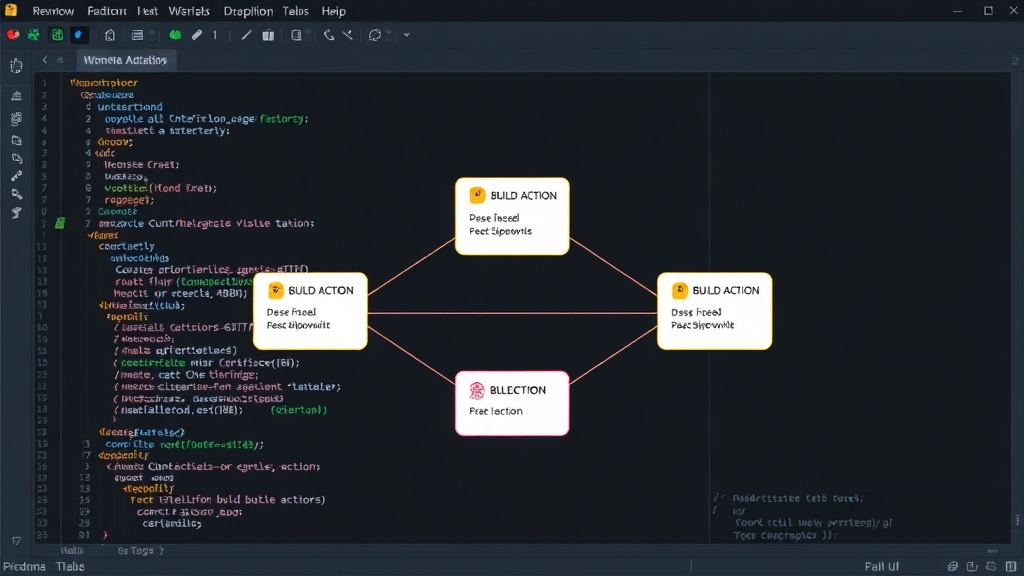
The fundamental shift required is to stop viewing a build as a linear sequence of commands. Instead, conceptualize it as a directed acyclic graph (DAG). In this model, each node represents an action – a single command that takes specific inputs and produces specific outputs. These actions are not arbitrary shell commands; they are treated as pure functions. A pure function, in programming, is one that, given the same inputs, will always produce the same outputs and has no side effects. When applied to builds, this means that if the inputs to an action (e.g., source files, compiler flags, dependencies) do not change, the output (e.g., object files, executables) will also remain the same, and the action itself doesn't alter anything outside its defined scope.
This functional perspective is crucial. It allows build systems to reason about dependencies and parallelism. If action A produces output X, and action B requires X as input, then B depends on A. If action C and action D are independent (neither requires the output of the other), they can be executed in parallel. This graph representation is the bedrock of modern build systems designed for scale.
Decoupling Actions from Execution
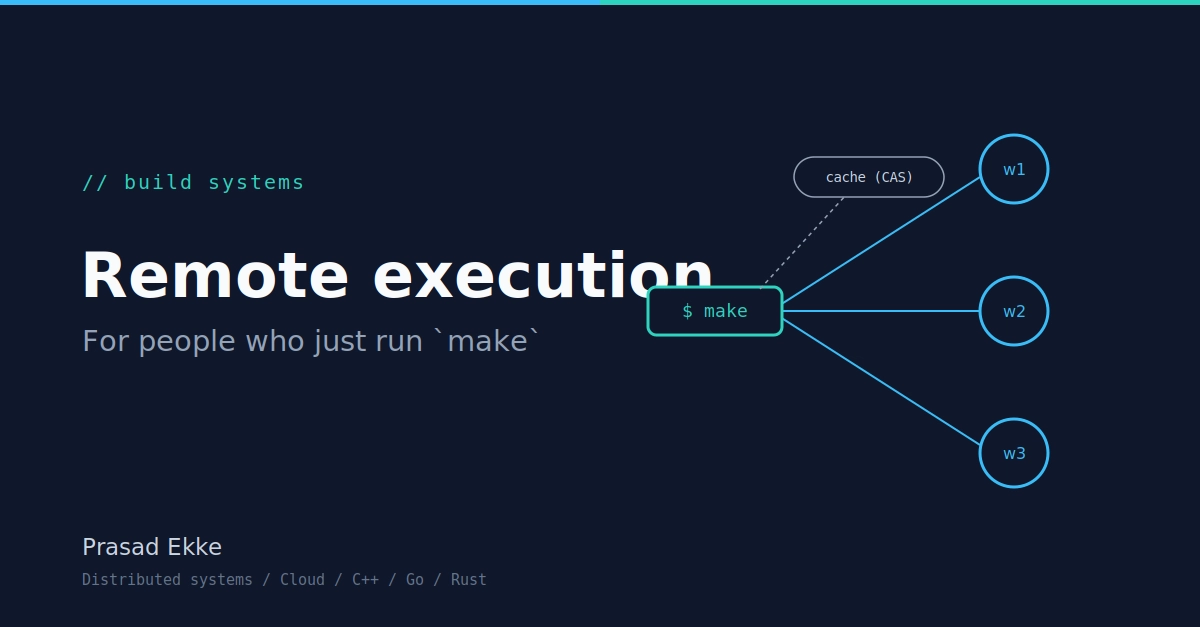
Remote execution fundamentally decouples the definition of build actions from where those actions are actually performed. Traditionally, when you run `make`, the `make` process directly invokes the underlying commands (like `gcc`, `javac`, `link`) on your local machine. The build system orchestrates these local calls.
With remote execution, the build system's orchestrator (often called a remote execution backend or service) receives a description of the build graph. Instead of executing commands locally, it serializes the necessary inputs (source files, compiler flags, environment variables) and sends them to a remote worker pool. These workers, often running in a distributed environment like a Kubernetes cluster or a specialized build farm, execute the commands. Once an action is complete, the worker sends the outputs back to the orchestrator. The orchestrator then caches these results and makes them available for subsequent actions, whether they are local or also remote.
This decoupling offers several key advantages:
- Scalability: The build workload can be distributed across many machines, overcoming the limitations of a single developer's laptop.
- Speed: Parallel execution of independent actions and the use of pre-computed cached results significantly reduce build times, especially for large projects.
- Reproducibility: By carefully controlling inputs and environments, remote execution can ensure builds are more consistent and reproducible across different machines and times.
- Resource Efficiency: Developers' local machines are freed from heavy build tasks, allowing them to focus on coding and debugging.
Caching: The Secret Sauce
Caching is what makes remote execution truly powerful. Every action, defined as a pure function, has a unique identifier derived from its inputs. This identifier, often a hash of the command, flags, and all input files, acts as a cache key. Before executing an action, the build system checks if a result for this key already exists in a shared cache. If it does, the output is retrieved directly from the cache, skipping the actual execution. This is often referred to as Remote Result Caching (RRC).
This cache can be local or remote, but for team-wide benefits, a shared remote cache is essential. It means that if one engineer or one CI job has already compiled a specific module with specific flags, any subsequent attempt to do the same thing will hit the cache. This dramatically reduces redundant work. The surprising detail here is not just that caching exists, but how it transforms the build process from a series of discrete, often repetitive, computations into a system that primarily retrieves pre-computed results, only performing new computation when inputs genuinely change.
What This Means for Developers
For developers used to running `make` or similar local build commands, adopting a remote execution model requires a mental shift. The build system becomes less of a black box that runs on their machine and more of a declarative specification of work that can be executed anywhere. Tools like Bazel, Buck, and Pants are prominent examples of build systems that heavily leverage remote execution and caching. They enforce the graph-of-pure-functions model.
If you're working on a large, complex project, you've likely already experienced the pain points of slow local builds. Remote execution, combined with robust caching, addresses these issues directly. It means your CI pipelines can be faster, your local development cycles can be quicker (by leveraging shared remote caches), and the overall developer experience can be significantly improved. The initial setup might involve integrating with a remote execution service and ensuring your build definitions are amenable to the pure function model, but the payoff in terms of development velocity and build reliability is substantial.
The Unanswered Question: Ecosystem Fragmentation
While the principles of remote execution and caching are clear, the practical implementation across different build systems and platforms can lead to fragmentation. Each system (Bazel, Buck, Pants, possibly newer ones) has its own remote execution protocol, caching mechanisms, and worker management strategies. This creates a challenge for tooling and integration. For developers who need to work across multiple projects using different build systems, or for companies trying to standardize their build infrastructure, navigating this landscape can be complex. What is needed is a more unified approach or better interoperability standards for remote build execution to simplify adoption and maintenance across the wider ecosystem.