What is Recursion?
Recursion is a fundamental programming concept where a function calls itself to solve a problem. Think of it like a set of Russian nesting dolls, where each doll contains a smaller, identical version of itself. In programming, a recursive function breaks down a complex problem into smaller, self-similar subproblems. It keeps calling itself with modified inputs until it reaches a simple, solvable state. This process is elegant but requires careful management to avoid issues.
At its core, a recursive function must have two critical components:
- Base Case: This is the condition that tells the function when to stop calling itself. Without a base case, the function would call itself indefinitely, leading to a stack overflow. It's the smallest, simplest version of the problem that can be solved directly.
- Recursive Case: This is where the function calls itself with a modified input, moving closer to the base case. It represents the step where the problem is broken down into a smaller, similar subproblem.
Consider calculating the factorial of a number. The factorial of a non-negative integer n, denoted by n!, is the product of all positive integers less than or equal to n. For example, 5! = 5 * 4 * 3 * 2 * 1 = 120. The base case here is 0! = 1 (or 1! = 1). The recursive step is n! = n * (n-1)!.
A C++ implementation might look like this:
int factorial(int n) {
    // Base Case
    if (n == 0) {
        return 1;
    }
    // Recursive Case
    else {
        return n * factorial(n - 1);
    }
}
When factorial(5) is called, it first checks if n is 0. It's not. So, it returns 5 * factorial(4). Then, factorial(4) is called, which returns 4 * factorial(3), and so on. This continues until factorial(0) is called, which returns 1. The results are then multiplied back up the chain: 1 * 1 * 2 * 3 * 4 * 5 = 120.
The Call Stack: How Recursion Manages State
Every time a function is called in C++ (or most programming languages), an entry is created on the call stack. This stack is a region of memory that keeps track of active function calls. Each entry on the stack, known as a stack frame or activation record, contains information about the function call, including:
- The function's local variables.
- Parameters passed to the function.
- The return address – where the program should resume execution after the function finishes.
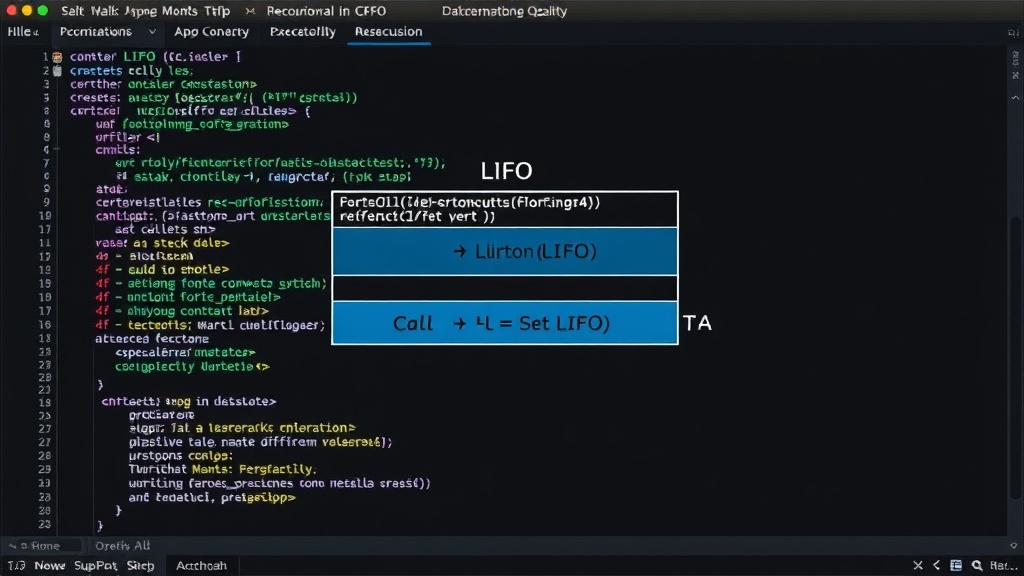
When a function calls another function, a new stack frame is pushed onto the top of the stack for the called function. When the called function returns, its stack frame is popped off, and execution resumes at the return address in the caller's frame. This is a Last-In, First-Out (LIFO) mechanism.
Recursion leverages this LIFO behavior. Each recursive call pushes a new stack frame onto the call stack. For our factorial example, calling factorial(5) would result in frames for factorial(5), factorial(4), factorial(3), factorial(2), factorial(1), and finally factorial(0) being pushed onto the stack. Once factorial(0) hits its base case and returns 1, its frame is popped. Then, factorial(1) can complete its calculation (1 * 1) and return, popping its frame, and so on, until the original call to factorial(5) completes and its frame is popped.
The call stack is essential for recursion because it remembers the state of each previous call. Without it, the program wouldn't know how to return to the correct point or what values to use when unwinding the recursive calls.
Stack Overflow: The Peril of Infinite Recursion
The call stack has a finite size. While it's generally quite large, it's not infinite. A stack overflow occurs when the call stack runs out of space. This typically happens in two scenarios:
- Deep Recursion: If a recursive function makes too many nested calls without reaching its base case, the stack can fill up. Each call adds a frame, and eventually, there's no more room.
- Infinite Recursion: This is the most common cause. It happens when the recursive function lacks a proper base case, or the recursive calls never lead to the base case. The function keeps calling itself forever (or until the stack overflows).
Consider a flawed factorial function:
int faultyFactorial(int n) {
    // Missing Base Case!
    return n * faultyFactorial(n - 1);
}
If you call faultyFactorial(5), it will keep trying to call itself with decreasing values of n, but since there's no condition to stop it, it will eventually exhaust the call stack's memory, leading to a crash and a stack overflow error.
The error message for a stack overflow can vary depending on the operating system and compiler, but it often indicates memory corruption or a segmentation fault. It's a critical runtime error that halts program execution.
To prevent stack overflows:
- Ensure a correct base case: Always define a condition that terminates the recursion.
- Verify progress towards base case: Each recursive call must make progress towards meeting the base case.
- Consider iterative solutions: For problems that involve very deep recursion, an iterative approach using loops might be more memory-efficient and safer. Many recursive problems can be rewritten iteratively.
- Limit recursion depth: In some environments, you can configure the maximum stack size, but this is a workaround, not a fundamental solution.
While recursion offers an elegant way to express certain algorithms, understanding the underlying mechanics of the call stack and the potential for stack overflow is crucial for writing robust and reliable C++ code.