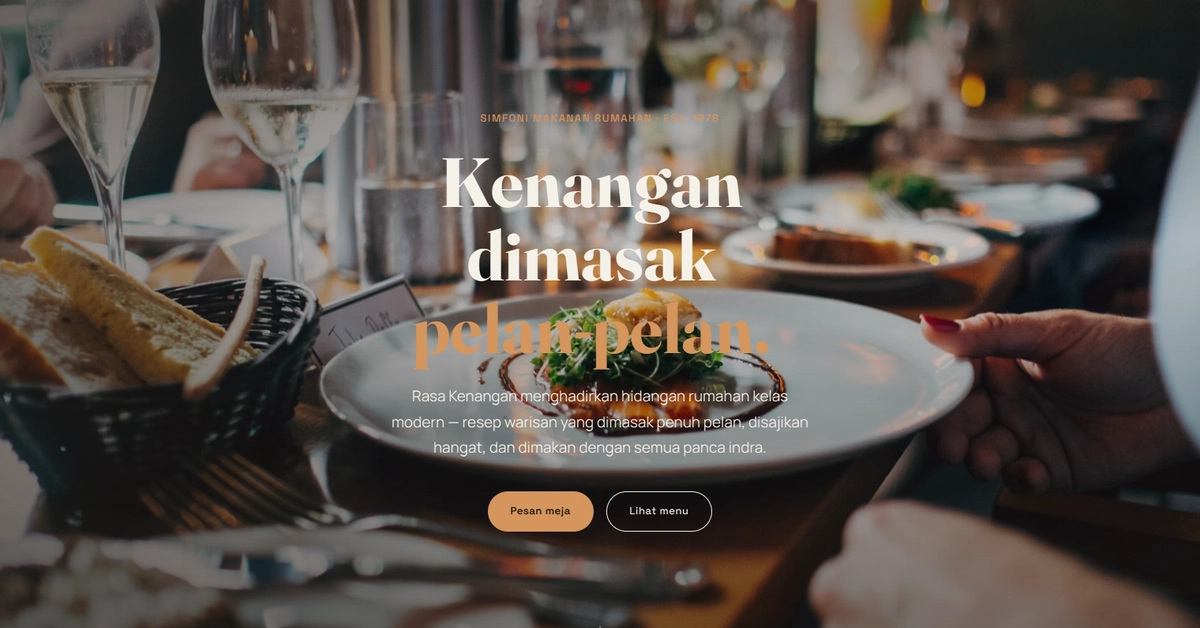
A Taste of Memory: Rasa Kenangan's Digital Debut
Rasa Kenangan, translating to "Flavor of Memories," is more than just a fictional upscale Indonesian comfort food restaurant; it's a testament to the power of fundamental web technologies. Located in Yogyakarta, this imaginary eatery has launched its digital presence not with a complex backend or a heavy-duty framework, but with a meticulously crafted, 100% static landing page built using only vanilla HTML, CSS, and JavaScript. The project, deployed on Cloudflare Pages, showcases a complete redesign focused on an immersive scroll narrative, proving that compelling user experiences don't always require the latest bleeding-edge tools.
The core philosophy behind Rasa Kenangan's online presence is to evoke the feeling of slow-cooked, comforting meals – "Kenangan dimasak pelan-pelan," or "Memories are cooked slowly." This sentiment is directly translated into the user experience, where scrolling through the page unfolds a story, revealing details about the restaurant, its ambiance, and its culinary philosophy. This approach eschews traditional multi-page websites for a single, dynamic page that guides the user through a narrative journey, making the interaction feel more intimate and engaging.
Building with Bare Essentials
The decision to rely solely on vanilla HTML, CSS, and JavaScript is a deliberate choice that highlights the developer's commitment to foundational web development. In an era dominated by frameworks like React, Vue, and Angular, and server-side technologies, building a rich, interactive experience with just the browser's native capabilities is a significant undertaking. This approach offers several advantages: faster load times, reduced complexity, enhanced security due to a smaller attack surface, and easier maintenance for a static site.
The HTML provides the semantic structure, defining the content and its hierarchy. The CSS handles the visual styling and layout, crucial for creating the immersive feel. This includes intricate animations and transitions that respond to user scrolling, transforming the page from a simple display of information into an interactive storybook. The JavaScript is the engine that drives these animations and interactions, orchestrating the reveal of content, parallax effects, and other dynamic elements without needing to communicate with a server for rendering.
This methodology results in a landing page that is not only visually stunning but also exceptionally performant. The absence of framework overhead means the page loads almost instantaneously, a critical factor for user retention in the digital space. For a restaurant aiming to create an inviting and memorable experience, a seamless and swift digital first impression is paramount. The static nature also simplifies deployment and hosting, allowing Rasa Kenangan to leverage platforms like Cloudflare Pages for global distribution and reliability at minimal cost.
The Immersive Scroll Narrative
The centerpiece of the Rasa Kenangan landing page is its immersive scroll narrative. As users scroll down the page, different sections animate into view, often with subtle parallax effects that create a sense of depth and engagement. This is akin to turning the pages of a beautifully illustrated book, where each scroll reveals a new chapter in the restaurant's story. The narrative might begin with the restaurant's concept, then move to its signature dishes, the ambiance, the location, and finally, a call to action.
For example, as a user scrolls, they might see imagery of traditional Indonesian ingredients fade in, followed by text detailing the philosophy of using fresh, local produce. Further scrolling could reveal animations of dishes being prepared, accompanied by descriptions that evoke taste and aroma. The design avoids abrupt transitions, opting for smooth, fluid animations that guide the user's eye and maintain a consistent, calming pace – mirroring the "slow-cooked memories" theme.
This narrative structure is not just about aesthetics; it's a strategic design choice to guide the user's journey and highlight key aspects of the restaurant. By controlling the flow of information and visual elements, the landing page can effectively build anticipation and convey the brand's essence. It transforms a potentially passive experience of browsing a website into an active, engaging exploration.
Implications for Web Design and Development
The Rasa Kenangan project serves as a powerful reminder that sophisticated and engaging web experiences can be achieved without relying on heavy frameworks. It challenges the notion that complex interactivity necessitates a full-stack approach or a client-side rendering framework. For developers, this project is an inspiration to hone their skills in core web technologies, demonstrating that mastery of HTML, CSS, and vanilla JavaScript can unlock significant creative potential.
For businesses, particularly smaller ventures or those with a strong brand narrative, a static, performance-optimized website like Rasa Kenangan offers a compelling alternative. It can be more cost-effective to develop and maintain, and its speed and reliability can significantly enhance user satisfaction and conversion rates. The success of this approach hinges on meticulous planning and execution, focusing on design, animation, and content flow to create a memorable user experience.
The choice of vanilla JS also has security benefits. Frameworks, while powerful, can introduce vulnerabilities or dependencies that require constant monitoring and updating. A purely static site built with native browser technologies inherently has a smaller attack surface. This makes it a robust choice for any entity prioritizing security and stability.
Ultimately, Rasa Kenangan is more than just a fictional restaurant's landing page; it's a showcase of elegant, efficient web development. It proves that with creativity and a deep understanding of the fundamentals, developers can build immersive, narrative-driven experiences that captivate users and effectively communicate a brand's story, all while prioritizing performance and simplicity.