Understanding RAG's Core Challenge
Retrieval Augmented Generation (RAG) systems aim to provide LLMs with access to external knowledge bases, dramatically improving their ability to answer specific or nuanced questions beyond their training data. However, the effectiveness of RAG hinges critically on the quality of the information retrieved. A common bottleneck is the user's initial query. Users often submit ambiguous, incomplete, or context-dependent questions. These raw queries, when directly converted into vector embeddings, might not align closely with the most relevant documents in a vector database. This mismatch leads to suboptimal retrieval, and consequently, less accurate or relevant LLM responses.
Consider a user asking, "How do I deploy it?". Without additional context, an LLM has no way of knowing what "it" refers to. If this query is directly embedded and searched, the retrieval system will likely fail to find relevant deployment guides. This is where techniques like Query Transformation and Query Expansion become indispensable tools in refining the RAG pipeline.
Query Transformation: Adding Clarity to Ambiguity
Query Transformation is the process of refining a user's initial, potentially ambiguous or incomplete, query into a more precise and actionable one. This is typically achieved by leveraging the LLM's inherent understanding of language and its existing contextual knowledge. The LLM analyzes the user's input, often in conjunction with any available conversational history, to infer the user's true intent and fill in missing details.
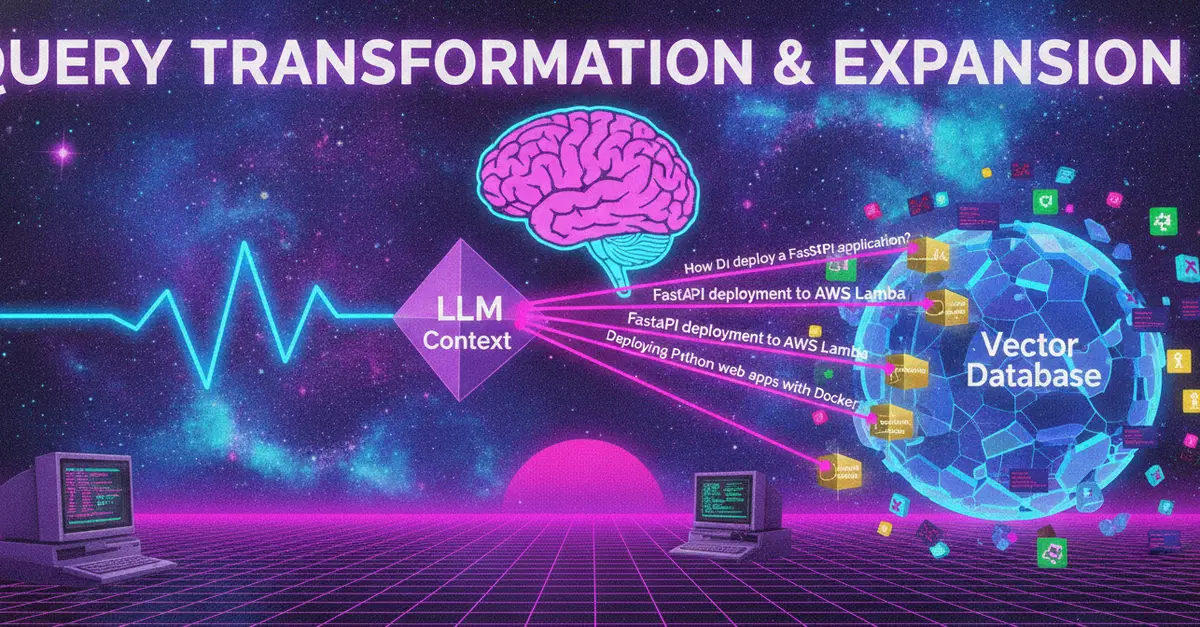
For instance, when a user asks, "How do I deploy it?", and the LLM has prior context from the ongoing conversation, it can infer that "it" might refer to a specific application or technology previously discussed. The LLM can then transform the query into something more specific, such as, "How do I deploy a FastAPI application?" or "What are the steps to deploy the XYZ microservice?".
The crucial element for effective query transformation is the availability of background information. This could be the preceding turns in a chat, metadata associated with the user's session, or even general domain knowledge the LLM possesses. By making the query more explicit, the system significantly increases the probability of retrieving highly relevant documents from the vector database. This targeted retrieval then provides the LLM with more accurate and pertinent information to generate a superior answer.
Query Expansion: Broadening the Search Net
While Query Transformation focuses on making a query *more specific*, Query Expansion aims to *broaden* the search to capture a wider range of potentially relevant documents. This technique is particularly useful when the initial query, even after transformation, might still be too narrow, or when the vector embedding of the query doesn't perfectly align with the embeddings of the most relevant documents.
The core idea behind query expansion is to generate multiple variations of the original query. These variations can include synonyms, related terms, paraphrases, or even different phrasings that capture the same underlying intent. By querying the vector database with this expanded set of queries, the system can retrieve documents that might have been missed by a single, narrowly defined query. This increases the recall of the retrieval process without necessarily sacrificing precision, especially when combined with effective re-ranking mechanisms.
An Example of Query Expansion in Action
Let's consider a user asking about "performance optimization for a Python web app." A direct embedding might miss documents that discuss "speeding up Flask applications" or "improving Django request handling." Query expansion would involve the LLM generating variations such as:
- "How to optimize Python web application performance?"
- "Strategies for improving the speed of Python web servers."
- "Techniques for reducing latency in Python web apps."
- "Best practices for Python web application performance tuning."
- "Making Flask/Django applications faster."
Each of these expanded queries can be embedded and used to search the vector database. The results from all these searches can then be aggregated and de-duplicated, or passed through a re-ranking stage to prioritize the most relevant ones. This multi-pronged approach ensures that even if the initial query embedding is slightly off, or if relevant documents use different terminology, the RAG system has a higher chance of finding them.
The Synergy Between Transformation and Expansion
Query Transformation and Query Expansion are not mutually exclusive; they are often used in conjunction to create a robust retrieval pipeline. A common pattern is to first transform an ambiguous query into a more specific one, and then expand that more specific query into multiple variations. This layered approach maximizes the chances of accurate retrieval.
For example, if a user asks, "What's the best way to handle large files?", the LLM might first transform this into "How to efficiently process large files in a cloud storage system?" (assuming cloud context). Then, this transformed query can be expanded into variations like:
- "Methods for uploading and processing large files in AWS S3."
- "Strategies for handling multi-gigabyte file uploads in cloud object storage."
- "Techniques for streaming and processing large files in Azure Blob Storage."
- "Best practices for managing large data files in Google Cloud Storage."
This combination ensures that both the intent is clarified and the search space is sufficiently covered. The output is a richer set of candidate documents for the LLM to draw upon.
Implementation Considerations and Future Directions
Implementing these techniques requires careful consideration of the LLM's capabilities and the structure of the knowledge base. The LLM needs to be prompted effectively to perform transformation and expansion. Prompt engineering plays a vital role in guiding the LLM to generate high-quality query variations.
Furthermore, managing the computational cost is essential. Generating and executing multiple queries can increase latency and processing overhead. Techniques like query de-duplication, intelligent selection of expansion terms, and efficient re-ranking algorithms are crucial for maintaining a responsive RAG system.
The evolution of RAG is moving towards more sophisticated query understanding. Future systems might incorporate multi-hop reasoning, where the output of one retrieval step informs the next query, or adapt query strategies based on the perceived difficulty or ambiguity of the user's request. The ultimate goal is to make the retrieval process as seamless and intelligent as possible, ensuring that the LLM always has the most relevant information at its fingertips.