
The Prototype Illusion
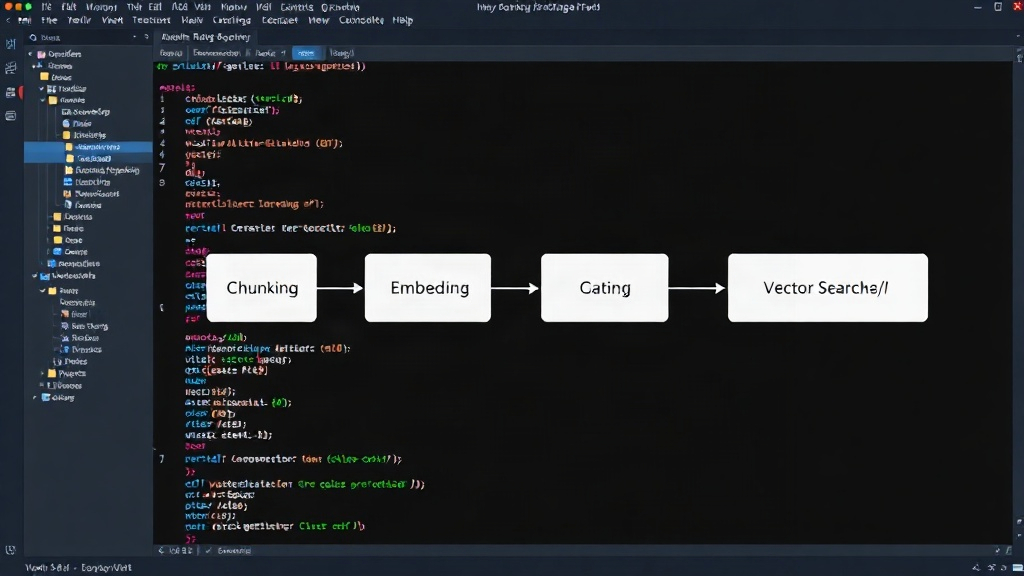
Every developer's first Retrieval-Augmented Generation (RAG) system feels like magic. It's typically a few dozen lines of Python: chunk documents, embed them, store vectors, and add a top-k similarity search to an LLM. It runs fast and answers basic questions surprisingly well. This initial success, however, often masks fundamental limitations that surface when real users interact with the system.
The naive prototype crumbles when faced with the complexities of human queries. Users don't just ask simple questions; they employ precise technical identifiers like error code 0x80070005, temporal constraints such as "What changed in our deployment policy last month?", or multi-part requirements like "Compare our feature set with our competitor's pricing tier." These queries expose the fragility of basic vector similarity, which often ignores exact strings and struggles with nuanced intent.
Beyond Top-K: Handling Real-World Queries
The core problem with simple RAG is its inability to adapt to diverse query types. When a user asks for a specific error code, semantic similarity might fail because the embedding model doesn't perfectly capture the significance of that exact string. Similarly, temporal queries require more than just semantic matching; they demand an understanding of time and context. Multi-part questions, especially those involving comparisons or complex relationships, often require synthesizing information from disparate sources or applying different retrieval strategies.
This is where the pipeline needs to evolve. The illusion of a perfect prototype shatters, and developers must confront the need for more sophisticated mechanisms. The limitations of a purely vector-based search become apparent, highlighting the need for hybrid approaches that combine keyword matching, metadata filtering, and semantic search. The goal is to create a system that understands not just the meaning of words, but also the intent and constraints embedded within a user's query.
Query Routing and Hybrid Retrieval
A critical step in building a robust RAG pipeline is implementing effective query routing. Instead of sending every query through the same retrieval process, the system should analyze the query and direct it to the most appropriate retrieval strategy. For instance, queries with specific identifiers might benefit from a keyword search or a direct database lookup, while broader conceptual questions might still leverage vector similarity. This hybrid approach ensures that the system uses the best tool for each job.
Hybrid retrieval, which combines multiple search techniques, is essential. This could involve using BM25 for keyword relevance alongside vector embeddings for semantic understanding. The system might also incorporate metadata filters to narrow down search results based on dates, document types, or other attributes. The challenge lies in orchestrating these different retrieval methods and combining their results in a meaningful way. This is not a simple addition of components; it requires careful design and tuning to ensure that the combined results are more accurate and relevant than any single method alone.
When Agentic Workflows Earn Their Keep
The complexity of RAG pipelines often leads to the consideration of agentic workflows. These systems, which can involve multiple steps, reasoning, and tool use, can be powerful but also introduce significant overhead. The key question for any developer is knowing when this complexity is actually justified. Agentic workflows are not a silver bullet and should not be implemented simply because they are a trendy concept.
Consider a scenario where a user needs to compare product pricing across multiple competitor tiers, and also understand the technical specifications of each product. A simple RAG system might struggle to gather and synthesize this information accurately. An agentic approach, however, could break this down: first, identify the relevant competitor pages; second, extract pricing information from each; third, extract technical specifications; and finally, synthesize this into a comparative summary. This requires the agent to use tools like web scrapers, structured data extractors, and potentially even make API calls. The decision to use an agentic workflow should be driven by the complexity of the task and the limitations of simpler RAG methods. If the task involves multi-step reasoning, interaction with external tools, or the synthesis of information that cannot be easily retrieved in a single pass, then an agentic approach might be warranted. However, the overhead in development, maintenance, and execution speed must be carefully weighed against the benefits.
The Constraint-Driven Design Principle
A parallel can be drawn to building an audio description pipeline for video. In that domain, the primary constraint is the available time within silent gaps in the dialogue. A perfectly crafted 9-second audio description is a defect if the gap is only 2.4 seconds. This hard constraint dictates the entire design process. Developers must find the silent gaps, calculate a word budget for each gap, generate descriptions that fit within that budget, and crucially, reject any description that exceeds it. The final step of muxing the audio track is only possible if all descriptions adhere to their time constraints.
This principle of constraint-driven design is directly applicable to RAG. The